
1. The Problem with Inbound Alone (and Outbound Alone)
Inbound is hard. It takes time. It takes consistency. It takes a distribution strategy most early-stage founders don't have. And when it does work, you're at the mercy of the algorithm.
That's the opening line from a LinkedIn post Sachin Jha published that resonated with thousands of technical founders. Because every founder has lived it. You write the content. You build the SEO. You wait. And wait. And meanwhile, your pipeline is empty.
Inbound alone: slow to compound, hard to control, difficult to scale predictably in year one.
Outbound isn't the answer either — at least not pure outbound. Cold emails with no context get deleted. Generic LinkedIn DMs annoy people. Spray-and-pray sequences produce 0.2% reply rates and burn your domain reputation.
The founders who are winning in 2026 figured out something specific: you don't have to choose between inbound and outbound. You run them as one integrated system, where inbound creates the context that makes outbound land.
2. What Is Inbound-Led Outbound?
Inbound-led outbound is a GTM motion where your content creates warm signals and your outbound team (or automation) acts on those signals with personalized, contextual outreach.
Instead of cold email → hope, the sequence looks like:
- Prospect sees your LinkedIn post about a pain they have
- They like it, comment, or follow your profile
- Your system detects that engagement as a buying signal
- Clay enriches their profile: company, role, tech stack, intent signals
- Automated (but personalized) outreach goes out referencing the post they engaged with
- The email or DM doesn't feel cold — it feels like a natural continuation of a conversation they already started
This is not a hack. It's not a loophole. It's what good sales has always been reaching the right person at the right moment with the right message. The difference is that technology now lets you do it at scale.
3. The 4-Step System for Building It
Step 1: Build Content That Attracts Your ICP
This starts with founder-led content. Specifically: posts that speak directly to the problems your ICP is dealing with right now. Not product pitches. Not company updates. Real-world insights about the problems they lose sleep over.
For a cybersecurity founder, that might be: "Why most CISO dashboards are lying to you." For a DevOps founder: "The hidden cost of managing Kubernetes at scale without automation."
The goal is not virality. The goal is precision resonance — making your exact buyer stop scrolling and think, "This person gets my world."
Step 2: Track Who Engages
Every like, comment, profile view, and post share is a buying signal. Tools like Shield Analytics, Taplio, and LinkedIn Sales Navigator let you see who is engaging with your content — and more importantly, who they are.
The engagement you care about most:
- Comments (highest intent — they took the time to write something)
- Profile views after a post (they saw the post, then came to check you out)
- Saves / shares (they want to reference this again — high purchase intent)
- Lead magnet downloads (they gave you their email — they're in your funnel)
Step 3: Enrich and Score in Clay
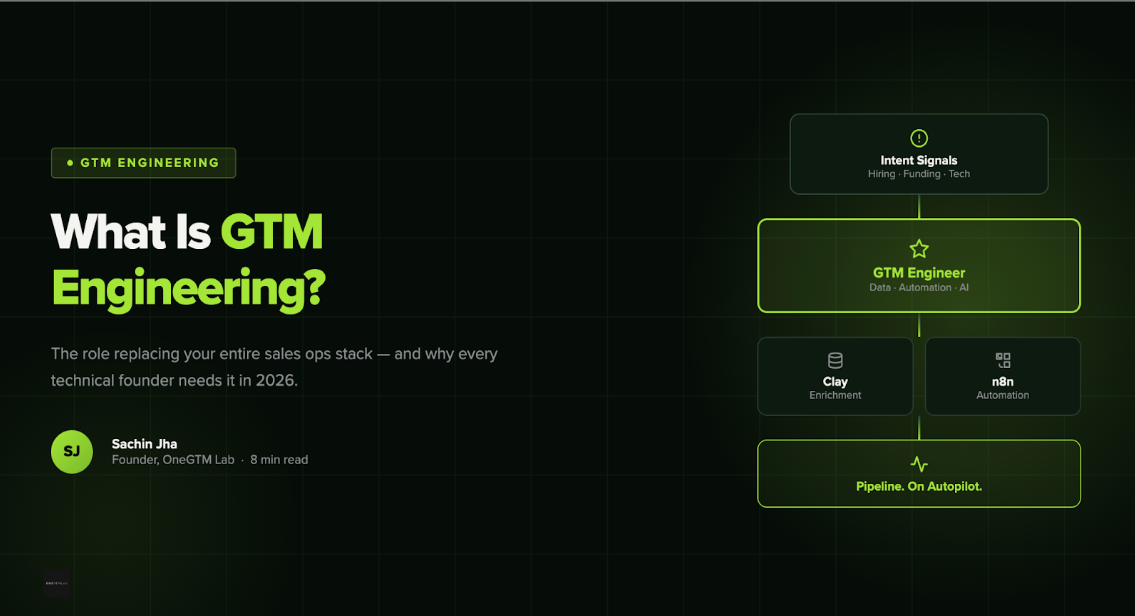
This is where GTM Engineering enters the picture. The engagement data goes into Clay, where you run waterfall enrichment to find their email, validate their title, check their company's tech stack, and score them against your ICP definition.
You're not reaching out to everyone who liked a post. You're reaching out to the Head of Security at a 200-person Series B company who liked your post about container security, whose company is hiring a SOC analyst, and whose current tech stack includes a competitor you displace.
That's not a cold email. That's intelligence-driven outreach.
Step 4: Reach Out with Context
The outreach message references the specific content they engaged with. Something like:
"Hey [Name] saw you liked my post about CISO dashboard blind spots. I've been building a framework for fixing exactly that for teams like yours. Worth a 20-minute chat?"
This works for three reasons:
(1) they already know who you are,
(2) the message proves you're paying attention, and
(3) it starts a conversation, not a pitch.
4. How to Track Content Engagement as a Buying Signal
Most founders track content performance by vanity metrics: likes, impressions, follower count. That's not buying signal data. Here's what to actually track:
- Comment on ICP-targeted post — High awareness + active engagement with your POV
- Profile view within 24h of post — Post triggered curiosity, they're checking you out
- Lead magnet download — Problem-aware and actively seeking solutions
- Repeated post views — Researching you, high purchase intent
- LinkedIn connection request (unsolicited) — Initiated relationship, reach out immediately
Set up a weekly review cadence where someone on your team (or your Clay automation) reviews the previous week's engagement and identifies ICP-matched contacts for outreach.
5. The Clay Workflow That Makes It Scalable
Here's a simplified version of the Clay workflow we build for clients running Inbound-Led Outbound:
- Import LinkedIn post engagers (via Phantombuster or Shield export)
- Enrich with company data, title, seniority, tech stack (Clay waterfall)
- Score against ICP: company size, role seniority, industry, tech stack fit
- Tier 1 (ICP match + engagement): immediate outreach via Clay + Instantly
- Tier 2 (ICP match, lower engagement): add to nurture sequence
- All activity synced to CRM with engagement source tagged
The whole system runs with minimal human intervention once it's built. What took a team of 3 SDRs doing manual research now runs as an automated workflow with higher precision.
6. Real Results: What This Looks Like for Technical Founders
Sachin Jha's LinkedIn presence — 50,000+ followers in cybersecurity and DevOps — isn't just a content play. It's the top of a conversion funnel. Here's what the data looks like:
- Content engagers who receive outbound outreach convert at 6–8x the rate of cold lists
- Reply rates on inbound-led sequences: 8–15% (vs. 0.5–2% on cold outbound)
- Meeting show rate: 80%+ (prospects already know who you are)
- Sales cycle: 30–40% shorter because trust is already established before the first call
For technical founders, this motion is especially powerful because your ICP is on LinkedIn, they're skeptical of generic outreach, and they respond to proof of expertise which your content provides before you ever send a message.
7. How to Get Started This Week
You don't need a massive content library to start. You need a system. Here's a 5-day launch plan:
- Day 1: Define your "content ICP" which specific job titles need to see your content
- Day 2: Write 3 posts targeting the top 3 pain points of that persona
- Day 3: Set up Shield or Taplio to track engagement analytics
- Day 4: Build your Clay enrichment table for inbound engagers
- Day 5: Write your outreach template referencing a specific content piece — launch
The Bottom Line
Inbound is hard. Outbound is cold. Inbound-led outbound is neither — it's the motion where your content does the trust-building and your outbound closes the loop.
The founders building this system today are having better conversations, shorter sales cycles, and higher close rates — not because they found a magic tactic, but because they built a system that treats content and outbound as two sides of the same coin.
Want us to build this system for your company? Book a free 30-minute GTM Diagnosis and we'll map your entire inbound-led outbound motion. → Get Your Free GTM Diagnosis at onegtmlab.com