

1. Why the Old Sales Ops Model Is Broken
If you've run an outbound motion at a B2B SaaS company, you already know the pain. You hire a sales ops person. They set up Salesforce fields, build a few reports, and maintain your Outreach sequences. Meanwhile your pipeline is stuck because no one owns the actual system that generates leads, scores them, enriches them, routes them, and turns them into booked calls.
The problem isn't that sales ops is bad. The problem is that modern GTM requires a fundamentally different skill set , one that sits at the intersection of data engineering, automation, AI, and sales strategy.
The average B2B SaaS company is running on a GTM stack built for 2018. The founders winning in 2026 have rebuilt their entire pipeline system from the ground up using AI and automation.
Sales ops focuses on maintaining what's already built. GTM engineering builds the system itself.
2. What Is GTM Engineering, Really?
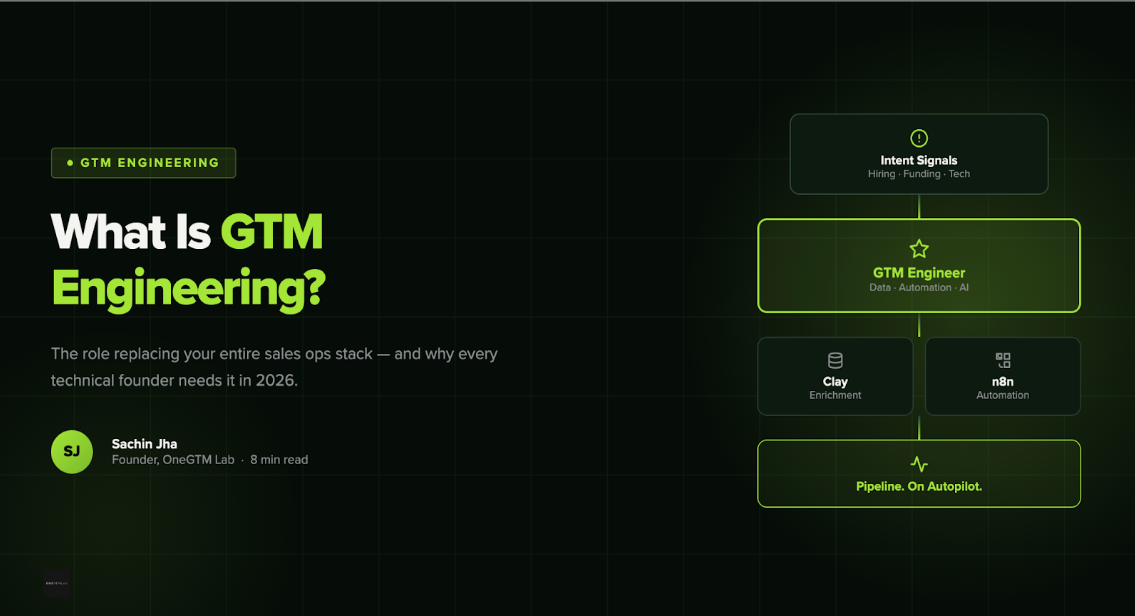
GTM Engineering is the discipline of building automated, data-driven systems that generate, qualify, and move pipelines , without relying on headcount to do it manually.
A GTM engineer is part data engineer, part growth hacker, part automation architect. They think in systems, not campaigns. Their output isn't a one-time email sequence. It's a compounding infrastructure that gets smarter every week.
Here's what that looks like in practice:
- Pulling technographic signals to identify companies using a competitor's product
- Building Clay workflows that enrich 10,000 leads in 20 minutes with company size, recent funding, tech stack, and hiring signals
- Setting up multi-step n8n automations that trigger personalized outreach the moment a company hits a buying signal
- Creating AI-powered lead scoring that routes hot leads to your AE calendar automatically
- Building dashboards that show pipeline health in real-time, not as a weekly report
This isn't marketing. This is infrastructure. And most B2B companies don't have it.
3. GTM Engineer vs. Sales Ops vs. RevOps: The Real Difference
These three roles get confused constantly. Here's a clean breakdown:
Role
Primary Focus
Sales Ops
Maintaining CRM, reports, process compliance
RevOps
Aligning sales, marketing, and CS around revenue data
GTM Engineer
Building automated systems that generate and move pipeline
The key distinction: Sales Ops and RevOps are largely reactive , they respond to what the sales team needs. GTM Engineering is proactive , it builds systems that don't depend on the sales team to function.
A GTM engineer asks: "How do I build a system that books 50 qualified meetings per month without a single SDR touching it?"
A sales ops person asks: "How do I make sure the CRM is accurate so we can pull this report?"
Both matter. But only one scales.
Want to see what GTM Engineering looks like in practice?
We run GTM Engineering as a managed service for technical founders. No hiring, no ramp time.
→ Get Your Free GTM Diagnosis at onegtmlab.com
4. What Does a GTM Engineer Actually Do Day-to-Day?
The daily work of a GTM engineer breaks into three areas:
Signal Detection
Finding the moments when a prospect is most likely to buy. This includes:
- Job postings (company hiring a CISO = security budget just opened)
- Funding announcements (Series A = infrastructure spend incoming)
- Technology changes (just adopted Kubernetes = DevOps tool opportunity)
- Community activity (posted in a LinkedIn group about a pain you solve)
- Competitive churn signals (reviewing your competitor on G2)
Data Enrichment & Qualification
Taking raw lists and turning them into actionable intelligence:
- Clay waterfall enrichment across 10+ data providers
- AI-powered account research using Clay agent
- Persona matching against your ICP definition
- Intent scoring based on stacked signals
Automated Outreach Execution
Building sequences that feel human but run automatically:
- Personalized first lines generated by AI from real signals
- Multi-touch sequences across email and LinkedIn
- Reply detection and auto-routing to the right rep
- Continuous A/B testing of subject lines, CTAs, and timing
5. The GTM Engineering Tech Stack
The tools matter, but the system design matters more. Here's what a well-built GTM engineering stack looks like in 2026:
Category
Tools We Use
Data Enrichment
Clay, FullEnrich, Prospeo, Apollo
Automation
n8n, Make, Zapier (for simple flows)
Outbound Execution
Instantly, Lemlist, LinkedIn Sales Nav
Intent Data
Bombora, G2, Hiring signal APIs
CRM & Routing
HubSpot, Attio, Salesforce
AI / Personalization
Claude, OpenAI (via Clay or n8n)
Analytics
Looker Studio, custom dashboards
The GTM stack isn't the strategy. The strategy is knowing which signals matter for your ICP and building a system that acts on them faster than your competitors.
6. When Should You Hire (or Partner with) a GTM Engineer?
You need GTM Engineering if any of these are true:
- You're spending $10K+ per month on outbound with less than 1% reply rate
- Your SDRs are doing manual research instead of selling
- You have good product-market fit but pipeline isn't growing predictably
- You're trying to expand into a new ICP segment and don't know how to source them
- You just raised a round and need to build the pipeline infrastructure to justify the next one
The challenge: a senior GTM engineer is hard to hire (they're expensive, rare, and have a 3-month ramp time), hard to retain, and still only one person. Most early-stage companies are better served by partnering with a firm that provides GTM Engineering as a managed service , with full visibility into the system they're building.
7. What GTM Engineering Looks Like at ONEGTMLAB
At ONEGTMLAB, we've run GTM Engineering programs for technical founders in cybersecurity, DevOps, and developer infrastructure. Here's what we've built for clients:
- A Clay-powered enrichment workflow that identified 500+ qualified CISOs based on recent security incidents at their companies, and booked 47 meetings in 6 weeks
- An n8n automation that triggered personalized LinkedIn DMs the moment a target account posted a job for a DevSecOps role
- A full outbound infrastructure for a seed-stage startup , ICP definition, domain warmup, Clay workflows, email sequences, CRM routing; live within 2 weeks
- A real-time pipeline dashboard that gave a founder and their board instant visibility into meetings booked, pipeline generated, and deal velocity
We don't just build the system. We run it. That's the difference between hiring a consultant who hands you a blueprint and a team that shows up every week to optimize the engine.
The Bottom Line
GTM Engineering is not a trend. It's the new baseline for B2B pipeline generation. Companies that build this capability , whether in-house or through a partner , will out-execute everyone still running on manual SDR motions and generic email sequences.
The question isn't whether you need GTM Engineering. The question is how fast you can build it.
Ready to build your GTM Engineering system?
We'll map your entire pipeline motion and show you exactly where the leverage is , in 30 minutes.