
There is a good chance you are overpaying for your GTM stack by somewhere between $5,000 and $7,800 every single month.
Not because you made a bad decision a few years ago. Because the game changed and nobody sent you a memo.
This article is not another "AI is taking over" think piece.
It is a practical breakdown of exactly what the modern GTM stack looks like right now, what each category actually costs, where the real risks are hiding, and how to figure out which category of tools your team should use, before you either overspend or oversimplify your way into a broken workflow.
If you are a GTM engineer, a RevOps lead, a founder running a lean agency, or anyone who has ever looked at a SaaS invoice and felt a quiet, specific kind of dread, you are in the right place.
By the time you reach the bottom of this article, you will know exactly where your stack belongs and what to do about it.
Let's get into it.
The GTM Stack Is Splitting Into Three Category (And Most Teams Are Stuck in Category One)
The way revenue teams buy and use software is going through a genuine structural shift. Not a trend. Not a vibe. A structural shift.
Even, Anthropic's revenue is reportedly racing from about $1 billion in 2024 to $47 billion by May 2026. That number matters not because Anthropic is impressive (though it is), but because it signals where enterprise spending is moving.
GTM teams are quietly reallocating budgets away from legacy platforms and toward AI-native and Claude-layer tools, and the gap between each layer in terms of cost, output, and operating complexity is growing wider every quarter.
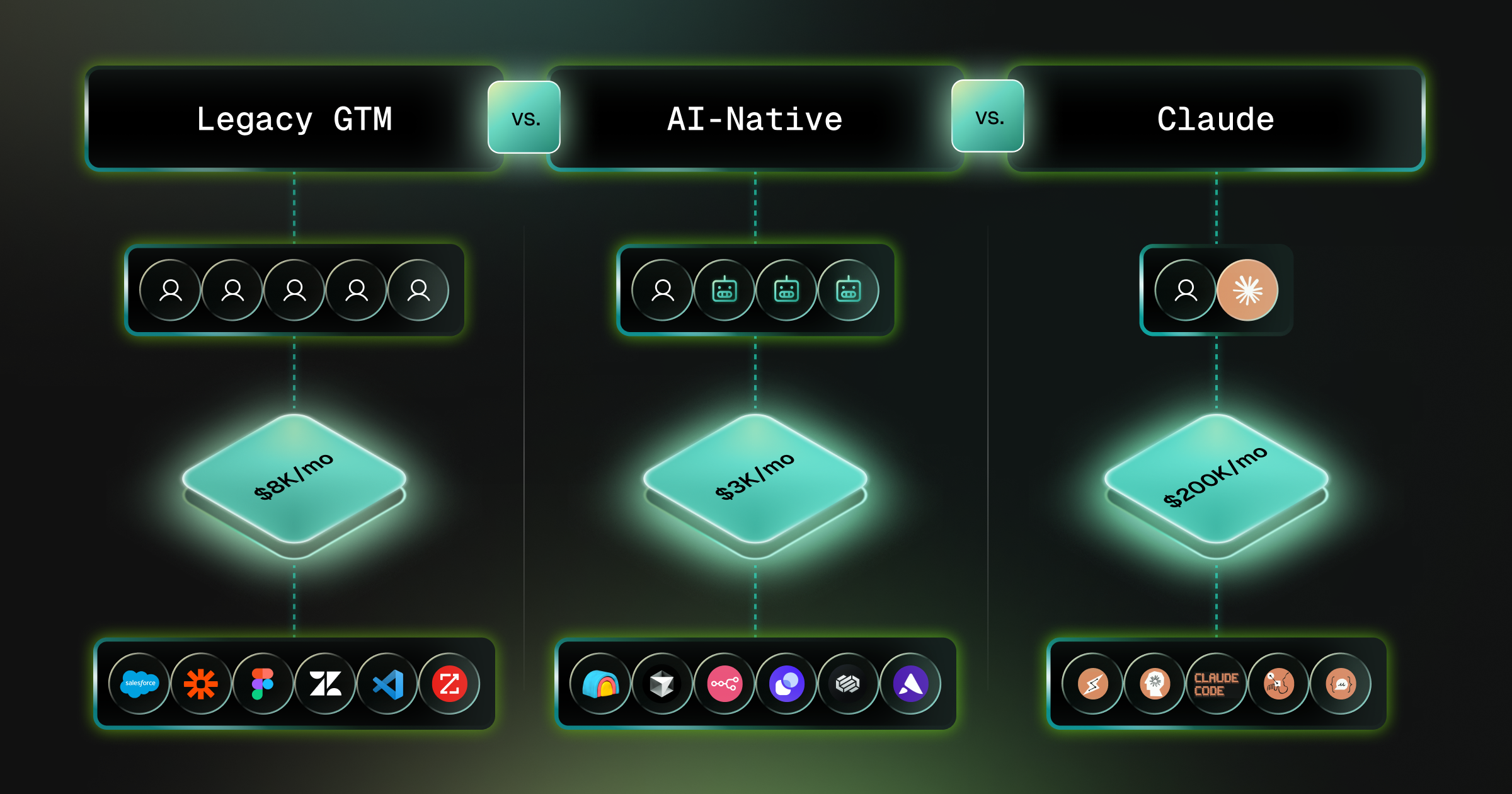
Here is the simplest way to think about it: there are now three categories of GTM stack, and each one represents a fundamentally different trade-off between price, power, and who has to operate it.
Understanding which category you are in, and which one you should be in, is one of the highest-leverage decisions a GTM team can make in 2026.
Category 1: Legacy Tools, the Expensive Comfort Zone
Let's be honest about what legacy tools are. They are not bad. They are just very, very expensive for what they deliver in 2026.
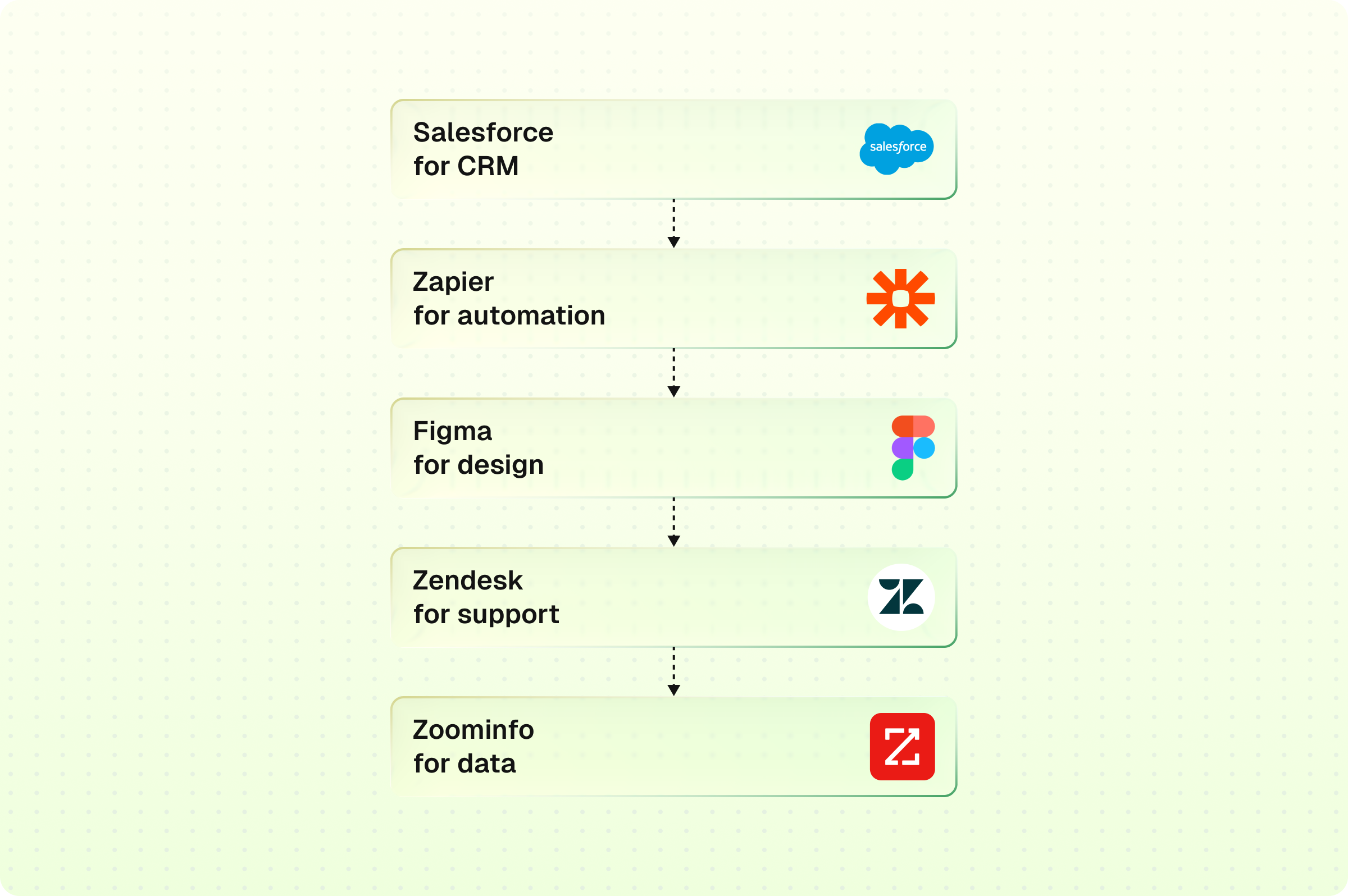
The classic legacy GTM stack looks something like this: Salesforce for CRM, Zapier for automation, Figma for design, Zendesk for support, ZoomInfo for data.
These are household names. They have enterprise-grade security, compliance certifications, dedicated support lines, and onboarding teams who will spend three weeks holding your hand.
And they cost upwards of $8,000 per month for a full stack.
- That bill is not irrational if you are a regulated enterprise where reliability is non-negotiable and your ops team needs predictable, battle-tested systems that will not surprise you in production. Legacy tools win on governance and edge-case reliability. That is real value, and it belongs in specific contexts.
- The problem is that a lot of teams paying $8,000 a month are not in those contexts. They are lean agencies, growth-stage SaaS companies, and mid-market B2B teams who are paying for maturity they don't need, integrations they have to build manually, and onboarding timelines that stretch for weeks. They are buying stability and paying for it in speed, and the AI-native layer has made that trade-off very hard to justify.
What Does a Full Legacy GTM Stack Actually Include?
A standard legacy stack includes:
- CRM like Salesforce or HubSpot Enterprise,
- A data provider like ZoomInfo or Clearbit,
- An automation layer like Zapier,
- A design tool like Figma,
- A support platform like Zendesk or Intercom,
- A sales engagement tool like Outreach or Salesloft.
When you add licenses, seats, and the integrations required to make these tools talk to each other, $8,000 per month is a conservative estimate for a team of ten.
Why Are Teams Still on Legacy Tools in 2026?
Inertia is a powerful force in enterprise software. Migrating a CRM takes months.
Retraining a team takes longer. And the people who signed the contract three years ago are not always the same people now being asked to justify it.
Legacy tools persist because switching costs are real, governance requirements are real, and "if it ain't broke" is a complete sentence in most procurement meetings.
That said, the AI-native layer has now reached a level of reliability where that logic is increasingly hard to defend for teams that are not operating under strict compliance requirements.
Category 2: AI-Native Tools, the 10x Output Layer for Skilled Operators
This is where things get genuinely exciting, and also genuinely demanding.
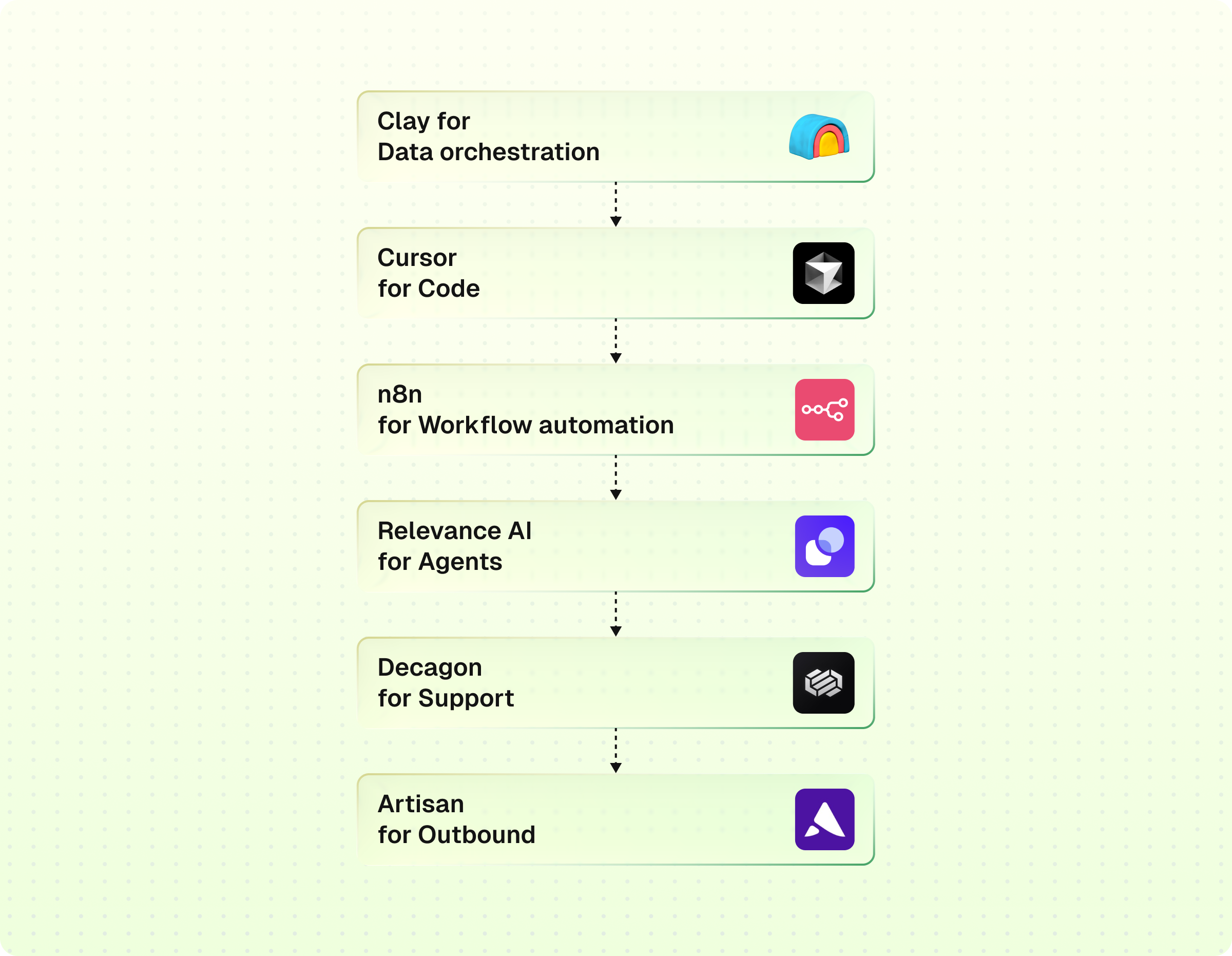
The AI-native GTM stack is built around tools like Clay for data orchestration and enrichment, Cursor for code, n8n for workflow automation, Relevance AI for agents, Decagon for support, and Artisan for outbound.
A comparable stack to the legacy setup above runs closer to $3,000 per month. That is a $5,000 monthly savings before you even account for the output difference.
And the output difference is significant.
The AI handles roughly 80% of the work across a well-built AI-native stack, which is where the "10x output for GTM operators" claims come from.
These are not marketing numbers. Teams running B2B sales prospecting with Clay and Claude Code, for example, are building enrichment waterfalls and personalization workflows in hours that would have taken a data team weeks to produce manually.
The catch, and it is a genuine one, is that:
- This layer needs a skilled operator to unlock its ceiling. The subscriptions are scattered across a dozen vendors. The workflows still break when an edge case shows up.
- Migrating from Zapier to Claude Managed Agents, for instance, is not a one-afternoon project. You are trading the vendor's operational complexity for your own operational complexity, and whether that trade is worth it depends entirely on who is doing the operating.
- For lean agencies and GTM engineering teams who can run these tools well, the AI-native layer is the obvious home. For teams without that operator capacity, Layer Two can quickly become a collection of expensive subscriptions that nobody fully uses.
Clay and Claude Code: Why This Combination Is Dominating GTM Engineering
The pairing of Clay for data orchestration with Claude Code for connecting and automating layers is showing up in nearly every high-performing outbound system right now.
- Clay handles the sourcing, enrichment, and signal detection.
- Claude Code reads the API docs, handles the errors, and wires the layers together.
The result is a connected GTM system that a single skilled operator can run, maintain, and scale, something that would have required a three-person engineering team eighteen months ago.
This is the core reason "GTM engineering for lean agencies 2026" has become one of the fastest-growing job and content categories in B2B sales.
Category 3: Claude Tools, One Interface to Absorb Them All
Now we get to the layer that is quietly reshaping how people think about GTM infrastructure entirely.
Anthropic's own product line, which includes Claude Code, Routines, Imagine, Managed Agents, and Cowork, is pointing directly at the same jobs the first two layers do.
The pricing reframes the conversation completely: roughly $200 per month plus token usage.
Two hundred dollars. Compared to $8,000 for legacy and $3,000 for AI-native.
The mechanics work like this:
You describe what you need in plain language, and the model builds it. One interface, significantly less context switching, and a capability ceiling that keeps rising as the underlying models improve. The value proposition for teams that can operate it is almost absurdly compelling.
But before you cancel everything and go all-in on Claude, there is something important to understand.
Claude Code Token Usage vs SaaS Subscription Cost: The Real Math
The $200 headline sits next to "plus token usage" for a reason.
Token costs are variable. A light usage pattern might keep your bill close to that number. A heavy agentic workflow, running enrichment loops, multi-step outreach sequences, and automated research cycles, can push your token costs meaningfully higher. The comparison to a fixed SaaS subscription is not always as clean as the headline suggests.
Claude Code token usage vs SaaS subscription cost is a calculation every team needs to run with their actual usage numbers, not the theoretical floor. For some workloads, the savings are dramatic. For heavy, continuous workflows, the math is closer than it appears.
That said, even at higher token usage, most teams find the Claude layer materially cheaper than a comparable legacy stack. The savings are real. The variability is also real. Plan for both.
The Claude Dependence Problem: The Risk Nobody Is Talking About Loudly Enough
Here is the part of this conversation that tends to get glossed over in the enthusiasm about $200 monthly bills and 10x output.
When you consolidate your GTM stack into a single vendor's product line, you hand that vendor the dials on your cost base. Token prices, rate limits, model behavior changes, new terms of service, and feature deprecations become decisions Anthropic makes and operational constraints you absorb.
There is a pattern worth naming:
- Anthropic lets the AI-native tools prove out the best version of a workflow, then ships a tighter, more integrated version informed by what worked. That is good product strategy. It is also a structural tension for teams who built their entire operation on a specific AI-native tool, only to watch Claude absorb its core functionality at a lower price point.
- The "Claude Dependence Problem" is not a reason to avoid the third layer. It is a reason to think carefully about which workloads you consolidate there and which ones you keep distributed across the AI-native layer for resilience.
- For regulated enterprises thinking about GTM stack reliability benchmarks, this vendor concentration risk is often the deciding factor. One vendor controlling your data layer, your automation layer, and your outreach layer is a single point of failure worth pricing into your architecture decisions.
- Regulated Enterprise GTM Stack Reliability Benchmarks: Where Claude Fits
For enterprises in regulated industries, the Claude layer is genuinely compelling for internal workflows, content generation, and research tasks where reliability requirements are lower.
For customer-facing systems, audit trails, and data governance requirements, legacy tools still provide the compliance infrastructure that the Claude layer cannot yet match.
The answer is not either-or. It is knowing which workload belongs in which layer.
How To Decide Which Category Of GTM Tools To Use?
Now that you understand the three category, the costs, and the trade-offs, here is how to actually make the decision for your team.
The right layer is determined by two variables: what you are optimizing for, and who is operating it.
1. If you are optimizing for reliability and governance, and you have a full ops team to run the stack, the legacy layer still makes sense for your core systems.
- Keep ZoomInfo or your data provider.
- Keep Salesforce if it is embedded in your compliance workflow.
- Start replacing the automation layer with AI-native tools where you can, and experiment with the Claude layer for internal productivity tasks.
2. If you are optimizing for output and speed, and you have a skilled GTM operator or engineer who can run AI-native tools, move aggressively toward Layer Two. The savings alone justify the transition for most teams, and the output ceiling is genuinely higher for operators who can reach it.
B2B sales prospecting with Clay and Claude Code, outbound automation with Artisan, and workflow building with n8n will outperform a comparable legacy setup at roughly a third of the cost.
3. If you are a lean agency or early-stage team optimizing for simplicity and cost, the Claude layer deserves serious consideration for tasks where natural language instructions can replace custom-built tooling.
Replacing Zapier with Claude Managed Agents, using Claude Code to connect your data and outreach tools, and running Cowork for internal operations can compress your stack significantly without the operational overhead of managing a dozen AI-native subscriptions.
High-performing teams in 2026 are running a blend of all three layers, leaning toward AI-native and Claude for anything they can operate themselves, and keeping legacy tools where reliability is genuinely non-negotiable.
The Bottom Line: Stop Paying 2020 Prices for 2026 Problems
The GTM stack is splitting. That is not a prediction anymore. It is an observable fact.
- Legacy tools still win on governance and edge-case reliability for the teams that genuinely need those things.
- The AI-native layer wins on price and output for operators who can run it.
- Claude's layer wins on simplicity and trajectory, with vendor concentration as the honest cost of admission.
The teams getting this right are not picking one layer and going all-in. They are running a deliberate blend, shifting workloads toward AI-native and Claude where they can operate them confidently, and holding onto legacy infrastructure only where reliability requirements actually justify the premium.
The teams getting this wrong are paying $8,000 a month for stability they don't need, or racing to consolidate everything into a single vendor without thinking through what that concentration means when the pricing changes.
The shift is real. The savings are real. The dependence risk is real. Plan for all three, and you are ahead of most of your competition before you have written a single email sequence.