

Revenue teams don't have a signal shortage. They have a prioritization problem.
Between the CRM, the website, intent data providers, review sites, LinkedIn, and job boards, the average revenue team is already sitting on more B2B buying signals than its reps could ever act on. The gap isn't capture, it’s knowing which signals deserve a human in the next hour, which deserve a nurture track, and which deserve to be ignored entirely.
This playbook covers 25 buying signals across seven categories, each with a confidence rating, example, and recommended action, so every signal arrives with a decision attached.
Read this alongside our RevOps playbook, How to Build a GTM Signal Response System. That piece builds the response system: the four tiers (HOTTEST, HOT, WARM, NURTURE), the SLAs, and the seven-day stacking window that govern how fast a signal gets actioned. This is the catalogue that feeds it: the twenty-five signals themselves, and how to read each one. One vocabulary runs across both.
What is a B2B buying signal?
A B2B buying signal is any observable event, behavior, or data point, generated by an account, an individual within it, or a third-party source, indicating a company is moving toward, or is already in, active purchase evaluation.
Three terms get conflated constantly, and keeping them separate is the difference between a signal program that works and one that generates arguments between sales and marketing:
- Signal: the observed evidence. Someone visited the pricing page. A funding round was announced.
- Intent: the underlying state you're inferring from that evidence. You never observe intent directly; you infer it from signals.
- Lead: an identified, actionable contact. A signal can exist with no lead attached (anonymous traffic), and a lead can exist with no signal (a scraped list).
This also settles a category error nearly every vendor makes: buying signals are the umbrella concept, and intent data is one category within it, sitting alongside behavioral, firmographic, technographic, engagement, relationship, and trigger-event signals. "Intent data" is not a synonym for buying signals; it's one of seven sources feeding the same decision.
A few more terms you'll see below, defined once:
- Dark funnel: The portion of buyer research happening anonymously, review sites, peer conversations, communities, before any attributable action.
- Buying committee: The multiple roles typically involved in a B2B purchase: economic buyer, champion, technical evaluator, end user, procurement/legal.
- Signal decay: Signals have a shelf life. A funding announcement stays relevant for weeks or months; a single page visit decays within days.
- Signal stacking: Multiple concurrent signals are more reliable than any single signal alone.
- First-party vs. third-party signals: Data from properties you own (higher confidence, narrower coverage) vs. purchased or aggregated data (broader coverage, lower per-signal confidence).
With those distinctions clear, the next step is deciding how each signal should be interpreted and acted on.
How to read this list
Every signal below carries three things:
- A confidence rating (High / Medium / Low): how strongly the signal, on its own, indicates active evaluation. High-confidence signals justify immediate, manual, personalized response. Low- and medium-confidence signals justify automated or nurture-level responses until they stack.
- A concrete example: what the signal actually looks like in your tooling.
- A recommended action: the response play. A signal without a mapped action is just a notification.
Two operating rules sit above all 25:
- Signals decay. A champion changing jobs is actionable for weeks. A pricing page visit is actionable for days. Build response-time expectations per signal, not one global SLA.
- Signals corroborate. One medium-confidence signal is a hint. Two from the same account inside seven days is a pattern worth promoting to Tier 1; three is a phone call, a high-confidence composite that often outweighs any single high-confidence signal. That one-two-three ladder is exactly the stacking rule our playbook runs on: one signal monitors, two promotes, three triggers human-touch outreach.
Practitioners commonly use heuristics like 3+ pricing page visits in a week to firm up a single signal, though the playbook escalates on distinct signal types, not repeats of one, or 3+ people from the same account within seven days as a multi-stakeholder threshold.
Treat these as starting points to tune, not verified benchmarks. We hold the stacking window at seven days throughout, to match the response system in our playbook, tight enough to indicate active exploration, long enough to capture a real evaluation cycle.
Here are the 25 B2B buying signals category wise
The list begins with the signals closest to your business: actions taking place on the properties you own.
Behavioral signals
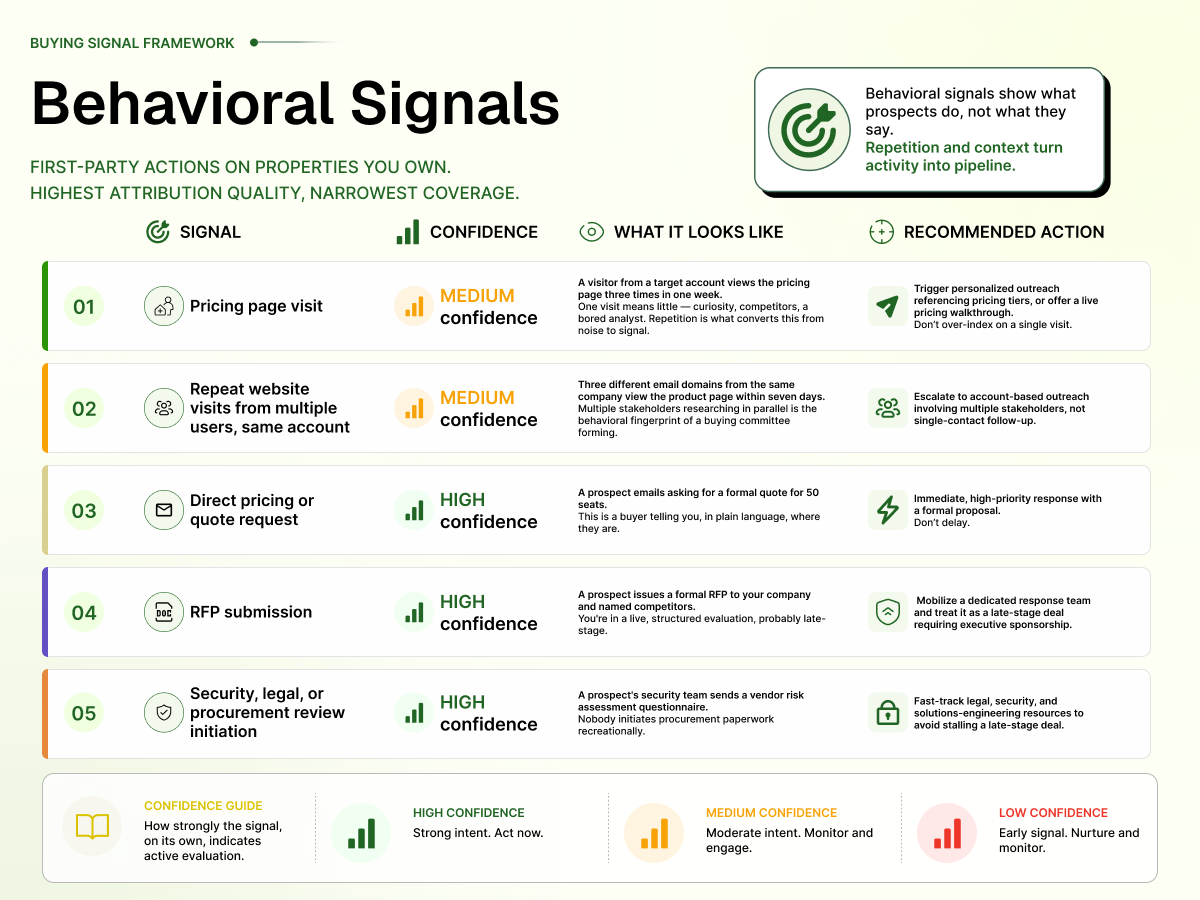
First-party actions on properties you own. Highest attribution quality, narrowest coverage.
1. Pricing page visit: Medium confidence
A visitor from a target account views the pricing page three times in one week. One visit means little, curiosity, competitors, a bored analyst. Repetition is what converts this from noise to signal. Action: Trigger personalized outreach referencing pricing tiers, or offer a live pricing walkthrough. Don't over-index on a single visit.
2. Repeat website visits from multiple users, same account: Medium confidence
Three different email domains from the same company view the product page within seven days. Multiple stakeholders researching in parallel is the behavioral fingerprint of a buying committee forming. Action: Escalate to account-based outreach involving multiple stakeholders, not single-contact follow-up.
3. Direct pricing or quote request: High confidence
A prospect emails asking for a formal quote for 50 seats. This is a buyer telling you, in plain language, where they are. Action: Immediate, high-priority response with a formal proposal. Don't delay.
4. RFP submission: High confidence
A prospect issues a formal RFP to your company and named competitors. You're in a live, structured evaluation, probably late-stage. Action: Mobilize a dedicated response team and treat it as a late-stage deal requiring executive sponsorship.
5. Security, legal, or procurement review initiation: High confidence
A prospect's security team sends a vendor risk assessment questionnaire. Nobody initiates procurement paperwork recreationally. Action: Fast-track legal, security, and solutions-engineering resources to avoid stalling a late-stage deal.
Intent signals
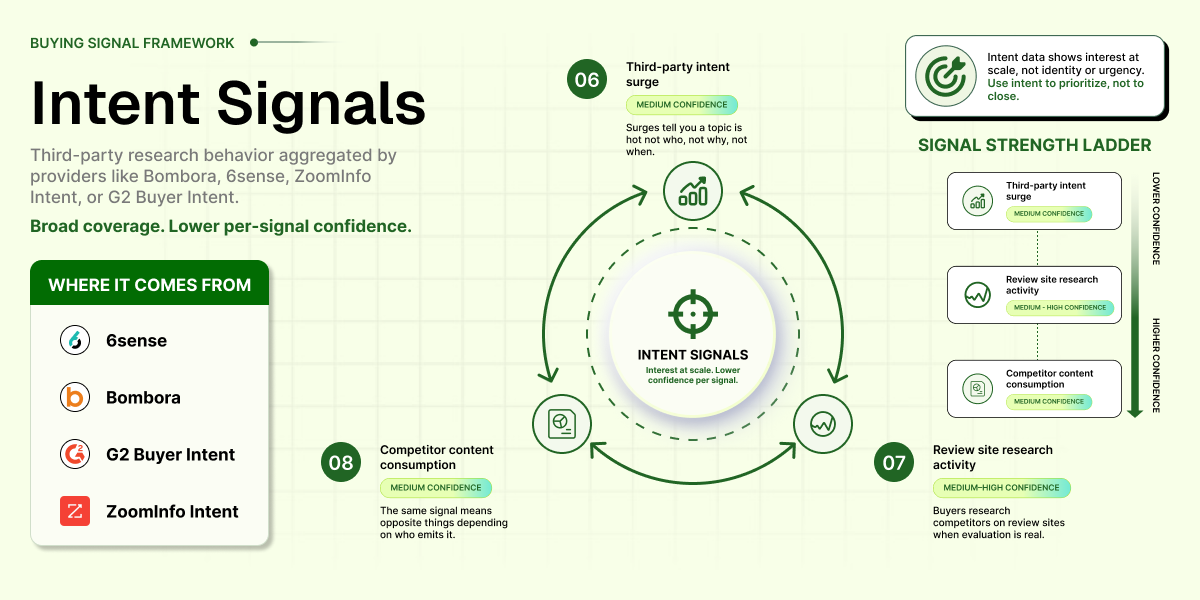
Third-party research behavior, usually aggregated by providers like Bombora (Company Surge), 6sense, ZoomInfo Intent, or G2 Buyer Intent. Broad coverage, lower per-signal confidence, the category most often mistaken for the whole discipline.
6. Third-party intent surge: Medium confidence
An account shows a 300% increase in content consumption around "sales engagement software" relative to its 90-day average. Surges tell you a topic is hot at an account, not who, not why, not when. Action: Add to a targeted nurture or ABM campaign. Intent surges alone are too noisy for direct outbound.
7. Review site research activity: Medium–High confidence
An account is flagged actively viewing competitor comparison pages on G2 for your category. Review-site research is dark-funnel behavior surfacing, buyers do this when evaluation is real. Action: Prioritize for direct SDR outreach; consider a review-site retargeting campaign.
8. Competitor content consumption: Medium confidence
An existing customer account shows spiking research activity around a competitor's product. The same signal means opposite things depending on who emits it. Action: For a prospect, lead with differentiation. For an existing customer, flag to Customer Success immediately as churn risk.
Firmographic signals
Changes in the shape of the company itself. Public, cheap to monitor, and usually about readiness to buy rather than evaluation in progress.
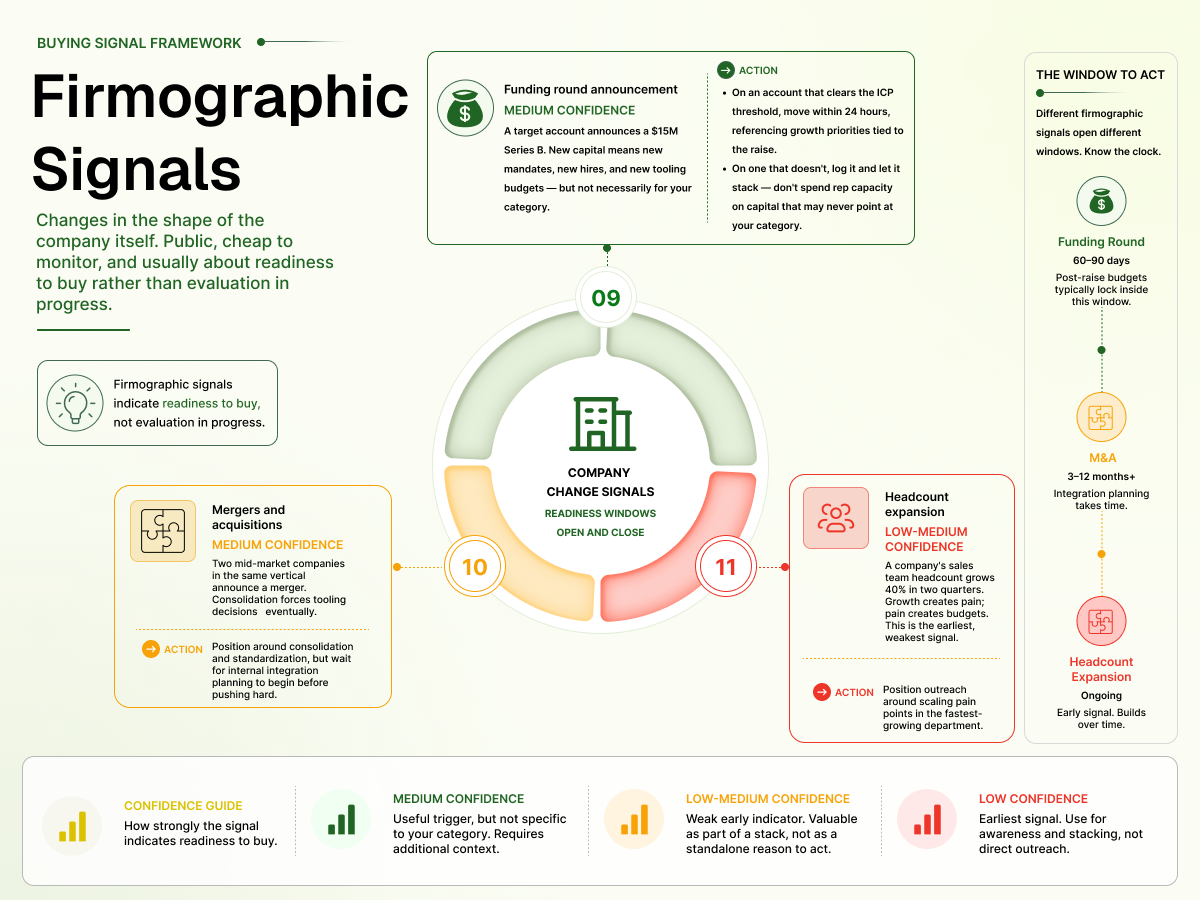
9. Funding round announcement: Medium confidence
A target account announces a $15M Series B. New capital means new mandates, new hires, and new tooling budgets, but not necessarily for your category. That split is the whole story: a funding raise is a time-bound triggering event, so the window is short, post-raise budgets typically lock inside 60–90 days, yet confidence that the raise points at your category is only medium.
Our playbook resolves the tension by classifying a qualifying raise as HOTTEST, actioned within 24 hours, while gating that speed on ICP fit (a score of 70+). Action: On an account that clears the ICP threshold, move within 24 hours, referencing growth priorities tied to the raise. On one that doesn’t, log it and let it stack, don’t spend rep capacity on capital that may never point at your category.
10. Mergers and acquisitions: Medium confidence
Two mid-market companies in the same vertical announce a merger. Consolidation forces tooling decisions, eventually. Action: Position around consolidation and standardization but wait for internal integration planning to begin before pushing hard.
11. Headcount expansion: Low–Medium confidence
A company's sales team headcount grows 40% in two quarters. Growth creates pain; pain creates budgets. This is the earliest, weakest signal in the list, valuable mostly as a stacking ingredient. Action: Position outreach around scaling pain points in the fastest-growing department.
Technographic signals
What's in, or leaving, an account's stack.
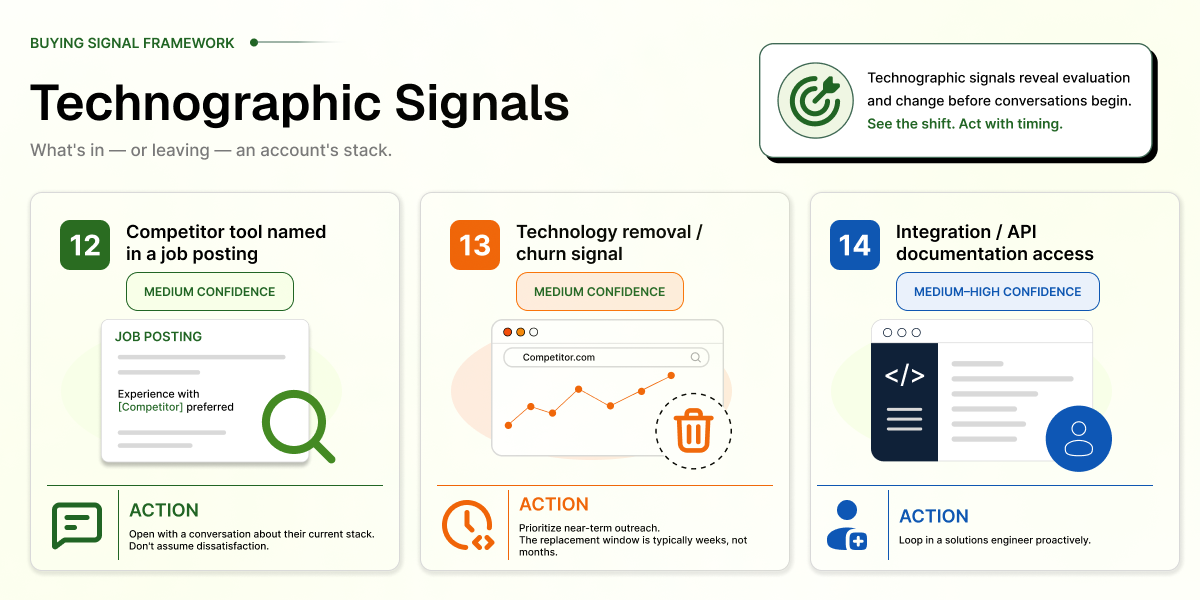
12. Competitor tool named in a job posting: Medium confidence
A posting for "RevOps Manager" lists "experience with [Competitor] preferred." You now know their stack. You don't yet know their satisfaction with it. Action: Open with a conversation about their current stack. Don't assume dissatisfaction.
13. Technology removal / churn signal: Medium confidence
Technographic data shows a competitor's tracking script disappearing from a target account's website. Someone just churned, and replacement decisions move fast. Action: Prioritize near-term outreach. The replacement window is typically weeks, not months.
14. Integration / API documentation access: Medium–High confidence
A prospect's engineering-domain email accesses your API documentation ahead of any sales call. Technical evaluators doing homework before sales gets involved is one of the most underrated signals in B2B, quiet, unprompted, and deeply practical. Practitioners consistently rank this kind of behavior above form fills: someone quietly trying to fit your product into an existing process, before sales even notices, is the buyer showing you their evaluation rather than telling you about it. Action: Loop in a solutions engineer proactively.
Engagement signals
Responses to things you put in the world.
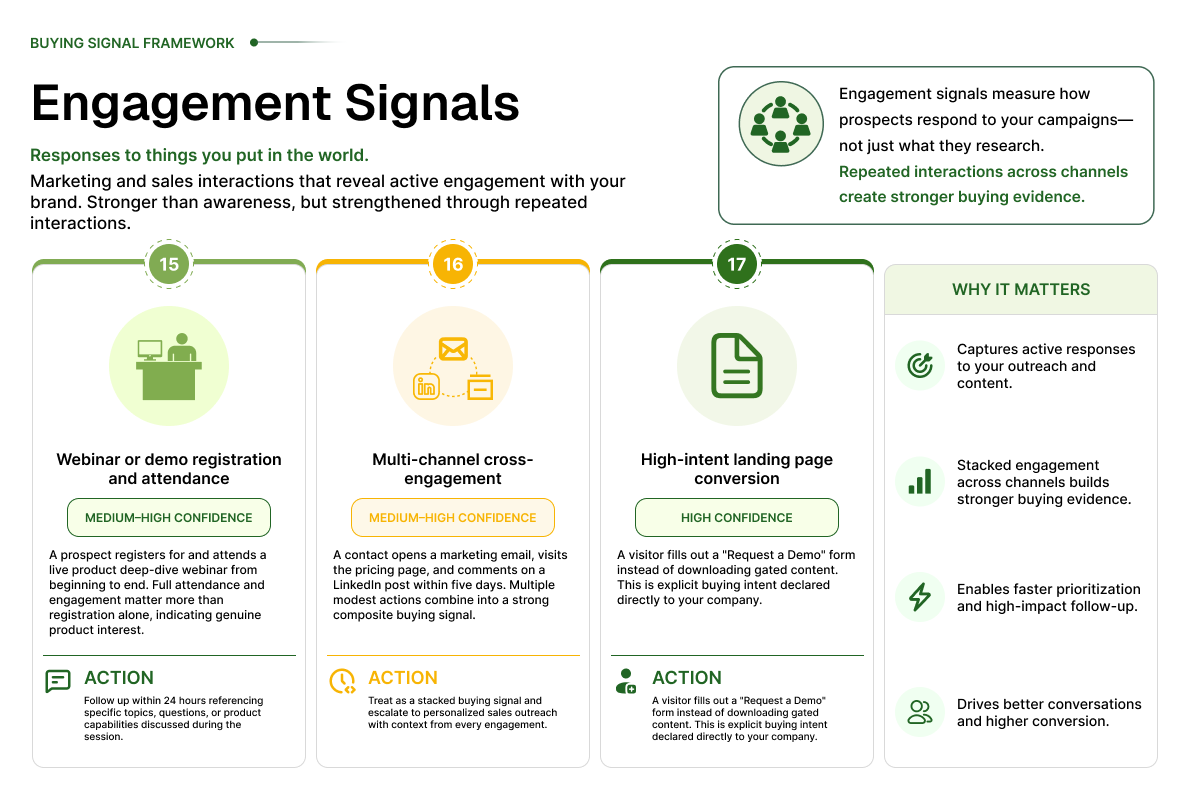
15. Webinar or demo registration and attendance: Medium–High confidence
A prospect registers for and attends a live product deep-dive webinar in full. Attendance and completion matter more than registration. Action: Follow up immediately, referencing specific content covered during the session.
16. Multi-channel cross-engagement: Medium–High confidence
A contact opens an email, then visits the pricing page, then comments on a LinkedIn post, all within 5 days. This is signal stacking made visible: individually modest actions compounding into a composite. Action: Treat as a high-priority composite signal and escalate to direct sales outreach.
17. High-intent landing page conversion: High confidence
A visitor fills out a "Request a Demo" form directly, not a gated-content form. Declared intent, in writing. Action: Same-business-day SDR follow-up. Response-time decay on high-intent form fills is well documented.
Relationship signals
People and trust moving between accounts. Frequently the highest-converting category, and the least systematically tracked.
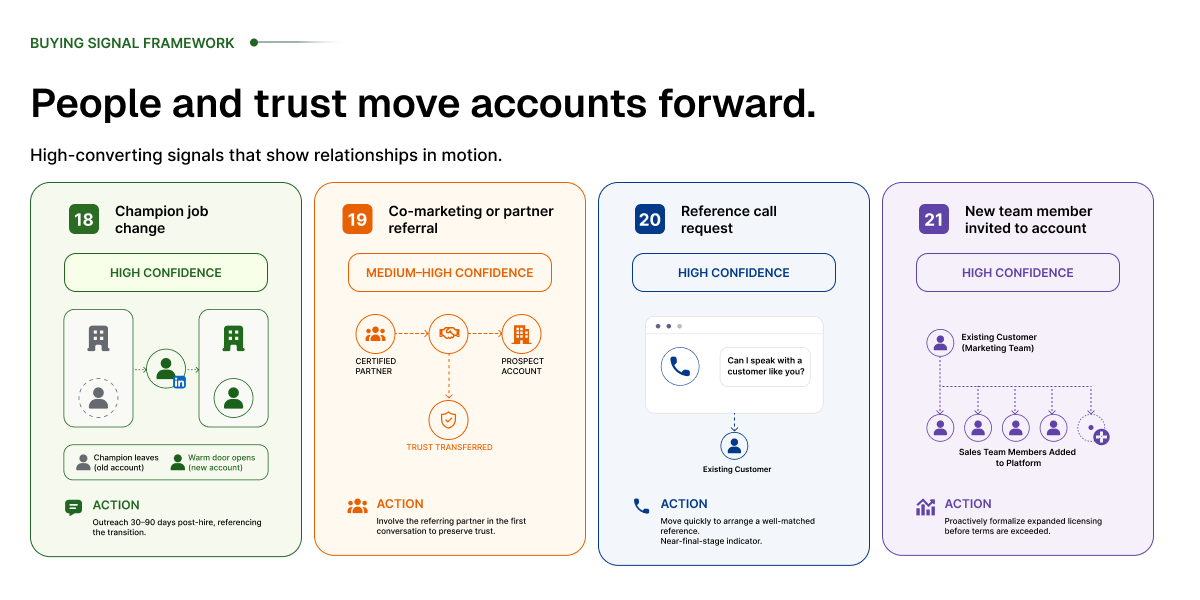
18. Champion job change: High confidence
A known product champion updates their LinkedIn to reflect a new employer. One event, two opportunities: a champion vacuum at the old account and a warm door at the new one. It is the canonical HOT signal in our playbook, action it the same day, because a new hire’s mandate to rebuild their stack peaks in the first 30 days.
Tools like UserGems and Lonescale exist almost entirely because of this signal, as Brian Lamanna, Account Executive at Gong, put it: "I've closed over 25% of my quota this year through UserGems." Action: At the old account, trigger a CS check-in to find a new champion. At the new account, reach out referencing their prior familiarity with the product.
19. Co-marketing or partner referral: Medium–High confidence
A certified implementation partner refers to a client actively seeking a complementary tool. Trust arrives pre-transferred. Action: Involve the referring partner in the first conversation to preserve that trust transfer.
20. Reference call request: High confidence
A prospect asks to speak with a customer in a similar industry and company size. Buyers don't burn reference favors early. Action: Move quickly to arrange a well-matched reference. Treat as a near-final-stage indicator.
21. New team member invited to an existing account: High confidence
A customer in the marketing department invites three sales team members into the platform. Expansion is happening whether or not it's on paper yet. Action: Proactively formalize expanded licensing before terms are exceeded informally.
Trigger events
External events that open a window. The window closes.
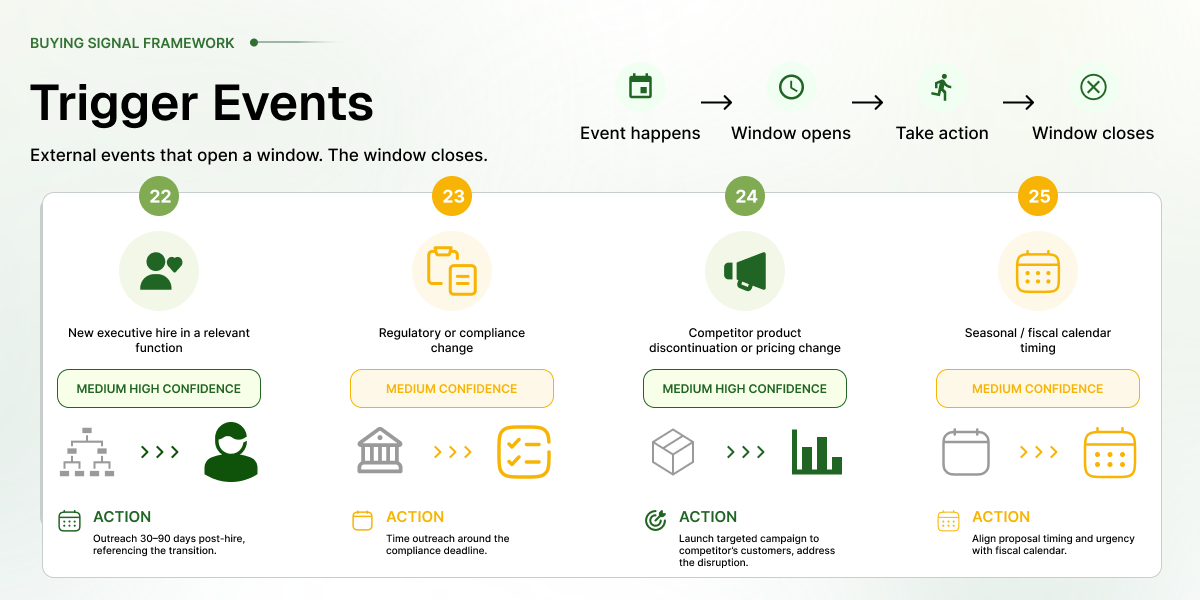
22. New executive hire in a relevant function: Medium–High confidence
A target account hires a new Chief Revenue Officer. New leaders review inherited tooling, it's one of the most predictable behaviors in B2B. Action: Time outreach 30–90 days post-hire, referencing the transition and the tendency to review team tooling.
23. Regulatory or compliance change: Medium confidence
A new data-privacy regulation requires companies in a given industry to implement compliance tooling within 12 months. Deadlines are the rare forcing function you didn't have to create. Action: Time outreach explicitly around the compliance deadline.
24. Competitor product discontinuation or pricing change: Medium–High confidence
A competing vendor announces a 30% price increase effective in 60 days. Their pricing team just built your campaign calendar. Action: Launch a targeted campaign toward that competitor's customer base, addressing the disruption directly.
25. Seasonal / fiscal calendar timing: Medium confidence
A prospect's fiscal year ends in March, creating a January–March use-it-or-lose-it budget window. Timing signals don't create demand, they concentrate it. Action: Align proposal timing and urgency framing with the account's actual fiscal calendar.
A deliberate note on scope: this list contains only positive, opportunity-side signals. Negative and risk signals, usage decline, engagement drop-off, support-ticket sentiment, are their own discipline and deserve their own piece.
Taken individually, these 25 signals form a catalogue. The matrix turns that catalogue into a prioritised queue.
The Signal Confidence Matrix: confidence × role
Twenty-five signals is a catalogue, not a queue. To turn it into a queue, score every incoming signal on two axes:
- Axis 1: Confidence tier. High, medium, or low, as rated above, adjusted for stacking. Two or more concurrent medium signals from one account promote the composite to high.
- Axis 2: Buying-committee role. Who emitted the signal matters as much as what the signal is. An economic buyer visiting your pricing page is not the same event as an intern doing it. Map each signal's source against the five standard roles, economic buyer, champion, technical evaluator, end user, procurement/legal.
The intersection sets the play. High confidence + economic buyer or champion = manual, personalized, fast, a rep, today. High confidence + technical evaluator = fast, but led by solutions engineering. Medium confidence + any role = automated nurture until it stacks. Low confidence = enrichment fodder; it improves account scores but never pages a human on its own.
This borrows its shape deliberately from Miller Heiman's Buying Influences, the role-based structure has survived decades because it maps to how B2B committees actually behave. Where classic qualification frameworks like BANT fall short is timing: BANT is static, a snapshot taken during a call, while signals are a live feed. MEDDIC gets closer ("Identify Pain" and "Champion" map directly onto signal categories), but neither framework tells you what to do with an event that arrived this morning. That's the job of the Signal Confidence Matrix.
For anyone cross-referencing that playbook: it scores signals on urgency × ICP fit, while this piece scores them on confidence × buying-committee role. These aren’t competing systems, they’re two cuts of the same queue. ICP fit is the account-level gate the playbook applies first: does this account matter at all?
Confidence and role are the weights this list applies next: within a qualifying account, how strong is the signal, and who emitted it? Run them in sequence, and the outputs converge, a signal’s confidence tier and decay window are what land it in one of the playbook’s four response tiers. High-confidence, short-decay events become HOTTEST or HOT; medium signals become WARM; low signals sit in NURTURE until they stack.
The reason to be this disciplined is trust. Over-scoring every signal doesn't produce better prioritization, it produces arguments between teams, and reps who stop opening the alerts. Only ICP-fit, role-weighted, confidence-tiered signals should ever reach a rep's queue.
A scoring system only works if it is equally clear about what should not be treated as purchase intent.
Where signal programs go wrong: false positives
Almost no competitor content covers this, so let's be the ones who do. The most common false positives, by category:
- Single pricing-page visits. Competitors, analysts, job seekers, and your own team on VPNs all visit pricing pages. Without repetition or corroboration, this is the noisiest "signal" in B2B.
- Intent surges with no first-party echo. Topic-level intent data flags accounts researching a category, which includes accounts researching it for a conference talk, a consulting deliverable, or a competitor's benefit. If a surge never corroborates with any first-party behavior, decay it out.
- Gated-content form fills are treated as demo requests. Downloading an ebook is a curiosity. Requesting a demo is intent. Scoring them the same is how "signal fatigue" complaints start.
- Funding announcements as universal triggers. New capital funds the roadmap the CEO already promised investors, which may not include your category. Funding is a readiness signal, not an evaluation signal, which is exactly why the playbook gates its HOTTEST funding alert on ICP fit rather than firing on every raise.
- Webinar registrations without attendance. Registration measures the strength of your promotion, not the prospect's interest. Weight attendance and completion instead.
The pattern behind every false positive is the same: a single, uncorroborated, role-ambiguous event treated as if it were a stacked, role-confirmed one. The fix isn't better data. It's the discipline of the Signal Confidence Matrix.
Once false positives are controlled, the next question is practical: what infrastructure is actually required to run the system?
The minimum viable signal stack
You don't need every tool. You need at least one source per layer:
- First-party behavioral: your website analytics and de-anonymization layer, plus CRM (Salesforce, HubSpot)
- Third-party intent: one provider, Bombora, 6sense, ZoomInfo, or G2 Buyer Intent, chosen for coverage of your ICP, not logo count
- Relationship tracking: UserGems or equivalent job-change monitoring; LinkedIn Sales Navigator for committee mapping
- Firmographic/technographic monitoring: funding, hiring, and stack-change alerts via tools like Apollo, Cognism, Clodura, or Leadfeeder
- Orchestration: wherever your routing logic lives, the CRM itself, or a workflow layer on top
The stack matters far less than the mapping. Every source must land its signals in one place, scored on the same two axes, with a named play attached. A signal architecture is a decision system that happens to have tools in it, not the reverse.
The tools provide the inputs, but disciplined implementation determines whether those inputs ever become pipeline.
Launch checklist
- Pick your first five signals, two high-confidence, three medium, from the Signal Confidence Matrix above. Not twenty-five. Five.
- Confirm you can capture each one today using your current tooling or signal tracking tools. If not, swap the signal. Don't buy another tool yet.
- Write the response play for each: channel, owner, message angle, and response-time SLA scaled to the signal's decay window.
- Define your stacking rule (the playbook’s ladder: 1 signal monitors, 2 in 7 days promotes to Tier 1, 3 triggers a human-touch call) and your role weighting.
- Route only ICP-fit, scored signals to reps. Everything else nurtures.
- Review weekly for the first month: which signals converted to meetings, which were false positives, which never fired. Prune ruthlessly.
- Add signals one at a time, only after the existing set has a >0 meeting count.
The checklist provides the operating model. The questions below address the definitions and decisions teams encounter most often.
Now, if you are sitting on more signals than your team can act on? That's the normal state, the fix is architecture, not more data. [Book a Strategy Call] and we'll map your existing sources against this Signal Confidence Matrix, pick your first five signals, and wire the response plays into your CRM.
.png)