.png)


You are sending emails. You are following up. You are doing the work.
And still, nothing is converting the way it should.
Here is the uncomfortable truth most B2B founders figure out too late: the problem is rarely the message. It is the timing. And it is the target. You are reaching the right type of company, but at the wrong moment, with the wrong level of context about where they actually are in their buying journey.
That is exactly the problem that Account-Based Marketing (ABM) and buying signals were built to solve. Together, they answer two of the most important questions in outbound:
- Who deserves your attention right now?
- Why is right now the right moment to reach out?
By the end of this guide, you will understand both concepts from the ground up, see how they connect to each other, and know how to start building a signal-powered ABM workflow using Claude Code, even if you have never touched anything like it before.
No jargon. No assumed knowledge. Just a clear system.
What Is ABM?
Account-Based Marketing, aka ABM, is a B2B strategy where you stop trying to reach everyone and start deliberately targeting a specific list of companies you have already decided are worth winning.
That is the whole idea. Focus over volume.
The classic way to explain it is this: traditional lead generation is fishing with a net. You cast wide, pull up whatever comes, and sort through the catch afterward. ABM is spearfishing. You pick the fish you want before you enter the water.
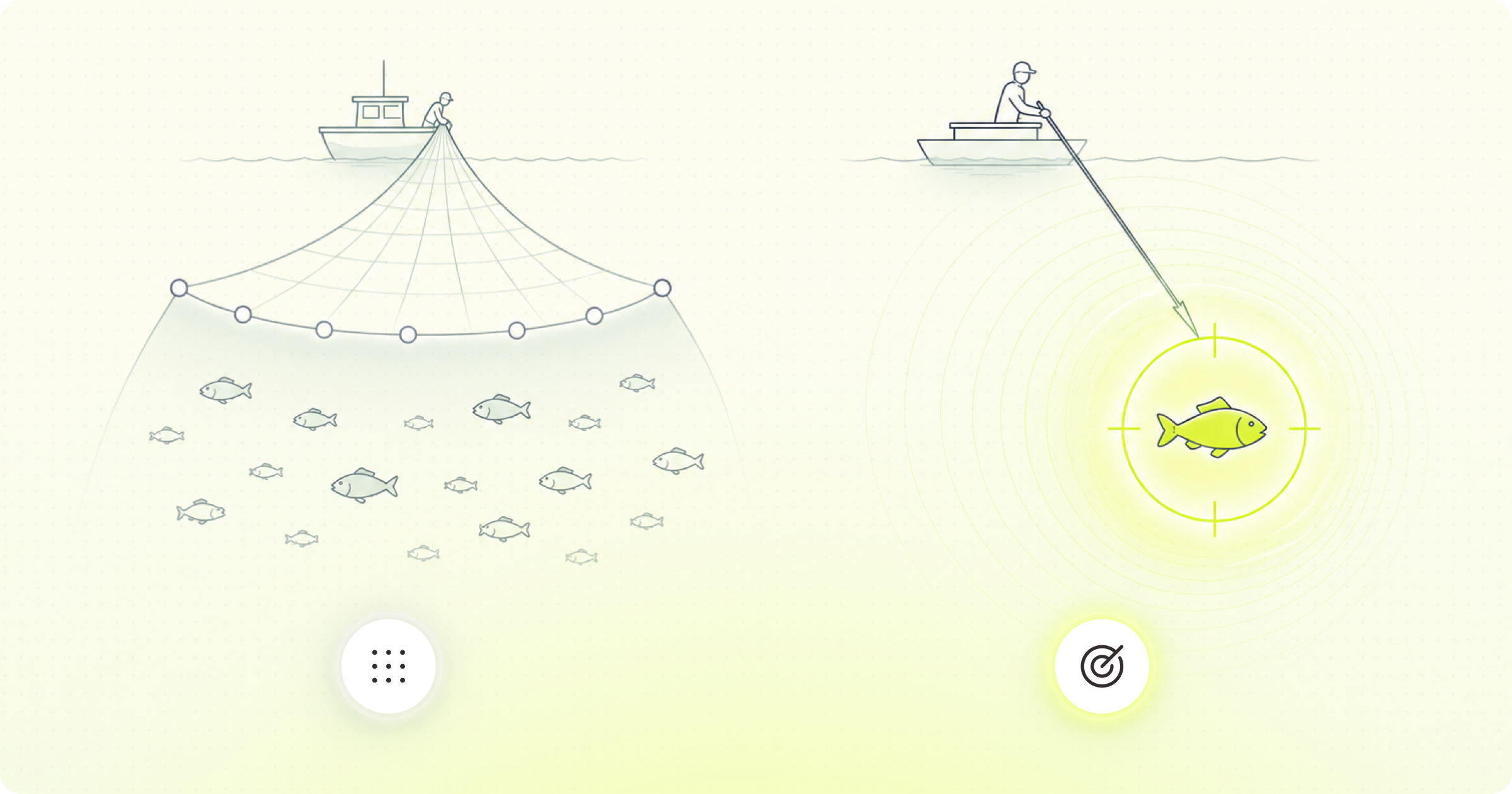
The "market of one" concept
In ABM, you treat each target account like its own market. That means your messaging, your timing, your channel choices, and your follow-up are shaped around what that specific company needs, not what a generic buyer persona needs.
This sounds like a lot of work. And done manually, it is. But that is not how modern ABM runs.
Why traditional outbound fails B2B founders specifically
When you are a founder, your time costs more than your SDR's. Every hour you spend reaching out to companies that were never going to buy is an hour you are not spending on the ones that will.
Traditional outbound does not discriminate. It treats a company that just raised a Series A the same as one that is freezing headcount. It sends the same email to someone actively researching your category and someone who has never heard of it.
ABM fixes that by making selectivity the default, not an afterthought.
The mistake almost every beginner makes
Founders hear "account-based marketing" and think it just means personalized email. It does not. Personalization is one tactic inside ABM. The strategy itself is about focus, coordination, and timing across multiple touchpoints over time.
Sending one bespoke email to 200 companies is not ABM. It is a personalized spray and pray with a better copy.
ABM tells you exactly who to focus on. But it still cannot tell you when to reach out. That is the job of signals.
What Are Buying Signals? (The Timing Layer ABM Is Missing)
A buying signal is any observable event or data point that suggests a company might be ready, or getting ready, to make a purchase decision.
Think of it like this. Imagine you are at a dinner party and someone mentions, completely unprompted, that their current project management software is driving their team insane. That is a signal. You did not ask. They volunteered the information. And now you know the timing is right to have a different kind of conversation.
In B2B, signals work the same way. Companies leave evidence of intent everywhere. Most sales teams are just not watching for it.
The four types of signals you need to know

Click on this article: 25 B2B Buying Signals Sales Teams Can Turn Into Pipeline, to learn more about signals.
Why one signal is almost never enough
We have worked with founders who acted on single signals and burned through their best accounts with poorly timed outreach. A funding announcement alone does not mean a company is in-market. A pricing page visit alone could be a competitor doing research.
One signal is a hint. Three signals pointing in the same direction is a pattern. And patterns are what you act on.
That brings us to the concept that separates good ABM from great ABM.
Signal Stacking vs. Signal Spray (The Mistake That Quietly Kills ABM Campaigns)
Signal spray is when you react to individual signals in isolation. One event fires, you reach out. The timing feels justified but the conviction behind it is thin. Most outreach built on single signals feels generic because it is. There is only one reason to reach out, and it rarely lands.
Signal stacking is when you layer multiple signals before making a move. You wait until two, three, or four things align before an account gets routed to an SDR or triggers an automated sequence.
The difference in outcome is significant.
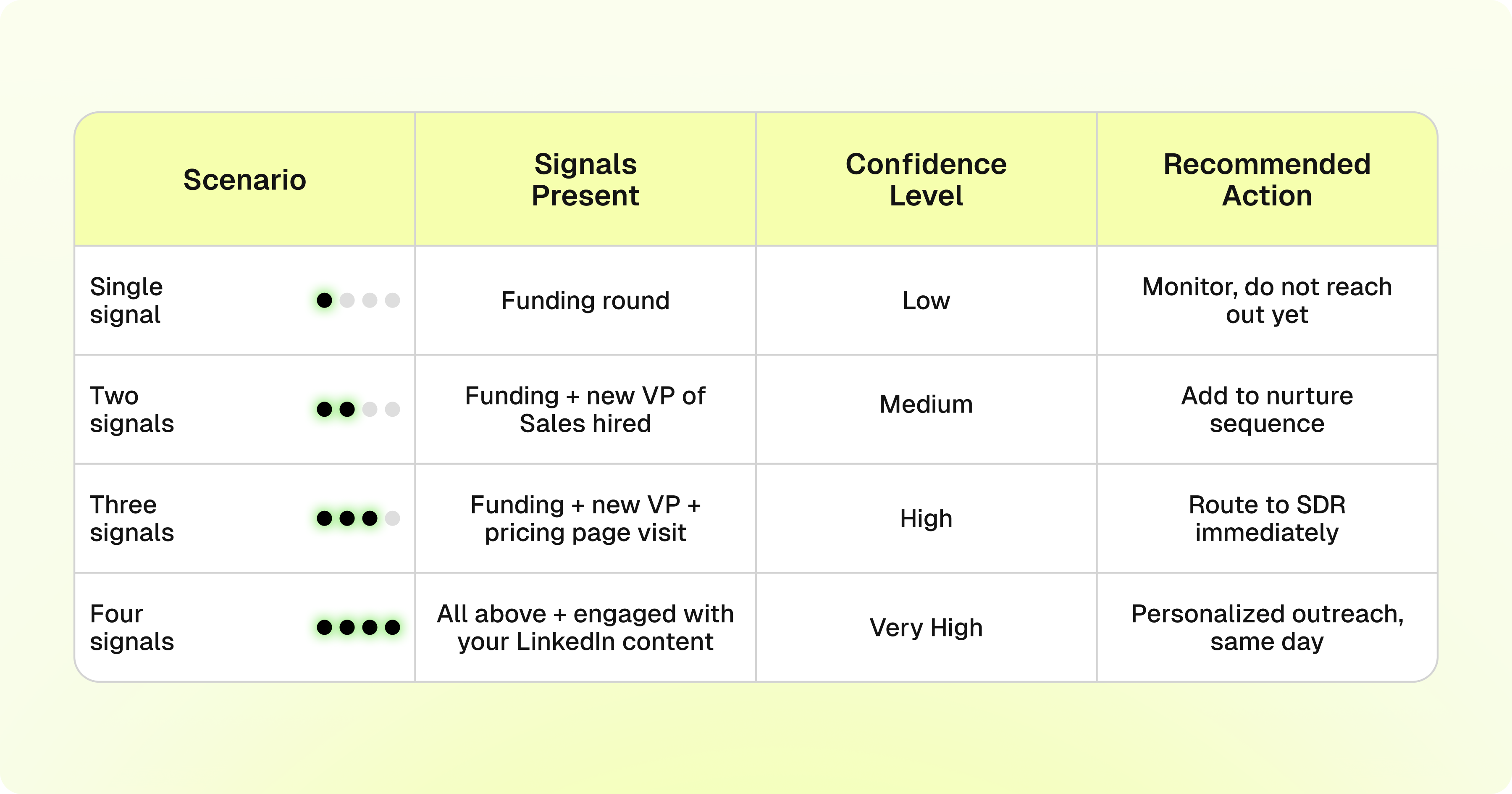
Building a basic signal scoring system
You do not need a complicated formula. Start simple:
- Assign each signal type a point value based on how strongly it indicates buying intent
- Set a threshold score that triggers each type of action
- Route accounts accordingly, automatically
A rough starting framework:
- Pricing page visit: 25 points
- Funding announcement (last 30 days): 15 points
- New VP or C-suite hire: 10 points
- LinkedIn engagement with your content: 10 points
- Job posting in a role your product supports: 10 points
- G2 category research (intent data): 20 points
Then set your routing rules:
- 60+ points: SDR reaches out within 24 hours
- 30-59 points: Account enters automated nurture sequence
- Under 30 points: Monitor only, do not activate yet
This is the piece most founders skip entirely. They have a target account list. They even watch for signals. But without a scoring layer, every account feels equally urgent and nothing gets prioritized well.
Now you understand the two engines. Here is how they work together inside a real campaign.
How ABM and Signals Work Together (The Full Picture)
ABM without signals is just a fancy target list. Signals without ABM is just noise monitoring without a strategy. The two are designed to work together, and the way they connect is through a concept called stage progression.
The four ABM stages
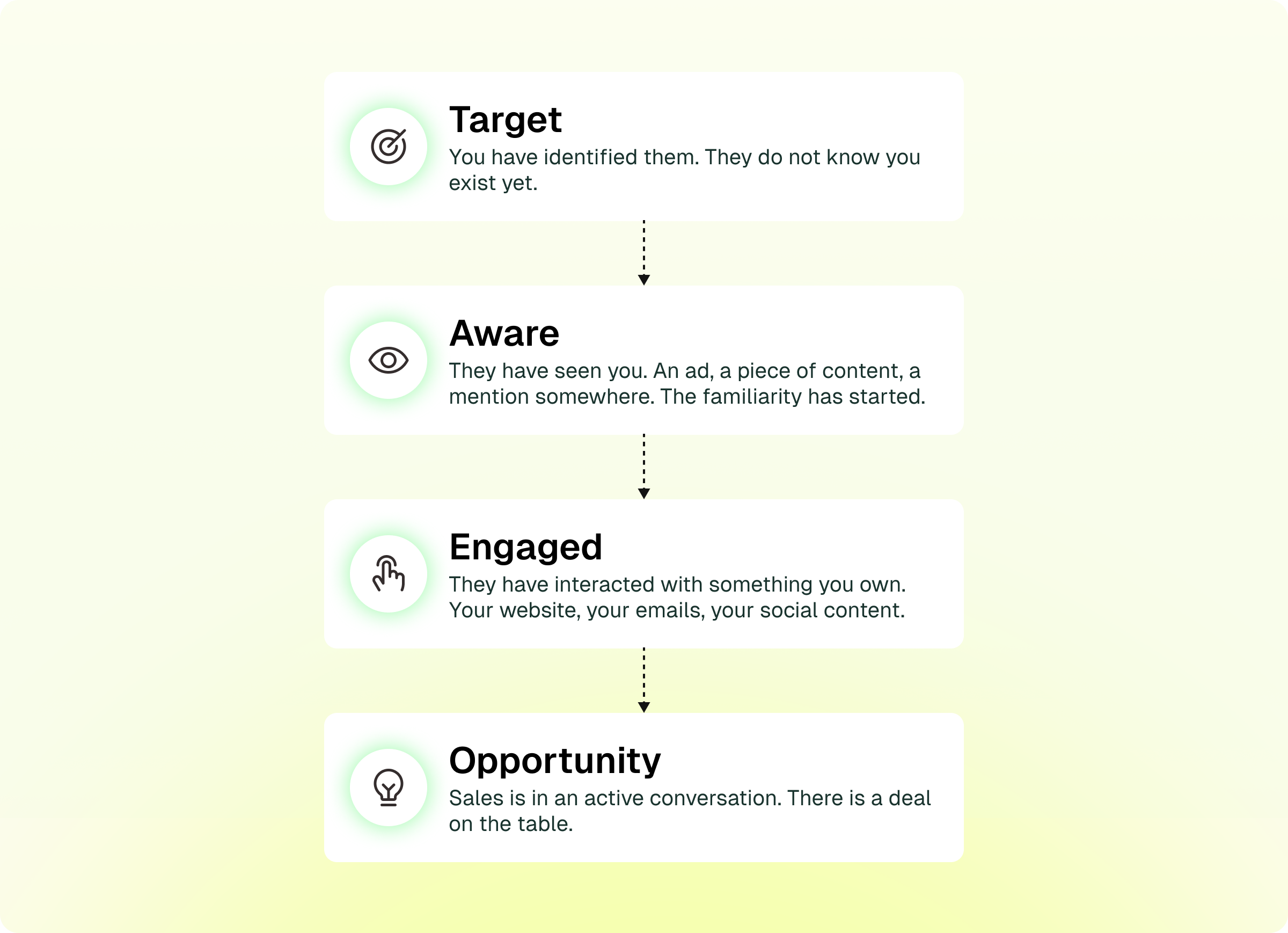
The mistake most teams make is trying to push everyone from Target to Opportunity as fast as possible. That is not how buying decisions work, especially in B2B where six to ten stakeholders are typically involved in a purchase.
Signals are what move accounts between stages
Think of it like a conveyor belt. Signals are the mechanism that advances an account to the next stage. An account sitting at "Aware" that suddenly visits your pricing page gets elevated to "Engaged" and triggers a different play. No human needs to review it. The system responds.
- A Target account raises funding: move to Aware, serve them ads
- An Aware account visits your site: move to Engaged, add to outbound sequence
- An Engaged account books a call: move to Opportunity, notify sales
Why this matters for the Rule of 7
The old marketing rule of seven says a buyer needs roughly seven touches before they act. What we've watched in B2B lately is that those seven touches work best when they're not seven repeats of the same message, but seven encounters across different contexts. Familiarity builds when someone keeps running into you in a few places, not when you hammer the same line over and over.
When a founder sees your LinkedIn ad, then reads your blog, then gets a cold email that references their recent funding round, it doesn't feel like a cold pitch. It feels like the start of a conversation they were already having in their head.
That is the Mere Exposure Effect at work. People trust what they recognize, and ABM with signals is how you engineer that recognition on purpose.
What running ABM without signals actually looks like
Without signals, you reach out to all 500 accounts on your list at roughly the same cadence. Some will be ready to buy. Most will not. You have no way to tell which is which until they respond or do not. You burn through your best accounts at the worst possible moments.
With signals, only the accounts showing evidence of readiness get activated. The rest keep warming. Nothing gets wasted.
That is the strategy. Now here is where Claude Code enters the picture.
Where Claude Code Fits In (And What It Actually Does)
Claude Code is an AI coding and automation tool built by Anthropic. For non-technical founders, the simplest way to understand it is this: you tell it what you want to happen, in plain English, and it builds and runs the logic that makes it happen.
Note: Claude code build the logic, but connecting it to real data sources (LinkedIn, CRM, new feeds) still takes configuration.
You do not need to know how to code. You need to know what outcome you want.
In an ABM and signals workflow, Claude Code acts as the central nervous system. Here is specifically what it can do:
What Claude Code handles in your ABM workflow:
- Monitor data sources and flag when a signal condition is met across your target account list
- Enrich account data automatically when a trigger fires, pulling company details, funding info, or hiring activity
- Score accounts against the point system you define, and update scores as new signals come in
- Draft personalized outreach triggered by specific signal combinations, not generic templates
- Push notifications to your Slack or CRM when an account crosses a scoring threshold
- Log account stage changes so you always know where every target account sits on the conveyor belt
However, remember this workflow requires MCP connections and API access set up first, as a one-time step.
The real-world pattern we see from founders
We have worked with B2B founders managing hundreds of target accounts who were doing all of this manually. Checking LinkedIn for hiring posts. Googling for funding news. Trying to remember which accounts had visited their site last week. Copying and pasting that research into a spreadsheet before writing a cold email.
That process is not just slow. It creates lag. By the time a founder acts on a signal they caught manually, the window has often passed. The new VP of Sales has already taken three demos from competitors.
Claude Code collapses that lag to near zero. When a signal fires, the scoring updates, the routing happens, and the outreach draft appears, all before a founder opens their laptop in the morning.
What Claude Code is not
It is not a magic button. The signal logic, the ICP definition, the scoring thresholds, those all have to come from you first. Claude Code executes a system you design. If the system is poorly defined, the output reflects that.
Think of it like a very capable operations hire. They will run the process with precision. But they need the process to exist before they can run it.
Here is how to build that process from scratch.
How to Build Your First ABM + Signal Workflow with Claude Code (Step-by-Step)
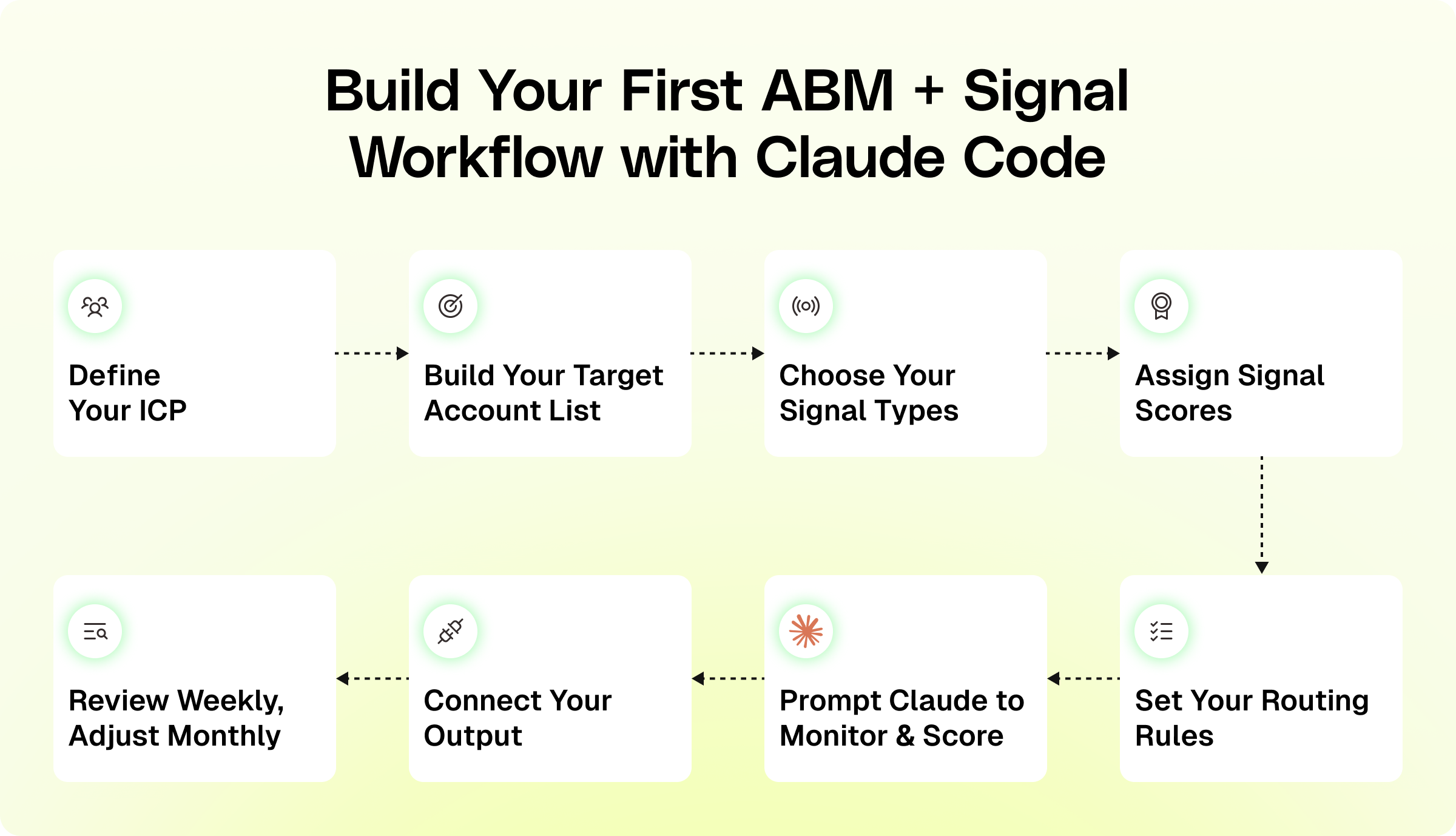
Step 1: Define Your ICP
Everything downstream depends on this. A vague ICP produces a vague account list and vague signals.
Your ICP definition should cover:
- Industry: What sector do your best customers operate in?
- Company size: Headcount range, revenue range, or both
- Geography: Where are they based?
- Tech stack: What tools do they already use that signal fit?
- Buying trigger: What usually happens at a company before they need you?
- Decision maker: Who signs the contract?
Write this out in a document before you open Claude Code. It is the foundation the whole system sits on.
Step 2: Build Your Target Account List
Start small. Seriously.
Most founders want to build a list of 5,000 accounts and automate everything at once. That is the wrong instinct. Start with 50 to 200 accounts that are a near-perfect match for your ICP. Quality of fit matters far more than volume at this stage.
Your list should include at minimum:
- Company name
- Website domain
- LinkedIn company URL
- Primary industry
- Approximate headcount
- Current tech stack (where available)
You can source this from LinkedIn Sales Navigator, Apollo, or manual research. Export to a CSV. That CSV becomes your input.
Step 3: Choose Your Signal Types
Do not try to track every signal type from day one. Pick two or three that are both relevant to your ICP and observable given the data sources you have access to.
Good starting combinations:
- For early-stage founders: Funding announcements + new leadership hires
- For product-led companies: Website pricing page visits + content engagement
- For services businesses: Job postings in relevant roles + LinkedIn content engagement
Define each signal clearly. Vague signal definitions produce false positives that waste your best outreach moments.
Step 4: Assign Signal Scores
Open Claude Code and paste in your ICP definition and your chosen signal types. Then prompt it to build a scoring model.
A prompt that works well at this stage:
"I have a list of target accounts. I want to score each account based on the following signals: [list your signals]. Assign point values to each signal based on how strongly it indicates buying intent. Set thresholds for three routing tiers: immediate outreach, nurture sequence, and monitor only. Output the scoring logic as a simple table I can review."
Review what it produces. Adjust the point values based on your knowledge of your own buyers. You know which signals matter most for your specific customers. Claude Code gives you a working draft. You make it accurate.
Step 5: Set Your Routing Rules
Once you have scores, you need to define what happens at each threshold. This is where Claude Code starts to behave like an automated ops layer.
Tell Claude Code:
"When an account reaches 60 or more points, draft a personalized outreach email referencing the specific signals that triggered the score. When an account reaches 30-59 points, add them to a nurture tag and send me a weekly summary. When an account is under 30 points, log the signals but take no action."
Step 6: Prompt Claude Code to Monitor and Score
This is where the automation kicks in. Claude Code can be set up to run monitoring logic on a schedule, checking your data sources for new signal activity against your target account list.
The prompt structure you need:
"Check this list of target accounts [paste CSV or link] against the following data sources: [e.g., LinkedIn for job postings, news sources for funding announcements, my website analytics for pricing page visits]. When a signal is detected, update the account's score and notify me via [Slack / email / CRM field]."
You will likely need to run this in iterations. Start by testing with five accounts before scaling to your full list.
Step 7: Connect Your Output
Decide where the outputs go:
- Slack: Best for founder-led sales where you want real-time alerts
- CRM field update: Best if you have an SDR who works from HubSpot or Salesforce
- Email draft in a Google Doc: Best if you want to review before sending
Claude Code can format its output for any of these. Tell it exactly what format you need and it will match it.
Step 8: Review Weekly, Adjust Monthly
This is the step most people skip because it feels less exciting than the setup. It is actually the most important one.
Every week, spend 15 minutes reviewing:
- Which accounts crossed a threshold?
- Did the outreach sent to high-score accounts get responses?
- Are there signals firing on accounts that turned out to be poor fits?
Every month, revisit your signal definitions and point values. Your scoring model should get smarter as you collect more data on what actually predicts a conversion versus what just looks like intent.
Setup is one thing. Knowing what to watch for is another.
We are going to have a dedicated article on how to build your ABM + Signal workflow with Claude Code (step-by-step). So stay tuned. (This is just a basic walk through, so that you can always come a check what the foundation part looks like before getting into the details)
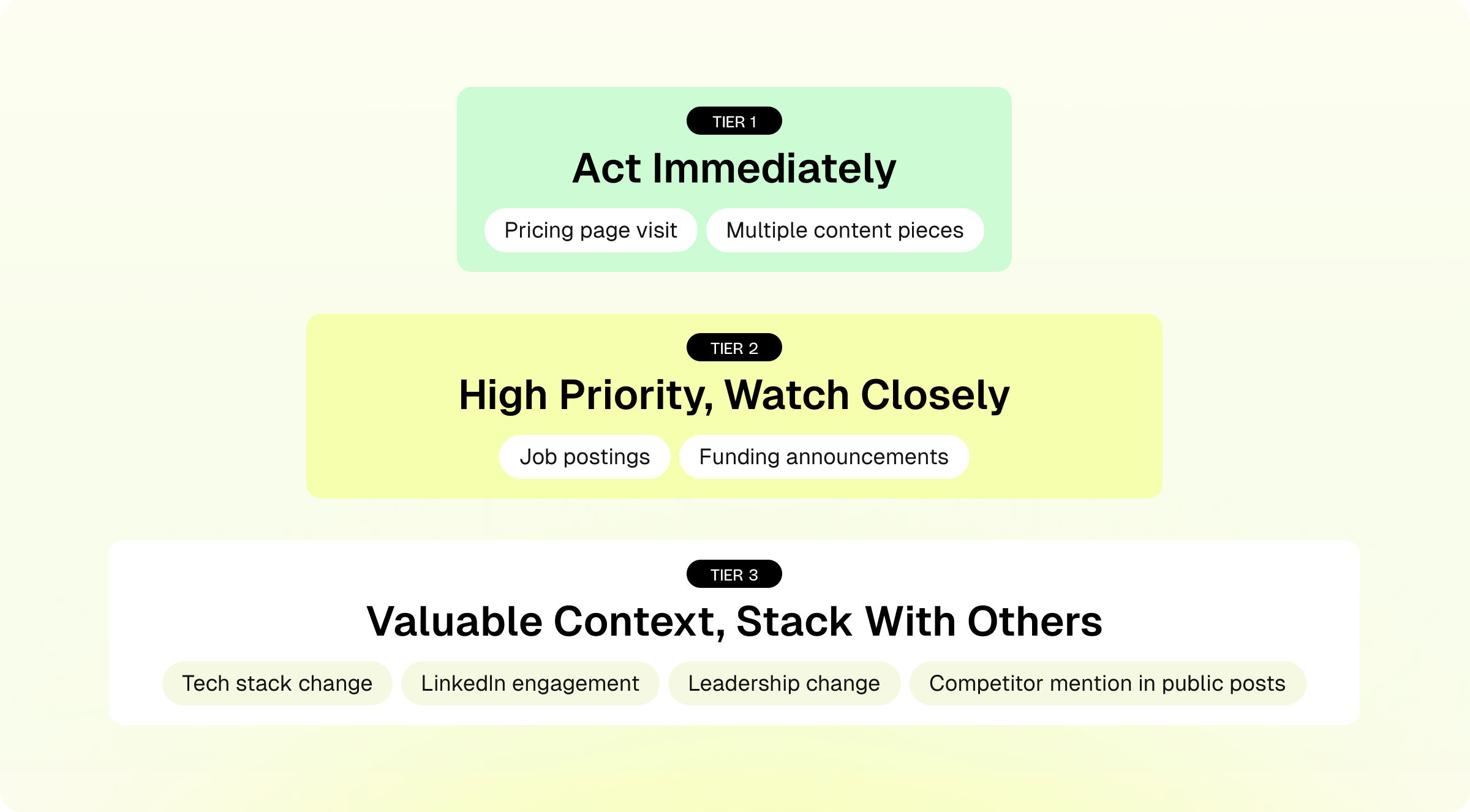
The Signals Worth Watching (Ranked by Conversion Power)
Not all signals are created equal. Some are strong predictors of near-term buying intent. Others are useful context but not worth acting on alone.
Here is how the most common signals stack up, based on how reliably they precede actual purchase conversations:
Tier 1: Act Immediately
- Pricing page visit — The strongest first-party signal. Someone at the company deliberately navigated to the one page that only buyers look at.
- Multiple content pieces consumed in one session — Not a casual browser. This is active research.
Tier 2: High Priority, Watch Closely
- Job posting for a role your product supports — If a company is hiring an SDR team and you sell sales tools, that posting is a buying signal.
- Funding announcement in the last 30 days — Budget just unlocked. The window for new tool decisions is typically 30 to 90 days post-announcement.
Tier 3: Valuable Context, Stack With Others
- LinkedIn engagement with your content — They know you exist and they are paying attention. Strong in combination with Tier 1 or Tier 2 signals.
- Leadership change at a target account — New leaders evaluate existing tools and make new buying decisions. Especially relevant if the hire is in a function your product serves.
- Competitor mention in public posts or reviews — They are thinking about the problem space. They may be unhappy with their current solution.
- Tech stack change — If a company just dropped a competitor tool, they are actively replacing it. That is a live opportunity.
One important caveat
Not every signal is observable for every business. Start with the signals you can actually access given your current data sources and budget. A pricing page visit requires website visitor identification software. Funding data is widely available for free. Job postings are public.
Build around what you can see, then expand as your toolset grows.
The Shift From Chasing to Choosing
Most outbound fails not because the product is wrong or the messaging is weak. It fails because the timing is off and the targeting is too broad to matter.
ABM gives you the discipline to stop chasing the entire market and start choosing the accounts worth winning. Signals give you the intelligence to know when a chosen account is actually ready to be approached. Claude Code gives you the infrastructure to run that system without an army of people maintaining it manually.
The goal was never to reach more people. It was always to reach the right people at the exact moment they are ready to hear from you.
That is not a volume problem. It is a system problem. And now you have the system.
Ready to build your first signal-powered ABM campaign?
.png)