
.jpeg)
Automation is familiar territory. You write the steps once, the machine repeats them exactly, and the value is that nothing surprising happens.
What emerged over the last two years is different in kind: software that decides its next step while it runs. Both kinds of systems are now sold under the same "AI agent" label. Gartner expects agentic AI in a third of enterprise software applications by 2028.
The AI agents vs. automation distinction is simpler than the marketing. An agent chooses its next action while it runs. Automation follows a sequence you defined in advance. For a lean GTM team, that distinction decides which tasks go where and what each should cost.
Telling them apart takes ten seconds.

Start With The Flowchart Test
If you can draw the entire workflow as a flowchart before it runs, it is automation. If the system makes a choice based on live input you could not have drawn in advance, it is an agent.
Everything else is detail. Automation's logic is fixed at configuration time and does not change during execution. An agent's logic adapts to what it perceives, which is why the same agent run against two different accounts can take two different paths and produce two different outputs.
A few terms are worth pinning down before we go further:
- Agentic AI is the umbrella category of systems designed to act autonomously toward a goal. An "AI agent" in the product sense is one implementation of it.
- Agent washing is rebranding rule-based automation as an AI agent without adding real autonomous reasoning. Gartner uses the term to describe most vendor claims in this space.
- Human-in-the-loop is a checkpoint where a person approves an agent's proposed action before it executes.
- Agentic automation is a third label some vendors use for several coordinated agents working toward one broader goal. It is a real thing, and it is out of scope here. This piece is about single-task classification, not multi-agent orchestration.
The test itself is easy. The reason to care about it is financial.

The Money Reason This Distinction Matters
According to Gartner's June 2025 assessment, only around 130 of the thousands of vendors claiming agentic AI were running genuine autonomous reasoning. The rest were rule-based automation with a new label. That is the practice Gartner calls agent washing, and it means the odds are against any given "agent" on your shortlist.
The same release predicts that more than 40% of agentic AI projects will be canceled by the end of 2027, on escalating costs, unclear business value, or inadequate risk controls. Set that against the adoption curve. That same third of enterprise applications is up from under 1% in 2024, and Gartner expects 15% of day-to-day work decisions to be made autonomously by 2028, up from zero. Read the two together and the picture is clear enough: the category is real and growing fast, and most of what is currently sold inside it is not what it claims to be.
For a three-person GTM team, getting this wrong is not an abstraction. Buy an agent for a task automation would have handled and you pay for orchestration overhead, token spend, and a failure mode that is far harder to debug at 6pm on a Friday. Buy automation for a task that genuinely needs judgment and you get a workflow that breaks quietly every time reality deviates from the flowchart. Both mistakes cost money, and only one of them announces itself.
So the useful question was never which approach is better. It is which tasks deserve which, and that needs a framework.
The Judgment Test
The Judgment Test crosses task variability against decision stakes, and the quadrant your task lands in tells you what to build.
Two axes, two questions:
1. Task variability. Does this task look the same every time it runs, or does each instance bring inputs you could not have anticipated?
↳ Low: the inputs are known fields in known formats.
↳ High: the inputs are unstructured, incomplete, or different every time.
2. Decision stakes. What happens when it gets one wrong?
↳ Low: a cleanup task, reversible in minutes.
↳ High: a real person sees it, or money moves.
That gives you four quadrants, and each one has a default answer.
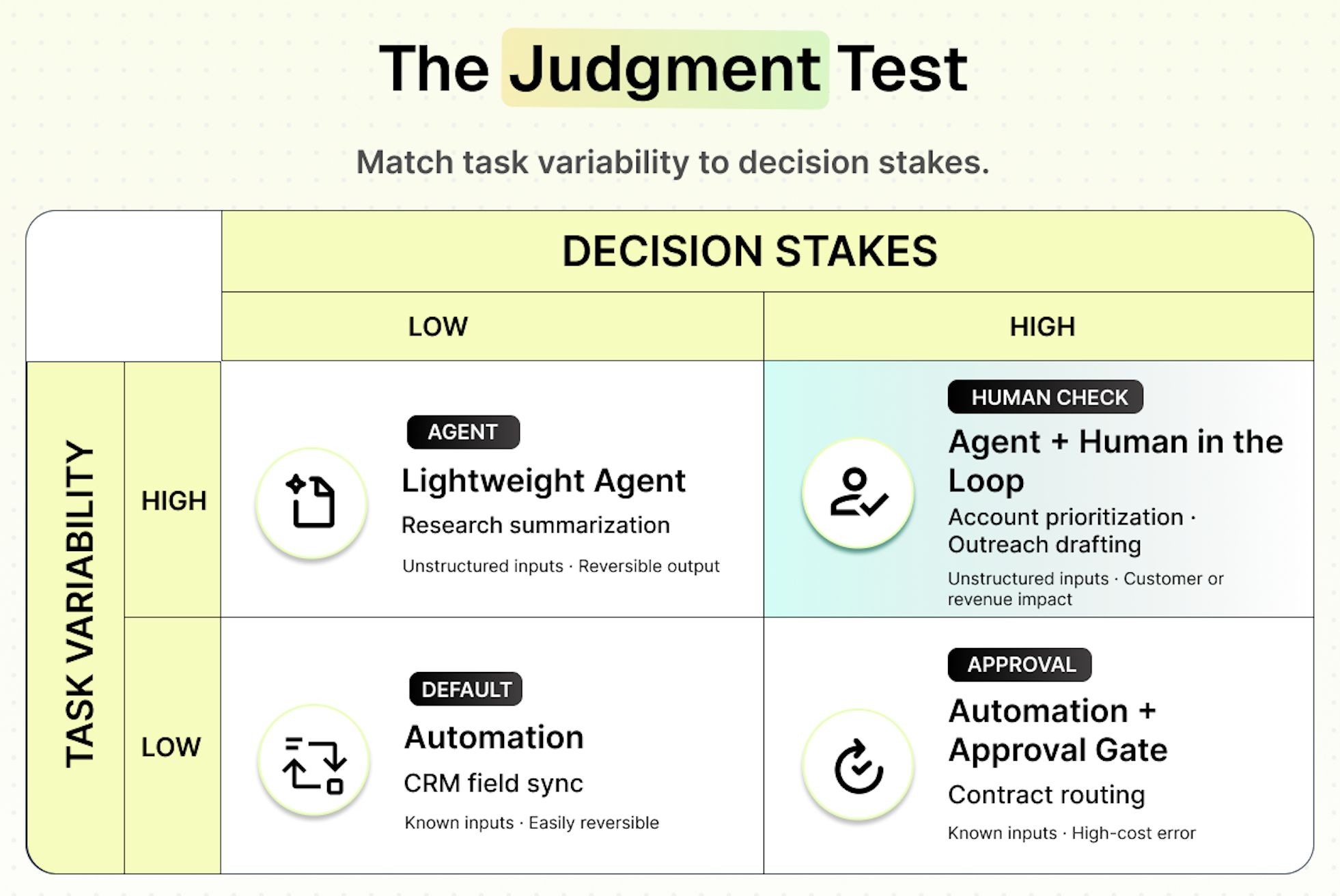
Notice what the matrix does not say. It never says agents are better. Three of the four quadrants either keep a human in the path or resolve to plain automation, which is usually the cheaper and more reliable answer.
If the shape of this feels familiar, that is deliberate.
Where This Fits With What You Already Run
Our earlier piece, Legacy GTM Tools vs. AI-Native Tools vs. Claude, split the stack into three vendor tiers. Within the AI-native tier there is a further split that matters more than the tier itself: which of those tools are agents, and which are automation wearing an AI label. The Judgment Test is that second cut.
It also sits one level below the Manual-to-Autonomous GTM Workflow Roadmap, which moves a team from manual execution to AI-assisted thinking to sequence automation to autonomous workflows. That roadmap answers when your team is ready for a stage. The Judgment Test answers which specific task belongs in which stage, which is the question you hit the moment you try to apply the roadmap on a Monday morning.
The same caution runs through both. As the 5 Stages of GTM Maturity model puts it, automation amplifies what is already there, and most teams running Claude Code are at Stage 2 trying to do Stage 4. An agent pointed at a process you have never run manually will not discover the process for you. It will scale the confusion.
There is one more line worth borrowing, because it is really what this whole framework formalizes: Claude eats the tasks, you still own the judgment. The Judgment Test is that sentence broken into a repeatable question you can ask of any task on your board.
Here is what that looks like against twelve tasks a lean GTM team actually runs.
The 12 GTM Tasks, Classified
Classification is by task, not by tool. The same platform can run either mode, which is exactly why tool names make a poor sorting key.
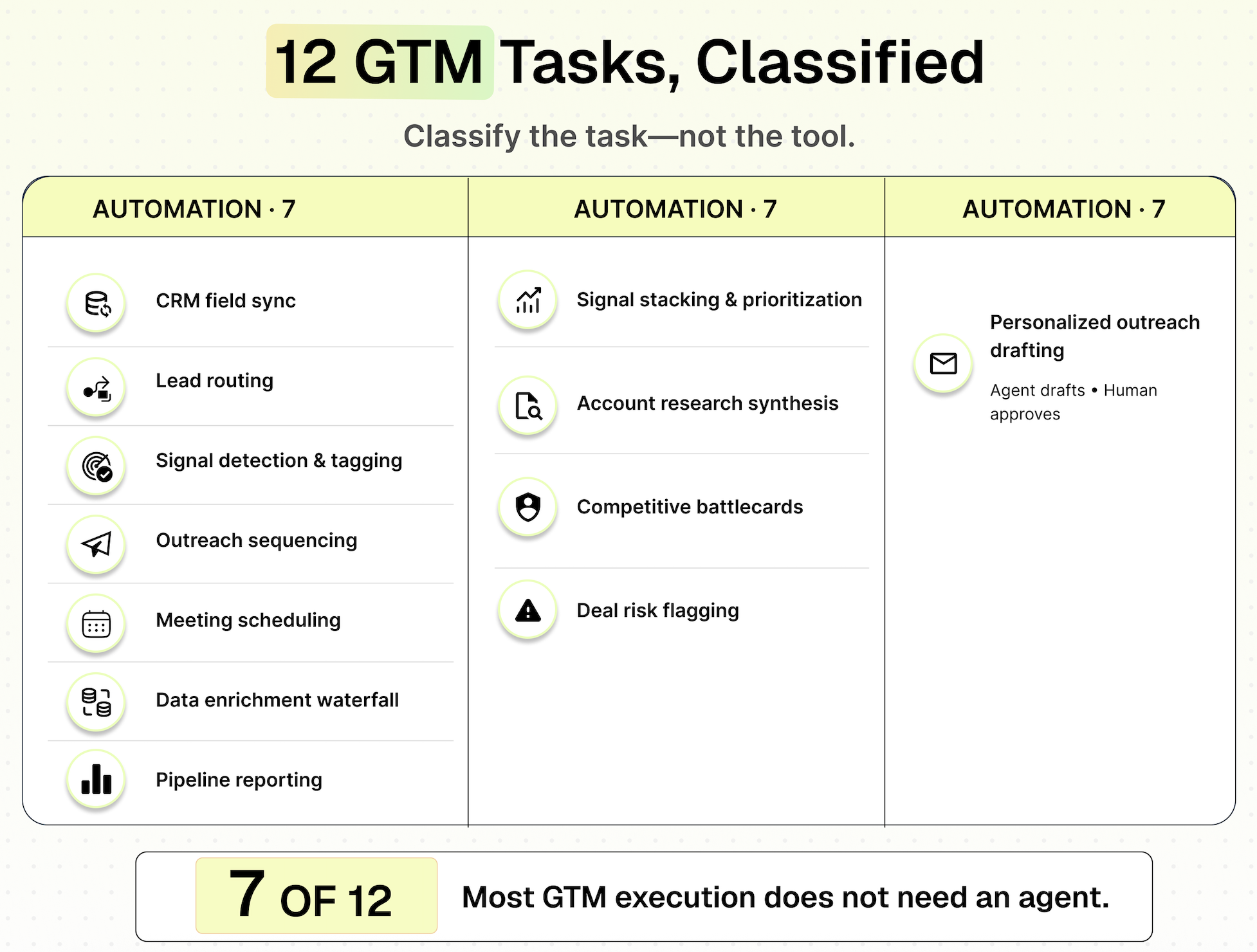
1. CRM field sync. Automation.
A new deal stage in HubSpot fires a Slack notification and updates a linked sheet.
↳ Fixed steps, same every time, no judgment required. A rule-based tool is the correct and cheaper answer.
2. Lead routing. Automation.
A form submission goes to the right rep based on territory and company size.
↳ Deterministic logic. An agent adds cost and risk here and buys you nothing.
3. Signal detection and tagging. Automation.
A funding announcement is captured from Crunchbase and tagged to the account record.
↳ Detecting a known event type is pattern matching against a known shape, not reasoning.
4. Signal stacking and account prioritization. Agent, with one important caveat.
Deciding whether three weak signals from one account justify promoting it to Priority Tier 1 today, given its ICP score and deal history.
↳ Weighing multiple unpredictable inputs together is the definition of high variability.
↳ The caveat: basic point-and-threshold scoring, where you assign points per signal type, sum them, and compare to a fixed number, is automation. That is the version most teams start with, and it is the version our own beginner's guide to buying signals describes. Agent territory begins when prioritization has to weigh things a fixed formula cannot hold, like deal history, relationship context, or how recent and how relevant a signal is together rather than separately.
Pro tip: If you can write the scoring rule down as arithmetic, keep it as automation. The moment you find yourself adding "unless" clauses to the rule, you have crossed into agent territory.
5. Account research synthesis. Agent.
Pulling a prospect's funding history, hiring pattern, and tech stack into a one-paragraph brief before a call.
↳ No fixed template fits every account. The system has to decide what is worth including, which is a judgment call made at run time.
6. Personalized outreach drafting. Hybrid: agent drafts, human approves.
Drafting a first-touch email that references a specific signal and the stakeholder's role.
↳ Judgment-heavy on angle and tone, and high-stakes because it reaches a real prospect. That combination is the human-in-the-loop quadrant, not full autonomy.
↳ This is the single most common place lean teams over-delegate. The draft is agent work. The send is not.
7. Outreach sending and sequencing. Automation.
Three follow-ups on a fixed schedule if no reply arrives.
↳ Once content and cadence are set, execution is deterministic. Nothing here benefits from reasoning.
8. Meeting scheduling. Automation, with a light agent for edge cases.
A prospect picks a slot from a calendar link and conflicts resolve automatically.
↳ Mostly rule-based. Only messy rescheduling, where three constraints collide, gets any value from adaptive behavior.
9. Data enrichment waterfall. Automation.
Running a contact through three providers in sequence until a valid email is found.
↳ A fixed fallback order is ordered execution, not decision-making. It feels smart because it recovers from failure, but the recovery path was written in advance.
Pro tip: "It handles exceptions" is not evidence of an agent. Pre-written fallbacks are still a flowchart. The question is whether the system invented the response or looked it up.
10. Competitive battlecard generation. Agent.
Turning a competitor's new pricing page into a sales-ready objection-handling note.
↳ Requires interpreting unstructured content and deciding what actually matters to your reps this quarter.
11. Pipeline reporting and dashboards. Automation.
A weekly dashboard populates itself from CRM fields with no manual pulling.
↳ Aggregation and display of known fields. Reasoning enters when someone interprets the dashboard, not when it builds.
12. Deal risk flagging. Agent.
Noticing that a champion has gone quiet, engagement has dropped, and a key stakeholder has not opened the last two emails, then deciding this deal needs a human check-in.
↳ Synthesizing several ambiguous, evolving signals into a judgment call is not a threshold trigger. A rule that fires on "no activity in 14 days" will flag half your healthy pipeline and miss the deal that quietly died on day 9.
Pro tip: Run this classification on your own stack before your next renewal cycle. If a task on the automation side is being served by an agent-priced tool, that is your cheapest available saving this quarter.
Seven of twelve land on automation. That ratio is the point, and it explains the three mistakes that follow.
Mistake #1: Buying an agent for a flowchart task
You watch a demo, the output is impressive, and you buy. Six weeks later the task it replaced was a five-step sequence that a rule-based tool ran for a fraction of the cost with none of the variance.
The fix: run the flowchart test before the demo, not after. Draw the workflow on paper first. If you can finish the drawing, you have already answered the question, and no demo should change that answer.
Mistake #2: Giving full autonomy to a task just because it needs judgment
Judgment-heavy does not mean autonomy-ready. Outreach drafting, pricing responses, and anything a customer will read are high on both axes, which is the quadrant that keeps a human in the path.
The fix: separate the drafting decision from the sending decision. Let the agent own everything up to the point where the action becomes irreversible, and put the gate exactly there.
Mistake #3: Classifying by tool name instead of by task
This is where agent washing does its damage, and it cuts both ways. Zapier shipped Zapier Agents in 2025 for autonomous multi-step execution without code, and n8n added an AI Agent node with LangChain integration and persistent memory in version 2.0 in January 2026. Both platforms were automation-only for most of their history, and both now run either mode.
So the honest answer to "is n8n an agent or automation" is that it depends entirely on which feature you are using. The platform name tells you nothing.
The fix: classify the task, then pick the feature that fits it. That is also why the twelve tasks above are sorted by task and never by vendor.
Worth saying plainly before we go further: a great deal of what gets called an agent today is really excellent automation, and that is not a criticism. Automation is frequently the right choice, the cheaper choice, and the more reliable one. Many teams also group both under a single commercial label when packaging a service, which is a reasonable marketing decision. The distinction in this piece matters when you are the one choosing what to build, not when you are reading how a vendor names a bundle.
Which leaves the question of what the wrong choice actually costs.
The case for boring automation
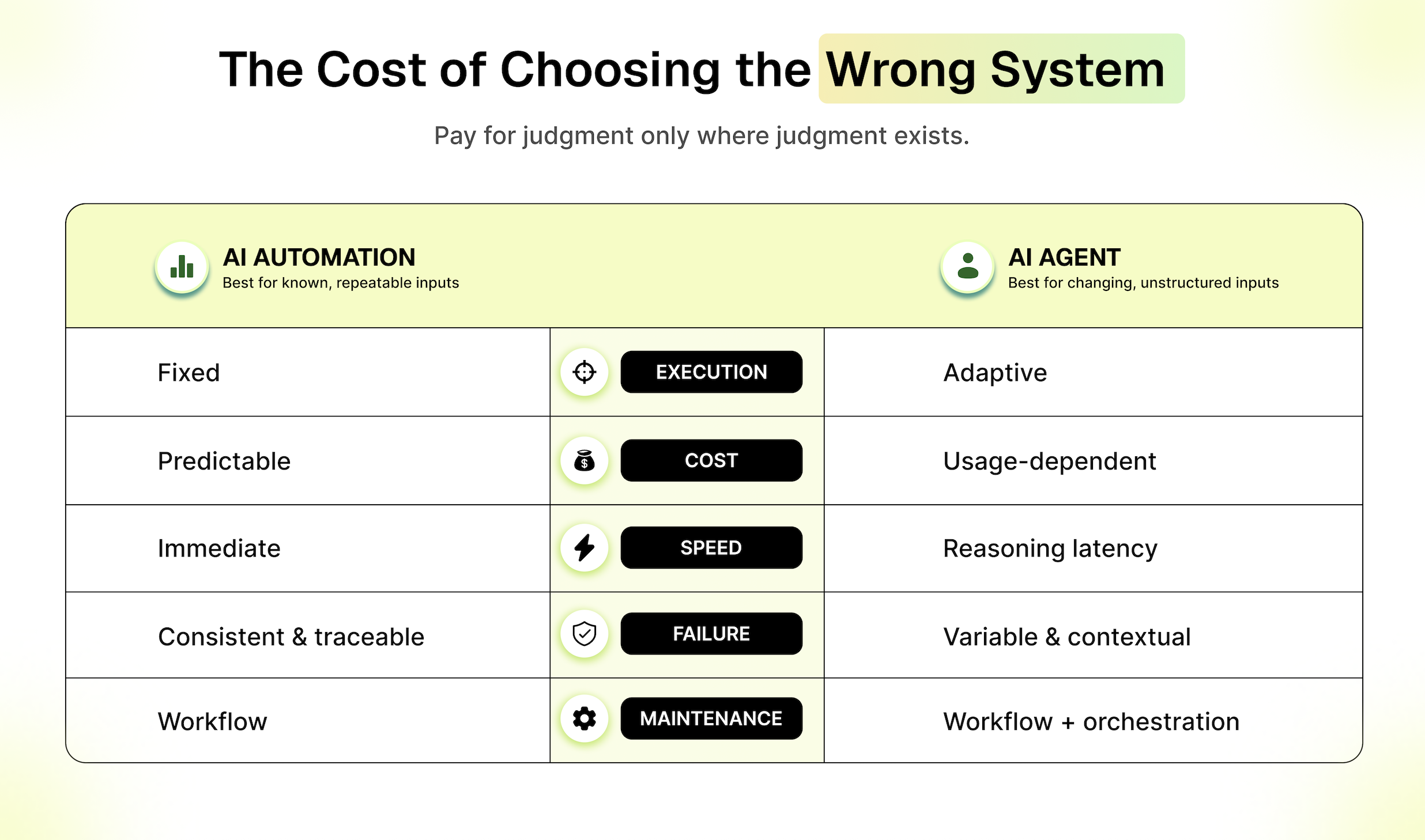
Agents carry costs that automation does not. Token spend scales with usage rather than sitting flat, orchestration adds a layer that has to be maintained by someone, and time-to-first-action is longer because the system has to reason before it moves.
They also fail differently. Automation fails loudly and in the same place every time, so you fix it once. An agent fails variably, which means a higher break rate at the edges and more hours spent reconstructing what it decided and why.
None of that is an argument against agents. It is an argument for spending them where variability actually exists, because that is the only place the extra cost buys you anything. On a payback basis, the cheapest agent you will ever run is the one you did not need to buy.


.png)