

A lot of people trying to learn AI GTM start at step twelve.
They want agents. Orchestration. A system that runs while they sleep.
But they skip the ladder to get there, and an agent inherits every weakness sitting underneath it.
Point one at a wishlist ICP and it will produce wrong work faster than a human ever could.
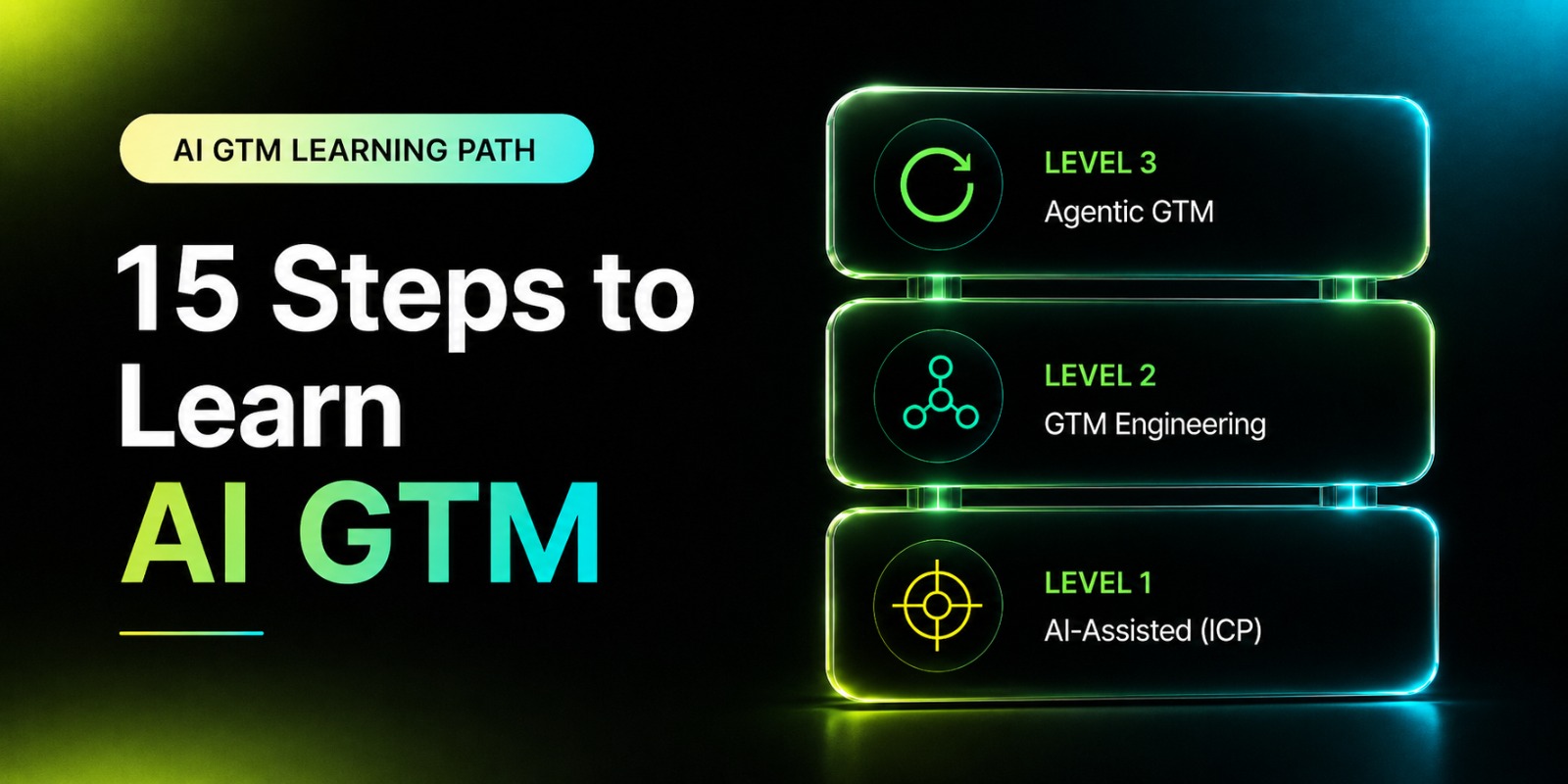
Here is the actual climb, the one I posted on LinkedIn with no CTA and no pitch. Fifteen steps across three levels, in order.
Read it as a learning path rather than another GTM model. It answers what to learn next, not how GTM works.
Foundations first. Engineering second. Agents last.
.jpeg)
The order below is fixed, and the rest of this piece is an argument for why. Start at the bottom.
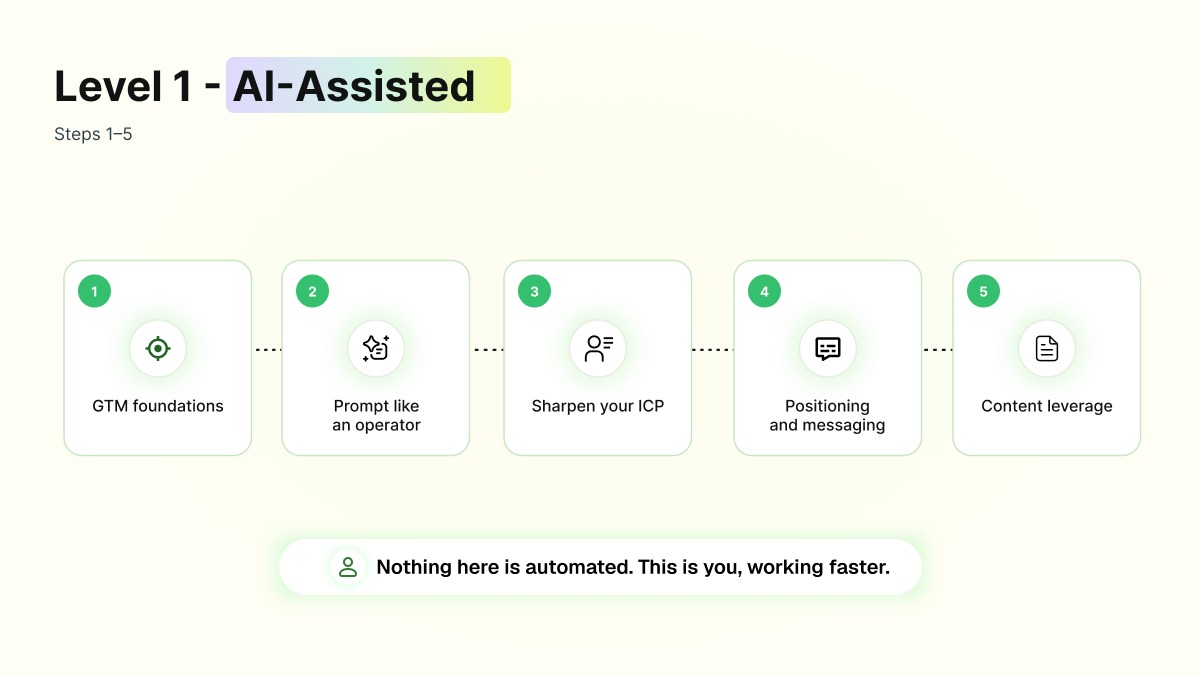
First Level: AI-assisted
This level is about doing the work you already do, faster and sharper.
No automation, no agents, nothing running unattended.
It is also the least exciting part of the ladder, and I am not going to pretend otherwise.
It is still the part that decides whether anything above it works.
1. GTM foundations
Foundations means your ICP, your positioning and your motion, settled before you touch tactics.
Every tool above this step amplifies whatever you feed it. Feed it a vague market definition and you get vague output at scale.
The full argument sits in 5 Layers of GTM.
2. Prompt like an operator
Prompting like an operator means using AI for research, copy and first drafts on demand, rather than asking it for opinions.
The shift is from asking a question to assigning a task with context, constraints and a format.
That single habit is what separates people who find AI useful from people who find it disappointing.
3. Sharpen your ICP
This step is building a real ICP with AI, not a wishlist dressed up as one.
AI is genuinely good here, because it can read hundreds of closed-won and closed-lost accounts and tell you what they share.
ICP is defined properly in The ABM Workflow Every Team Needs In 2026.
4. Positioning and messaging
Positioning and messaging is the work of turning features into buyer language.
Your product does things. Your buyer has problems.
This step is the translation between the two, and no amount of automation downstream will fix a bad translation. Where that work should sit in a team is covered in GTM Agency vs GTM Engineer vs In-House vs Fractional Leader.
5. Content leverage
Content leverage means shipping posts, briefs and pages at speed without losing the voice.
Hold on to this step, because it comes back at step 9 for a reason most ladders miss.
The system behind it is documented in The Automated LinkedIn Content Distribution System.
Tools to use for this level
Claude, ChatGPT and Perplexity are established and safe to build habits on.
Exa is the one still moving, and it does a different job to the other three. It is a search API built for AI applications rather than a chat product.
Level one makes you faster. It does not make the system bigger, and that is what the next five steps are for.
Level two: GTM engineering, steps 6 to 10
This level is the amplifier. You stop doing the work faster and start building the thing that does the work.
It is also where the vocabulary gets slippery, so each step below opens with a plain definition before anything else.
6. Signals over lists
This step is learning the difference between a buying signal and intent data.
A list tells you who exists. A signal tells you something changed.
The library of what is actually worth watching is in 25 B2B Buying Signals Sales Teams Can Turn Into Pipeline.
7. Data and enrichment
Enrichment is filling in what you do not know about an account or a contact, in code rather than by hand.
The important idea here is waterfall enrichment, where you query providers in sequence until one returns a usable answer.
It is defined in full, alongside the outbound workflow it feeds, in Intent-Based LinkedIn Outreach: The Workflow For 2026.
8. Signal pipelines
A signal pipeline wires triggers into a live buying feed, so a change in the market arrives as a task rather than as a report.
This is the first step where something runs without you. Not an agent, just plumbing.
The plumbing has to be boring and reliable before anything clever sits on top of it.
9. Timing and relevance
This step is about reaching the buyers who are in-market now.
It is also the one place where I want to be precise about a number I use often.
The 95:5 rule comes from Professor John Dawes at the Ehrenberg-Bass Institute, published with the LinkedIn B2B Institute.
Companies change providers roughly every five years, so around 20% are in-market in a given year and about 5% in a given quarter.
Dawes’ own conclusion is that marketers should invest in reaching the out-of-market 95%, because they are future buyers who will pick a brand they already recognise.
The rule is an argument for brand building.
So when this step says reach the 5%, it is not telling you to ignore everyone else. It is telling you which half of your GTM does which job.
- Outbound works the 5%. People who are in-market this quarter and can act on a relevant message now
- Content works the 95%. Step 5, running quietly, so your name is already familiar when their five years are up
That is why this ladder has a content level and an outbound level, and why neither substitutes for the other. The timing argument in full is in GTM Engineering Is Not a Job Title.
10. Outbound systems
Outbound systems means personalising at scale and killing spray-and-pray for good.
This is the most thoroughly covered step on this site, so I will keep it to one point.
Personalisation at scale is not writing more variants. It is having enough signal that the message writes itself, which is only possible because you built steps 6 through 9.
Tools to use for this level
Apollo, Clay and n8n are established. Deepline and Railway are still moving, and they are not the same kind of thing.
Deepline is a unified API and CLI for GTM data built for agent use, covering enrichment, scraping, validation and sequencing.
Railway is a deployment platform rather than a GTM tool, and it belongs here as the infrastructure your enrichment code actually runs on.
.jpeg)
Everything so far still needs a human deciding what happens next. Level three is where that changes.
Level three: agentic GTM, steps 11 to 15
This is the activator, and it is the thinnest ground on this site, so it gets the most room here.
It is also where the step-twelve problem lives. People arrive at this level first, buy an orchestration tool, and find it has nothing to orchestrate.
11. Operator setup
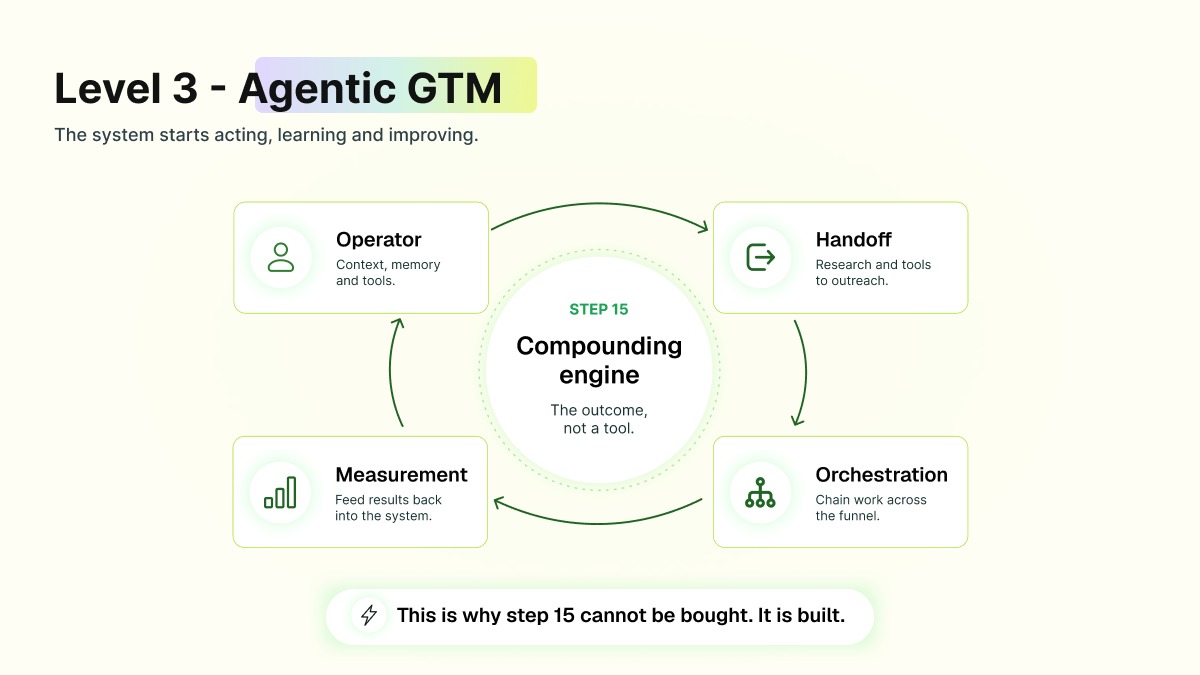
An operator is an agent you have given three things: context about your business, memory that survives between runs, and tools it is allowed to use.
Miss any one of those and you do not have an operator.
Context without memory means re-explaining everything each time. Memory without tools means an agent that knows a lot and can do nothing.
This is also the point where the distinction between an agent and an automation stops being pedantic.
An automation follows a path you defined. An agent chooses a path. The difference, and when each is the right answer, is in AI Agents vs AI Automation.
Start with one operator and one narrow job.
The instinct to give it everything at once is the same instinct that made people start at step twelve.
12. Research to outreach
This step is handing off a multi-step operation end to end, from finding an account to sending the first message.
It is the first genuine handoff, and it is where the value of everything below suddenly becomes visible.
The operator uses your ICP from step 3, your messaging from step 4, your signals from step 6 and your enrichment from step 7.
If any of those is weak, you will see it here, in output you would not send yourself.
My advice is to run it in draft mode for longer than feels necessary.
Read what it produces, correct it, and only then let it send. The correction round is the actual training.
13. Orchestration
Orchestration is chaining operators across the funnel, so the output of one becomes the input of the next.
A research operator finds and qualifies. An outreach operator writes and sends.
A follow-up operator watches for a reply and decides what happens next.
The hard part is not the chaining. It is deciding where a human sits in the chain, and being honest that the answer is not nowhere.
Keep a human at the point where a mistake is expensive and irreversible. Everywhere else, let it run.
14. Measurement loops
A measurement loop closes the loop on what actually converts, and feeds that back into the operators.
This is the step people skip, and skipping it is why so many agentic setups quietly decay after a strong first month.
The system keeps running and nobody notices it has drifted.
You need three things wired in: what was sent, what converted, and what the operator should do differently as a result.
The third one is the loop. The first two are just reporting.
Without this step you have automation that is getting slowly worse. With it, you have a system that is getting better on its own.
15. Compounding engine
A compounding engine is a GTM system that runs while you sleep and improves while it runs.
Compounding is the operative word and it is not a figure of speech.
Every loop from step 14 makes the next cycle slightly better targeted, so the gap between this system and a static one widens over time.
This is the step everyone wants on day one. It is also the only step on the ladder you cannot buy, because it is not a tool.
It is the residue of the fourteen steps underneath it.
Tools to use for this level
Cowork and Projects are established, and it is worth being accurate about what they are.
Both are Anthropic product surfaces rather than standalone GTM tools. MCP is an open protocol for connecting models to tools and data, not a product you buy.
Relevance AI is the one still moving at this level. On how these compare with the incumbent stack on cost and trade-offs, see Legacy GTM Tools vs AI-Native Tools vs Claude.
Across all three levels, one distinction is worth carrying with you.
What is safe to build on, and what is still moving
Some of these tools have been stable for years. Others are good and moving quickly.
That is fine as long as you know which is which before you make one of them load-bearing.
.jpeg)
Established means stable enough to build a process around. Still moving means worth using and worth watching.
Which leaves the only question that matters if you are reading this from the bottom of the ladder.
Where to actually start
Find the highest step you can honestly say is solid, then start at the one after it.
For a lot of teams that is step 3 or step 4, which is an unglamorous answer.
Nobody wants to hear that the path to agentic GTM runs through a positioning exercise.
But teams fail here because they try to buy step 15 without building steps 1 through 10.
The ladder is not a difficulty ranking. It is a dependency chain.
Work the steps in order and level three arrives faster than it does for the people who started there.
A few practical questions come up often enough to answer directly.
.png)