

We refunded $33,000 to a client before the work started. Kickoff was the following Monday. Nothing had shipped.
I still think about how close we came to starting anyway.
I wrote it down on LinkedIn, and a few people came back with the same follow-up.
Not about the refund. About the system behind it, and how it runs end to end.
So here it is. The LinkedIn motion we run on our own names, and the numbers it produced over roughly 90 days.
The refund is where the standard behind it shows up most clearly, so I will start there.
Why we refunded $33,000 before kickoff
The concerns did not arrive in one piece. They built during the POC, small at first, and then they stacked.
Three requests, in the order they came:
- 1,000 likes on a LinkedIn post
- $1M in pipeline and 50 calls by the end of September
- Send the team to the office so the work could be watched
None of those is an unusual ask from a founder on its own. Everyone wants proof fast.
Something about the tone was off and I could not name it right away.
So before the contract was locked, a few of us spoke to other leaders on the client’s team.
Ordinary reference conversations, run openly as part of scoping, the same way we run them on any engagement of that size.
What came back was a pattern. Not one bad week.
We sat with it for a day, then made the call. Refund the advance and walk away, before a single deliverable went out.
I am glad we found out before Monday and not three months into it.
The number is the reason anyone is reading this. The standard is older than the number, and we wrote about it before it had a price attached, in We Don’t Say Yes To Every Client.
That standard is not only about who we take on. It also governs how we find them in the first place.
We do not run cold outbound for ourselves
We are an outbound agency. We do not run cold outbound for ourselves. Not once, not to a single stranger.
We built the entire business on trust. Every founder who works with us finds us before we ever find them.
Almost everything that reaches us comes from LinkedIn. A post someone read months ago, or a founder mentioning us in a room we were not in.
The only outreach we run goes toward people who already raised their hand quietly.
Someone who viewed a profile twice. Someone who sat on our posts for three weeks straight and never typed a word.
That is the whole difference between chasing a number and earning a room.
What inbound-led outbound actually means
Inbound-led outbound is outreach that only ever goes to someone who has already acted. The behaviour comes first, always.
Nobody enters this motion cold. There is no list to buy, because the list does not exist until people create it themselves.
The triggers we act on are narrow and specific:
- A profile viewed more than once
- Repeat engagement on our posts
- Engagement on a competitor’s posts, which tells us the problem is live
- A reply to a DM, however short
- An inbound form fill or newsletter action
Why this is not the same as warm outbound
Warm outbound usually means a purchased list softened by content. The list still comes first and the content is a wrapper around it.
Here the order is reversed. Content runs first, behaviour follows, and outreach is the last thing that happens rather than the first.
That reversal is the piece. It is also why the two halves of our system cannot be read separately.
The system, in two halves
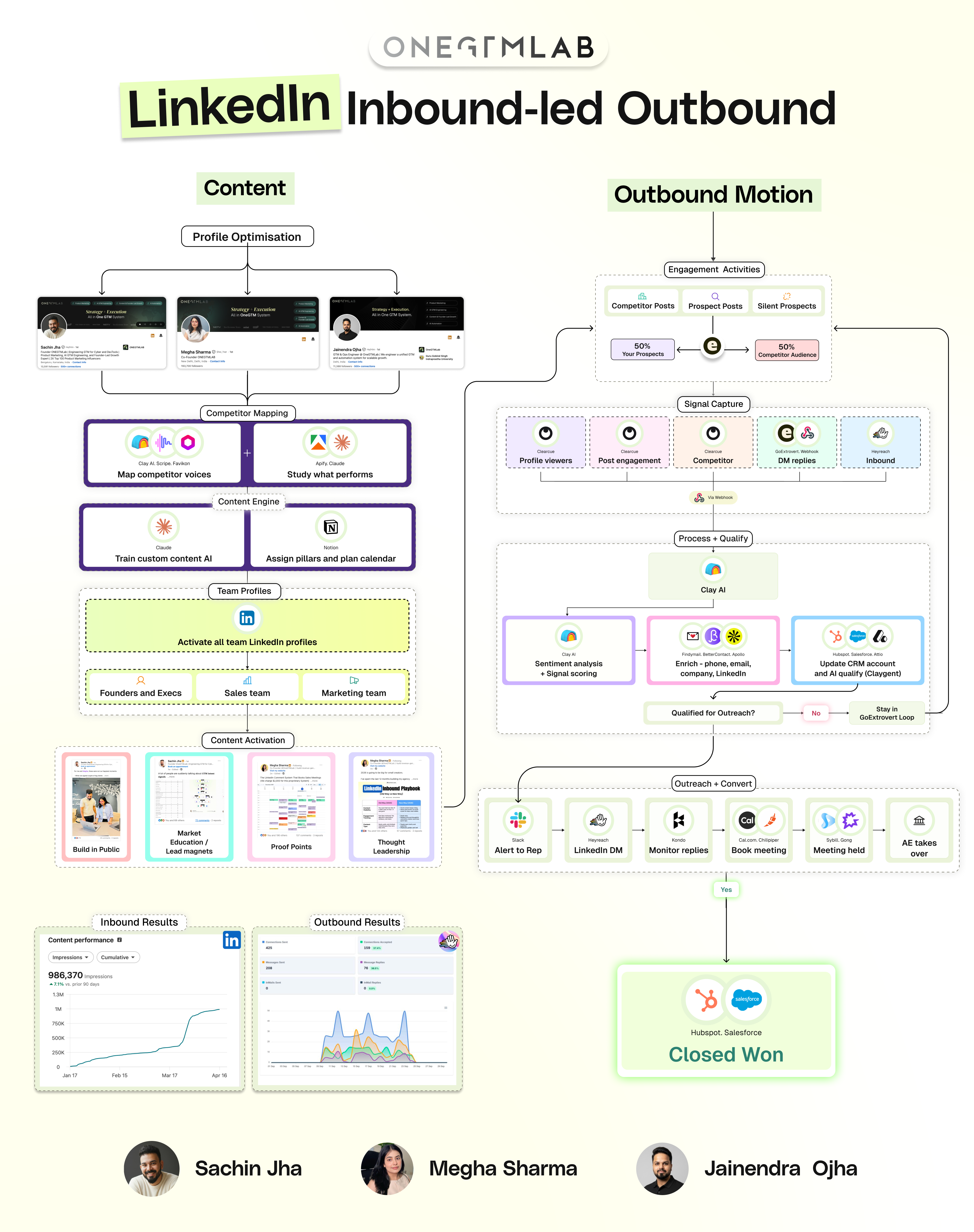
The graphic above is a map, not a manual. Every step in it is already documented.
Where a box needs detail I will link to the post that carries it rather than repeat it here.
Read it as two halves that meet in the middle. The left half creates signals and the right half responds to them.
Nothing on the right fires without something on the left.
The left half: content that creates the signal
The content side exists to produce behaviour we can see, not impressions we can report.
Profiles before posts
It starts with the profiles. Mine, Megha’s, Jainendra’s, and every founder and exec at the company, all optimised and posting.
Team profiles are then activated in three groups: founders and execs, the sales team, and the marketing team.
A signal can land on any of them.
Mapping the market before writing a word
Before the calendar exists, we map competitor voices using Clay, Scripe and Favikon.
Then we study what actually performs using Apify and Claude.
The engine itself is a custom content AI trained in Claude, with pillars and calendar assigned in Notion. The build is documented in How To Build A LinkedIn Content Engine Using Claude Code.
The four buckets we post in
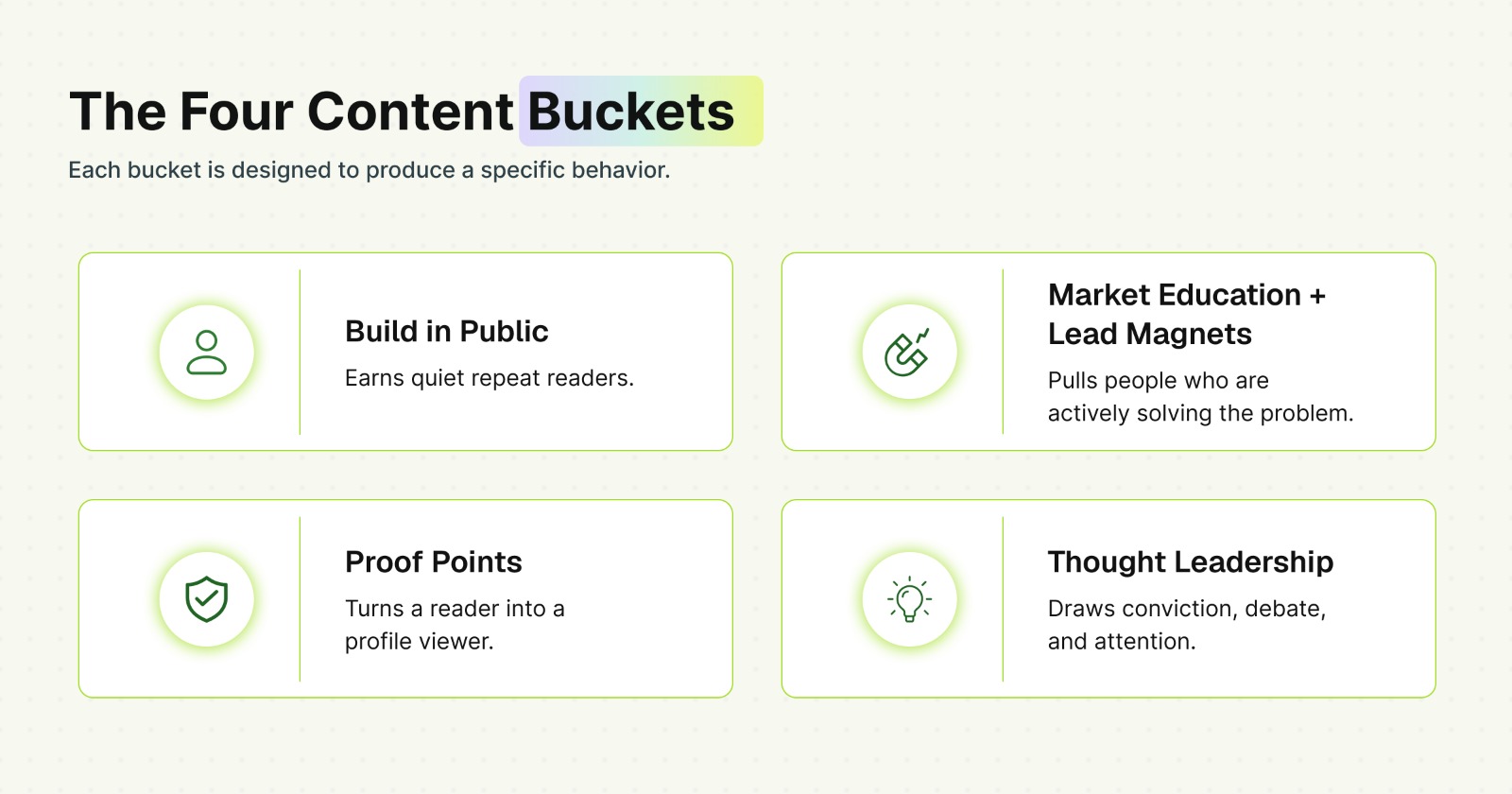
Everything published sits in one of four buckets, and each one earns a different kind of attention:
- Build in public. Work in progress, decisions, misses. This is what earns the quiet repeat readers
- Market education and lead magnets. Frameworks and teardowns that pull people actively solving the problem
- Proof points. Numbers, results, receipts. This is the bucket that converts a reader into a viewer of a profile
- Thought leadership. Positions we are willing to defend, including unpopular ones
The full content operation, including the roadmap, the design system and the repurposing loop, is in The Automated LinkedIn Content Distribution System.
The join: content creates the signal, the signal triggers the outreach
This is the part I have never written down properly, and it is the only piece of this system that is genuinely new here.
Content does not generate leads for us. It generates behaviour.
Behaviour is captured as a signal, and the signal is the only thing permitted to trigger outreach.
Three things follow from that, and they are worth sitting with:
- No content, no signal, no outbound. The content is not awareness spend sitting beside the sales motion. It is the input to it
- The audience the content attracts sets the ceiling on the outbound. Write for the wrong reader and the signals arrive from the wrong people
- Volume is capped by real interest. We cannot decide to send 5,000 requests this quarter. The system will not produce the names
Capture runs across a small stack. ClearCue watches profile viewers, post engagement and competitor engagement.
GoExtrovert and a webhook catch DM replies. HeyReach handles the inbound side.
Which behaviours are worth capturing at all is a longer conversation, and we covered the library in 25 B2B Buying Signals Sales Teams Can Turn Into Pipeline.
.jpeg)
The right half: outbound that only responds
Once a signal exists, the outbound side is mechanical.
That is deliberate, because judgment belongs at the capture stage, not the send stage.
Engagement activities run first across competitor posts, prospect posts and silent prospects.
That is split evenly between our own prospect set and competitor audiences, through GoExtrovert.
Processing and qualification happen in Clay. Sentiment analysis and signal scoring first, then enrichment through Findymail, BetterContact and Apollo.
Then a CRM update and AI qualification through Claygent into HubSpot, Salesforce or Attio.
Conversion is a short chain. A Slack alert to the rep, a LinkedIn DM through HeyReach, replies monitored in Kondo.
Then a meeting booked in Cal.com or Chili Piper, Sybill or Gong on the call, and AE handover.
Every tool in that chain, and the reasoning behind each choice, is set out in Intent-Based LinkedIn Outreach: The Workflow For 2026. I am not going to restate it here.
What happens to accounts that never qualify
They are not discarded, and this is where a lot of outbound programmes quietly leak value.
An account that does not clear the qualification bar goes back into the GoExtrovert loop.
We keep showing up in their feed and engaging with their posts.
Some of those accounts qualify six months later on their own timing. The loop is patient in a way a sequence never is.
All of which is easy to describe and harder to prove, so here is what it produced.
What the numbers actually look like
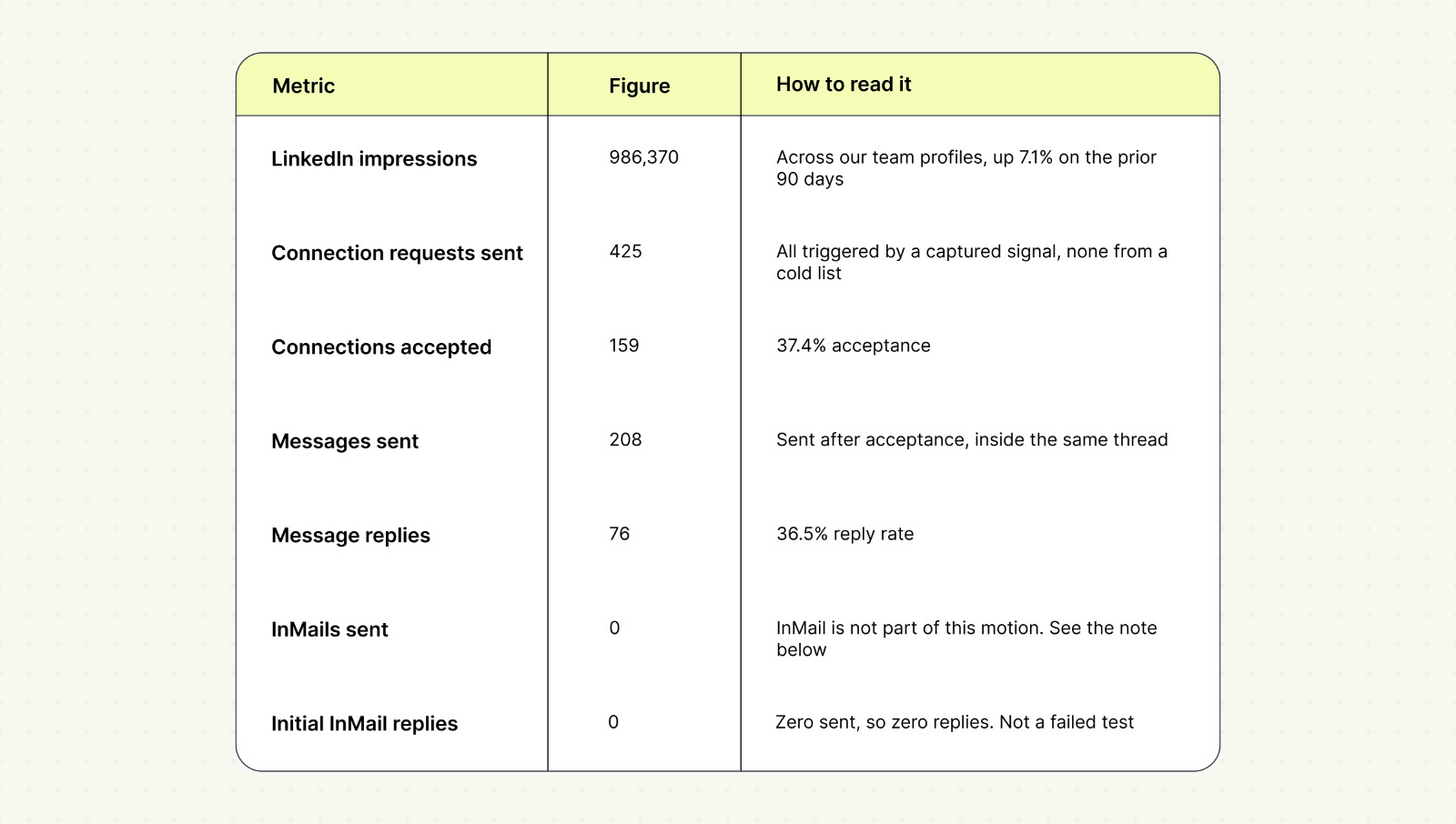
These are platform analytics from our own team profiles, not a study and not a client case.
Read them as one account set over one window. The impressions figure covers roughly 17 January to 16 April.
The outbound figures cover the same motion on the same profiles.
Source: LinkedIn analytics and outbound dashboard, ONEGTMLAB team profiles, January to April.
Two notes so nobody has to guess
The denominators matter more than the percentages.
159 of 425 and 76 of 208 let you check the arithmetic yourself, which a bare percentage never does.
The InMail rows read zero because we do not send InMail in this motion.
The outreach is connection-based and it happens after a signal, so there is nothing to report rather than something that failed.
I am not going to tell you these are extraordinary numbers.
Anyone who knows LinkedIn benchmarks can judge them, and they were produced without a single cold list.
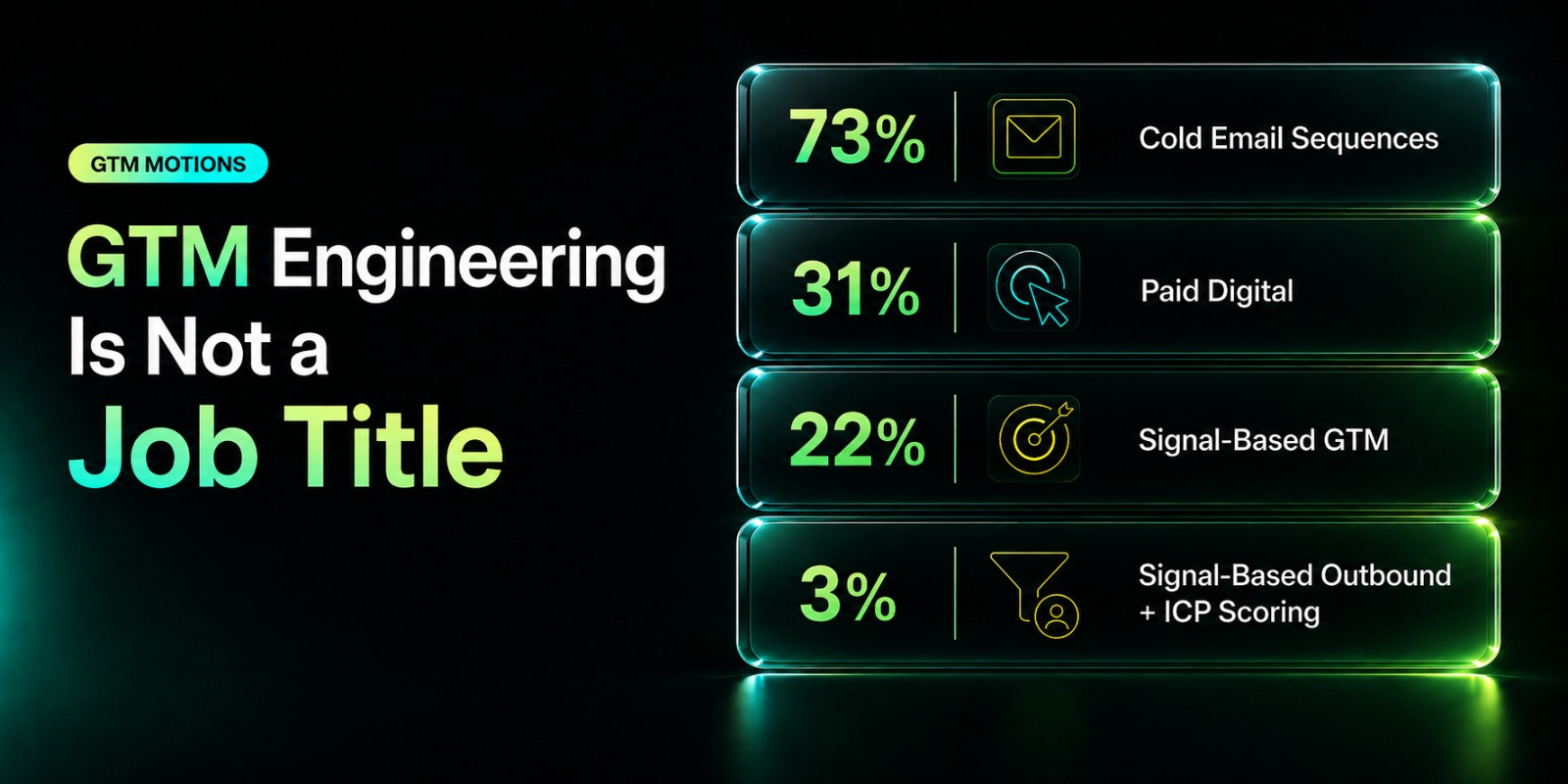
That is the argument we have been making for a while, that signal capture and readiness scoring have to come before the sequence, set out in GTM Engineering Is Not a Job Title.
This is that argument with our own numbers attached.
.jpeg)
.jpeg)
Why we show this to every founder before they sign
Every founder who talks to us sees this workflow before anything is signed. Not a case study version of it, the actual one.
Partly that is a diligence thing. If you are about to hand outbound to an agency, you should see the machine, including the unglamorous parts.
More than that, it is a test we set for ourselves.
A system we would not run on our own pipeline is a system we have no business recommending.
Which is also why the refund was not a hard decision in the end.
The same standard that decides who we reach out to decides who we work with.
If we did not trust it enough to run our own pipeline through it, we would have no business selling it to anyone else.
A few practical questions come up often enough to answer directly, and none of them are covered above.
If you want the system rather than the summary
The outbound half is documented in full in Intent-Based LinkedIn Outreach: The Workflow For 2026, and the content half in The Automated LinkedIn Content Distribution System. Between them you have the manual.
If you would rather have us look at your own signals before you build anything, book a call and bring your LinkedIn analytics. We will tell you honestly whether there is enough behaviour to work with yet.