

I spend a lot of time engineering GTM systems. Signals, scoring, sequences, routing, automation.
The more sophisticated those systems get, the more obvious one uncomfortable thing becomes.
None of them can make a buyer want to move. They can put the right message in front of the right person at the right moment.
The yes still happens somewhere else.
That is why I keep coming back to the psychology of selling. Lead gen is a volume problem. Buying is a psychology problem.
You can engineer the motion, but you cannot engineer the mind.
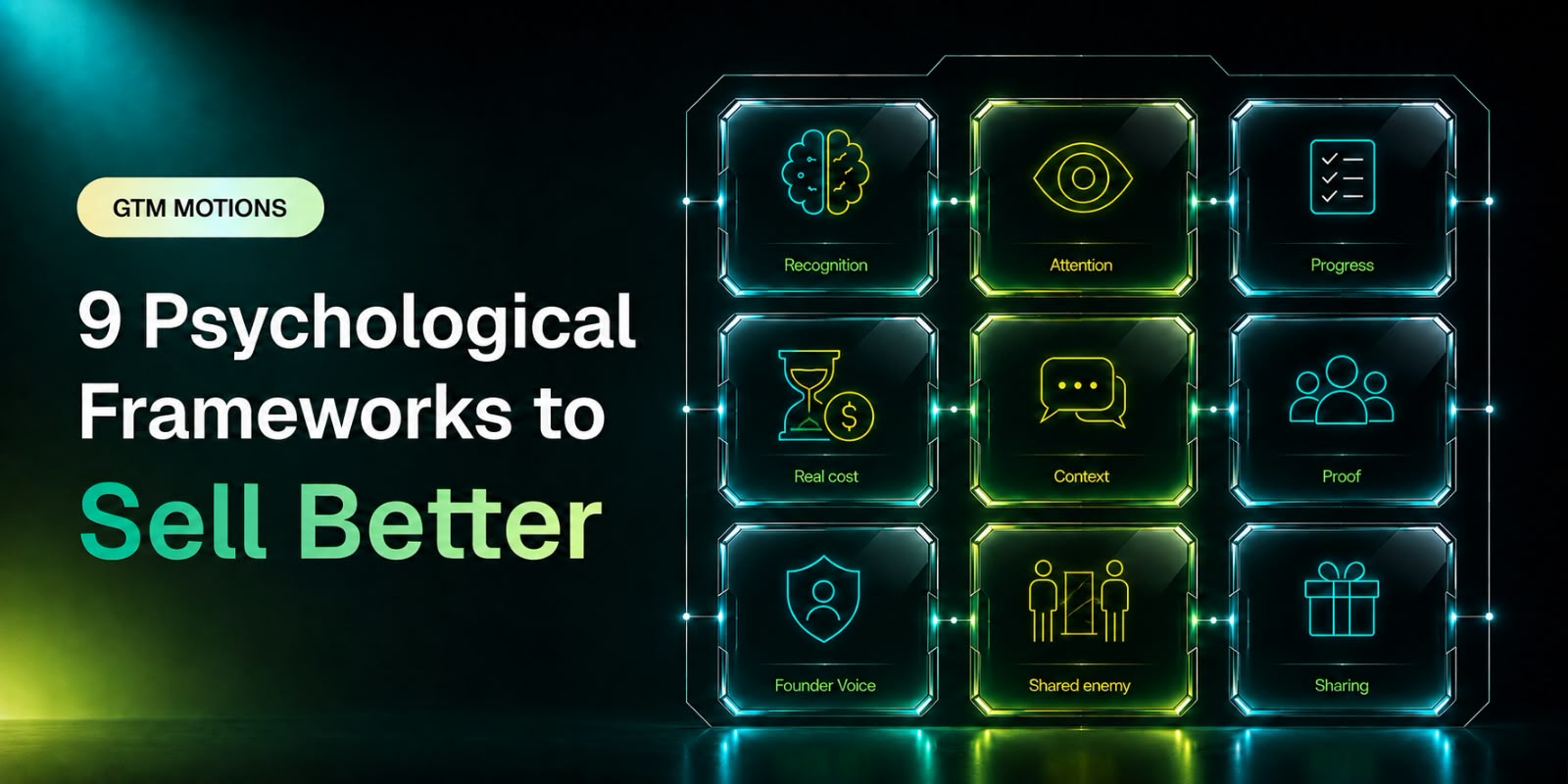
These nine frameworks help explain what happens inside that gap, and how to apply it without turning psychology into manipulation.
Now that the gap is named, it is worth being specific about why it matters more than the stack.
Why This Matters More Than Your Stack
I run a GTM engineering company, so this argument matters to me.
An engineered motion can capture intent, enrich accounts, route signals and trigger outreach faster than any human team.
But a system can only amplify what is already inside it.
The relevance of the message, the clarity of the problem and the buyer's reason to care.
That is also why GTM tends to fail in the seams. A clean workflow does not fix a vague story.
A high account score does not create urgency. A perfectly timed sequence can still arrive with nothing worth saying.
There is an ethical line here too. Psychology is not permission to invent fear, fake scarcity or pressure someone into a bad decision.
Used properly, these ideas help a buyer recognize a real problem, process the evidence and decide with less friction.
Now that the line is clear, the useful question is not which framework is cleverest. It is where each one helps in an actual GTM moment.
The Nine Frameworks, Applied to B2B GTM
Below we've explained the 9 frameworks in a detailed manner.
1. System 1 and System 2
Daniel Kahneman popularised the distinction in Thinking, Fast and Slow (2011), while crediting psychologists Keith Stanovich and Richard West for the terms.
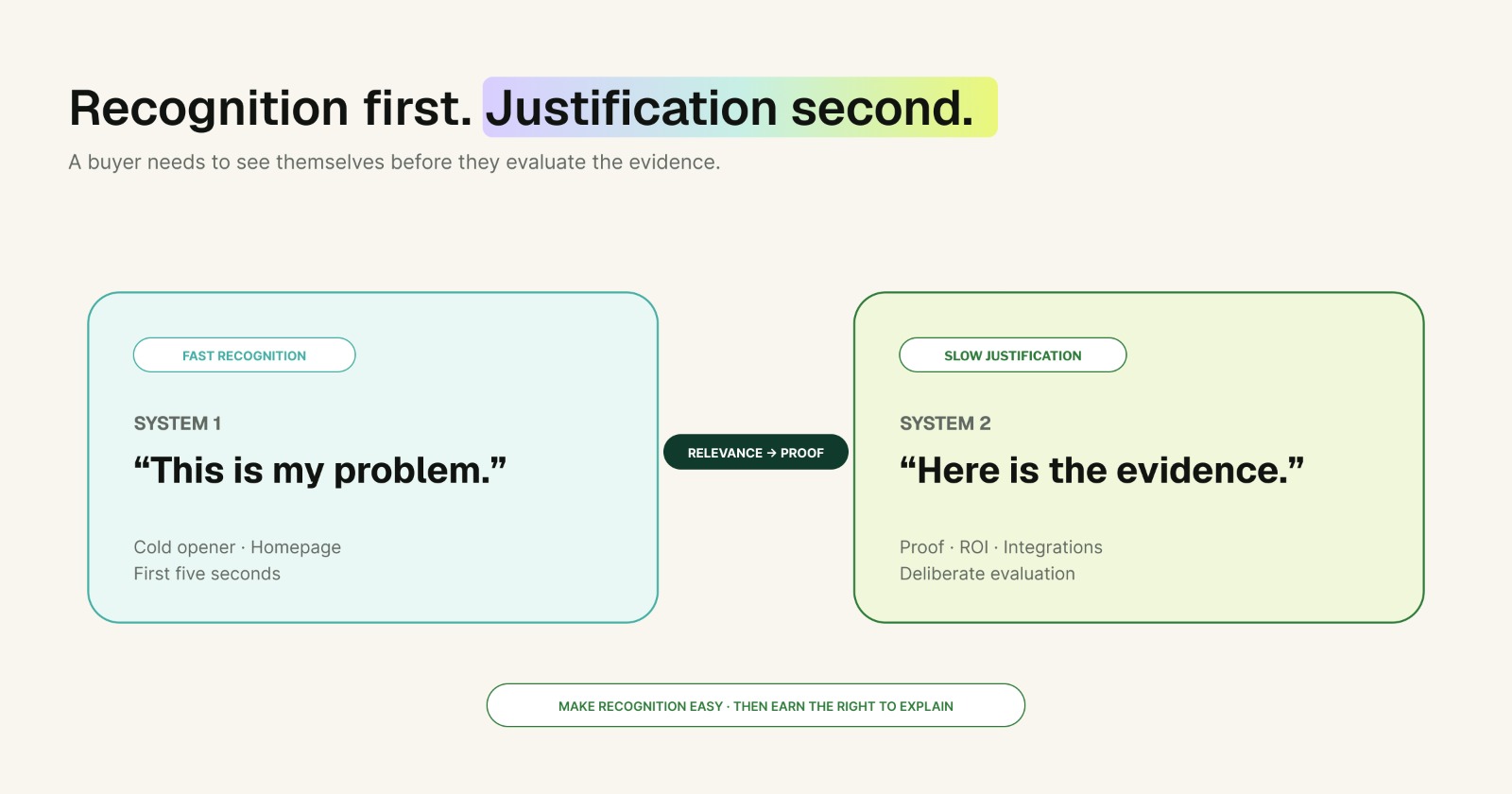
System 1 is fast, automatic and intuitive. System 2 is slower, deliberate and analytical.
In a buying context, that does not mean emotion wins and logic is decoration.
It means relevance is often recognized before a buyer sits down to rationally evaluate it.
Where it shows up in GTM
Think about the first five seconds of a cold opener, homepage or demo.
The buyer needs to recognize themselves quickly enough to keep paying attention, then find enough proof for the slower evaluation.
A strong message gives System 1 a reason to lean in and System 2 a reason to stay.
The mistake to avoid
Teams often lead with the proof before establishing relevance.
They open with architecture, integrations or ROI calculators before the buyer has decided the problem belongs to them.
Make recognition easy first, then earn the right to explain.
2. The Fs of Attention: A Working Checklist
My original post credited this to "Schaffer", but we could not verify a canonical published six-part framework behind that attribution.
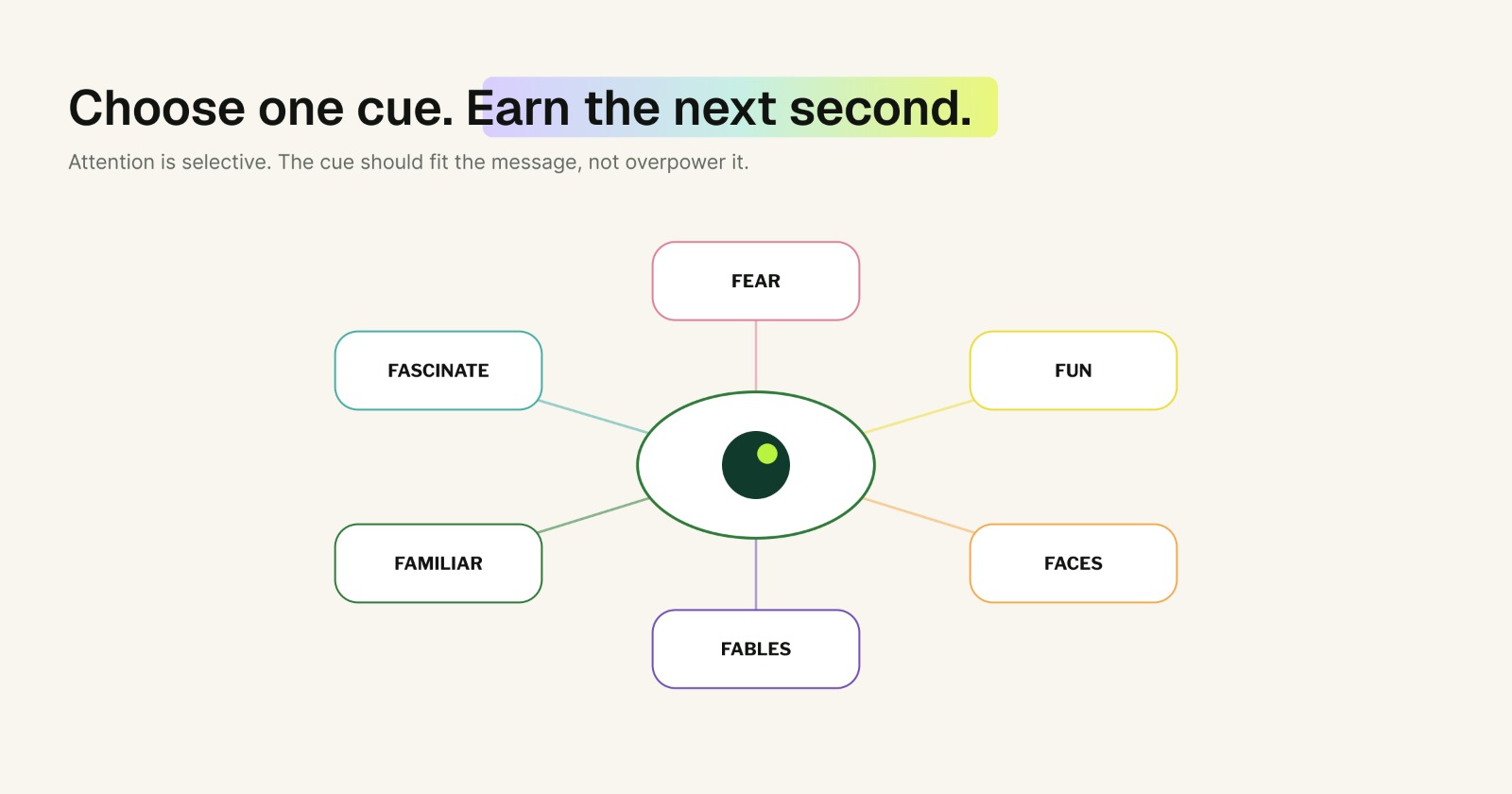
So I am treating it here as a practical ONEGTMLAB attention checklist: Fear, Fun, Faces, Fables, Familiar and Fascinate.
The idea is simple. Attention is selective, especially in a crowded feed or inbox.
A message needs a recognizable cue before the reader gives it processing time.
The cue does not have to be loud. Familiarity, a human face or a strong story can work without becoming clickbait.
Where it shows up in GTM
Use this at the top of a LinkedIn post, email, ad or landing page.
Pick one attention mechanism that naturally fits the message. A founder story may use Fables.
A sharp category observation may use Familiar. A real business risk may use Fear, provided the risk is true and specific.
The mistake to avoid
Do not stack every cue into one piece.
When everything is urgent, surprising, emotional and clever, nothing feels trustworthy.
The job is to earn the next second of attention, not hijack it.
3. Jobs To Be Done
Clayton Christensen popularised Jobs To Be Done in Competing Against Luck (2016), with important parallel development by practitioners including Tony Ulwick and Bob Moesta.
Jobs To Be Done changes the unit of analysis. Buyers are not simply purchasing a product category.
They are trying to make progress in a particular circumstance and hire a solution to help them get there.
That shift moves the conversation from what the product is to what changes after it is chosen.
Where it shows up in GTM
This belongs in discovery, positioning and qualification.
Ask what changed, what is now difficult and what progress the buyer is trying to make.
The same logic is why we do not say yes to every client.
A poor fit is often a mismatch between the job the buyer needs done and the job the offer performs.
The mistake to avoid
Feature-first selling describes the tool before establishing the job.
The buyer then has to translate capabilities into progress on their own.
Do that translation for them. Sell the after, not just the feature.
.jpeg)
4. The Seven Principles of Influence
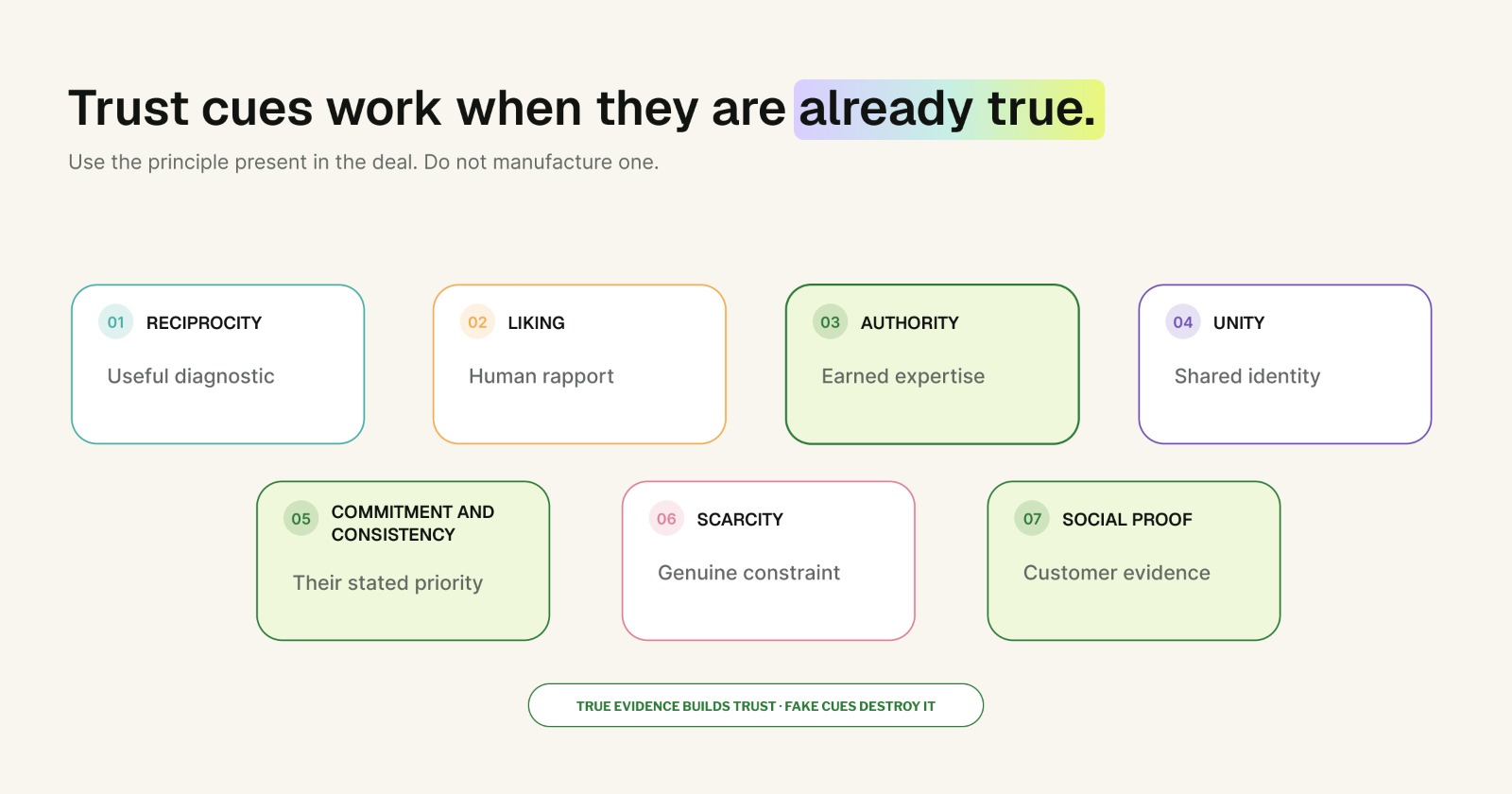
Robert Cialdini's seven principles of persuasion span his work in Influence and Pre-Suasion: Reciprocity, Liking, Authority, Unity, Commitment and Consistency, Scarcity, and Social Proof.
These principles describe common shortcuts people use when deciding what to trust, value or act on.
In B2B, they are already present whether a team names them or not.
A customer reference creates social proof. A useful diagnostic creates reciprocity. A credible point of view can create authority.
Where it shows up in GTM
- Proposal: use relevant customer evidence rather than generic logo walls.
- Founder-led sales: build authority by teaching something useful before asking for time.
- Late-stage deal: use Commitment and Consistency by reconnecting the decision to priorities the buyer already stated.
- Community and category work: use Unity by making the buyer feel part of a credible shared identity.
The mistake to avoid
The principles work badly when manufactured.
Fake scarcity, borrowed authority and irrelevant social proof are trust destroyers.
Use the principle that is already true in the deal instead of trying to manufacture one.
5. Pre-Suasion
Robert Cialdini developed the idea in Pre-Suasion (2016): what receives attention immediately before a request can shape how that request is interpreted.
The practical lesson is not to manipulate the room before the pitch.
It is to understand that context changes meaning.
A pricing conversation feels different after the buyer has quantified the cost of delay.
A demo feels different after everyone has agreed on the workflow that is failing.
Where it shows up in GTM
Use pre-suasion in the setup to a discovery call, demo, proposal or renewal.
Frame the problem first, agree on the evaluation criteria and then make the ask.
When the context is explicit, the buyer evaluates the recommendation against a problem they helped define.
The mistake to avoid
Teams often rush straight to the ask because the meeting is short.
That saves five minutes and loses the frame.
The setup is not administrative overhead. It is part of the sale.
.jpeg)
6. Loss Aversion
Daniel Kahneman and Amos Tversky's prospect theory (1979) established the broader decision framework behind loss aversion.
Losses can carry roughly twice the psychological weight of equivalent gains.
That matters because B2B sellers love the upside. Faster growth. More efficiency. Better visibility.
But a buyer may be more motivated by a concrete loss already occurring.
Revenue leaking, hours being wasted, risk compounding or a strategic window closing.
Where it shows up in GTM
Build the cost of doing nothing into discovery and the business case.
Quantify the current state before describing the future state.
If the problem costs 30 hours a week or delays a launch, make that consequence visible and let the buyer weigh it.
The mistake to avoid
Loss aversion becomes manipulative the moment the loss is invented.
Do not manufacture urgency. Document the cost that already exists.
The strongest reason to act now is one the buyer can verify themselves.
.jpeg)
7. The Attractive Character
Russell Brunson's Attractive Character concept appears in DotCom Secrets and his broader ClickFunnels teaching. It uses recognizable roles and backstory to make a message feel human.
The four roles are the Reporter, the Adventurer, the Reluctant Hero and the Leader.
This is not academic decision science in the same sense as prospect theory. It is an applied marketing framework.
It is useful because B2B brands still need a human point of view.
People understand a company's expertise faster when they can see who learned it and what they believe.
Where it shows up in GTM
Founder-led content is the obvious use case, but the principle also applies to sales decks and webinars.
The goal is not to manufacture a persona. Pick the role that is already true.
A technical founder who learned the hard way may be the Reluctant Hero. An operator sharing field notes may be the Reporter.
The mistake to avoid
Trying to sound like a thought leader is usually where this goes wrong.
A polished persona without earned experience feels synthetic.
The story works when the role explains why the audience should trust the lesson.
.jpeg)
8. Pick a Villain: The Common Enemy Effect
The "self-serving bias" attribution in my original graphic was not the right mechanism.
A better foundation is social identity theory from Henri Tajfel and John Turner, with the common-enemy idea later used explicitly in marketing frameworks such as Brunson's.
The useful idea is not to pick a competitor and start a fight.
It is to name the shared problem that you and the buyer are on the same side against.
That could be spreadsheet chaos, wasted ad spend, fragmented data or a category assumption everyone tolerates.
Where it shows up in GTM
Use the villain to sharpen positioning, category narrative and founder content.
"You versus us" creates resistance. "You and us versus the problem" creates alignment.
The villain gives the story tension without turning the market into a schoolyard.
The mistake to avoid
Do not make a person, customer group or competitor the villain unless you want the brand to become adversarial.
The safest villains are broken assumptions, wasteful systems and outdated defaults.
Name what deserves to disappear.
9. Why People Share: Social Currency
Jonah Berger's Contagious (2013) describes six STEPPS behind word-of-mouth. Social Currency is the piece that matters most here.
What people share can signal something about who they are.
That changes the content question. The goal is not merely to make something informative enough to consume.
It is to make it useful or distinctive enough that sharing it says something positive about the sharer.
In B2B, that often means helping someone look informed, generous, sharp or ahead of the curve.
Where it shows up in GTM
Build content that can travel inside a company.
A diagnostic, benchmark, framework or uncomfortable observation gives the reader something they can forward with a reason attached.
The best B2B content often doubles as a sentence the reader wishes they had written themselves.
The mistake to avoid
Brands optimize for impressions and forget the identity of the sharer.
If sharing your post makes the reader look promotional or obvious, they will not do it.
Give value first, then give the reader a reason to attach their name to it.
.jpeg)
Now that all nine are on the table, they become more practical when mapped to the moments where buyers actually make progress.
How the Nine Frameworks Stack Across a Deal
There is no universal order, and these are not nine steps in a funnel.
Different frameworks matter at different moments.
The map below helps a team diagnose the psychological job in front of them before reaching for another tactic.
.jpeg)
The practical lesson is simple: diagnose the moment before choosing the mechanism.
If the buyer has not recognized the problem, more social proof is premature.
If they believe the problem but cannot justify action, another attention hook is noise.
Now that the map is in place, the question I hear most often is where a team should actually begin.
What I Would Do First
Start with one real deal, not a workshop.
Pull up a cold sequence, discovery call, proposal or renewal that underperformed and ask where the decision broke.
Then use the framework that addresses that moment.
- If nobody stops to read, start with attention and fast recognition.
- If prospects engage but do not see enough relevance, use Jobs To Be Done.
- If they understand the product but do not trust the case, examine influence and proof.
- If deals stall after interest, quantify the cost of doing nothing and revisit the frame.
- If founder content feels corporate, define the human role and the story behind it.
- If content gets consumed but not shared, ask what sharing it lets the reader signal.
Only after that should you automate the response.
This is the same principle behind choosing the right GTM operating model. Infrastructure is valuable when it amplifies something that already works.
Automating an unresolved decision problem simply helps it fail at scale.
.jpeg)
Now that the starting point is clear, a few practical questions come up that the article above does not answer.
The Hard Part Is Still the Yes
The industry is very good at engineering motion.
We can capture more signals, score more accounts, personalize more messages and automate more of the path to a meeting.
None of that makes the human decision disappear.
You can engineer the motion. You cannot engineer the mind.
Learn the psychology first. Then let the stack scale it.
If your GTM system is working but the yes still is not, ONEGTMLAB can help you find where the decision breaks. Let's talk.