


Six people in one company, six definitions, and the space between them where the work quietly goes missing.
Ask six people in the same company what GTM means. You will get six answers.
I have been running that experiment by accident for ten years, in rooms with a hundred people and rooms with two. It comes out the same way every time.
Nobody in those rooms is lying. Each person is describing the part they can see from where they sit. Which is how go-to-market keeps failing at companies full of people who are individually excellent at their jobs.
Everyone thinks they own it
Ask around the table
- Ask the sales team, and they will tell you go-to-market is what they do. The calls, the pipeline, the deals that close. Hard to argue with someone who can point at a number.
- Ask marketing, and you get the same confidence with different nouns. Campaigns, leads, the website, the demand that makes the calls possible in the first place.
- Ask a product marketer, and they will tell you the strategy is theirs, and that every launch runs through them, which is usually true.
- Ask the product team, and they will look at you like you asked who owns the building they built.
Then there are the two answers from the edges.
The two answers from the edges
- A founder will tell you go-to-market is a hire they will make next quarter, once the round closes.
- A student will tell you it is a job title on LinkedIn, and honestly, that is the most accurate answer in the room.
None of them is wrong. That is the part people miss when they try to settle this argument.
Each one is describing a real piece of a real thing, and the trouble is not inside any of those definitions. It is in the gap between them.
The space with nobody's name on it
GTM does not live in a department. It shows up in the space between departments, and that space usually has nobody's name on it.
You have seen how this looks from the inside. The positioning is genuinely good, and the deck is genuinely beautiful, and the sales team is telling a different story on calls, because nobody sat in the seam and made the handoff happen.
There is no meeting where this gets caught. There is no dashboard for it, no line item, no person whose quarterly review suffers when it goes wrong.
Someone always notices
Someone always notices, though. It is usually a product marketer three months into the job, or a founder at eleven at night looking at a funnel that does not add up.
They can see the seam clearly, and they cannot fix it, because fixing it is not in anyone's job description, including theirs.
That is the strange cruelty of it. The failure is completely visible and completely unassigned. And while it sits there unowned, it is not staying inside the building.
Outside, there is one person trying to follow along
Four teams inside one company end up telling four slightly different versions of the same story. Outside, there is one buyer trying to make sense of all four.
They are not reading your org chart. They are a person with too many tabs open, thirty minutes between meetings, and four other vendors saying similar things.
They do not experience your internal seams as internal. They experience them as a company that does not seem sure what it is.
Buyers do not usually walk away saying the messaging was inconsistent. They walk away saying it felt risky, or they will circle back next quarter, which means the same thing.
Inconsistency reads as uncertainty, and nobody signs a contract with a company that seems uncertain about itself.
I used to think this was a big-company problem, the kind of thing that shows up once you have enough teams to have gaps between them. That turned out to be wrong.
Different budget, same disease
I have watched this at both ends of the size spectrum. Big teams with real budgets and a person in every seat. Small teams with two people and no runway to get it wrong twice.
Same failure, every time
The resources were completely different. The failure was identical.
- Strategy sitting in one place, execution happening somewhere else, and nobody owning the seam between them.
- Workflows broken, messaging fragmented, systems that were meant to talk to each other not talking.
Different budget. Same disease.
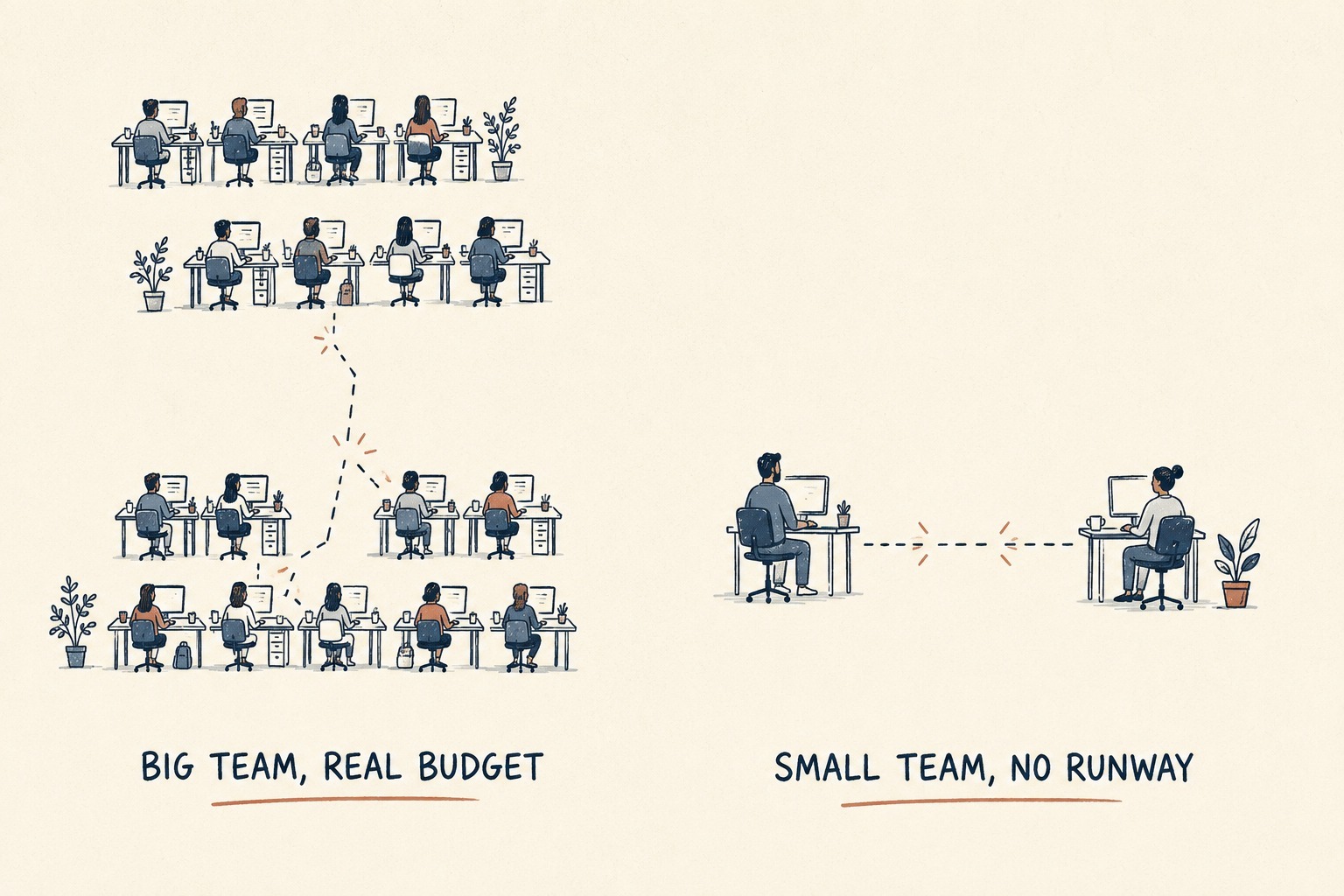
That is when it stopped looking like an execution problem to me and started looking like a structural one.
If money fixed it, the well-funded companies would have fixed it. They have not, and the reason is that you cannot hire your way into a space that has no name.
Building used to be the hard part
There is a reason this is getting louder now rather than ten years ago, and it is not that GTM got harder. It is that everything next to it got easier.
Building used to be the hard part, on either side of the table. A founder can now ship a working product over a weekend. Inside a company, one marketer can stand up a campaign that used to take a full team a month.
So the bottleneck moved. The question is no longer whether you can build it. The question is whether you can get it in front of the right people, tell a story that actually lands, and do it before somebody else gets there first.
That is a hard shift for a lot of good people. If you spent your career being excellent at the thing that used to be scarce, being told the scarcity moved does not feel like progress.
It feels like the ground shifting, and pretending otherwise helps nobody.
.jpeg)
Nobody really knows, and that is not the problem
I am not going to pretend I have the definition that survives contact with every company. Ten years in, I do not think one exists.
GTM is not a department, and it is not a hire you make once the funding lands, and it is not a stage you enter after the roadmap locks.
The map of where it breaks
What I do have is a map of where it breaks. It breaks in the seam.
It breaks when the story lives in one team, the systems live in another, and the person who could connect them does not exist on the org chart.
The better question
So the useful question is not who owns GTM. Everyone in that room of six was going to say they do, and they were all going to be a little bit right.
The better question is where the seam is in your company, and whose name you are willing to put on it.
Because GTM is not a phase. It is an engine, and it has to be running from day one, not day two hundred.
This piece is the argument behind the first video in our new series, where I break down what actually runs that engine.
If you have ever been the person who could see the seam and could not fix it, the rest of this series is for you.

.jpeg)

.png)