

Several skills have to arrive together for anything to move, and that coupling is what makes this decision expensive. Hire for one skill and you get one skill, while a senior role takes two to three months to fill and another three to six to ramp.
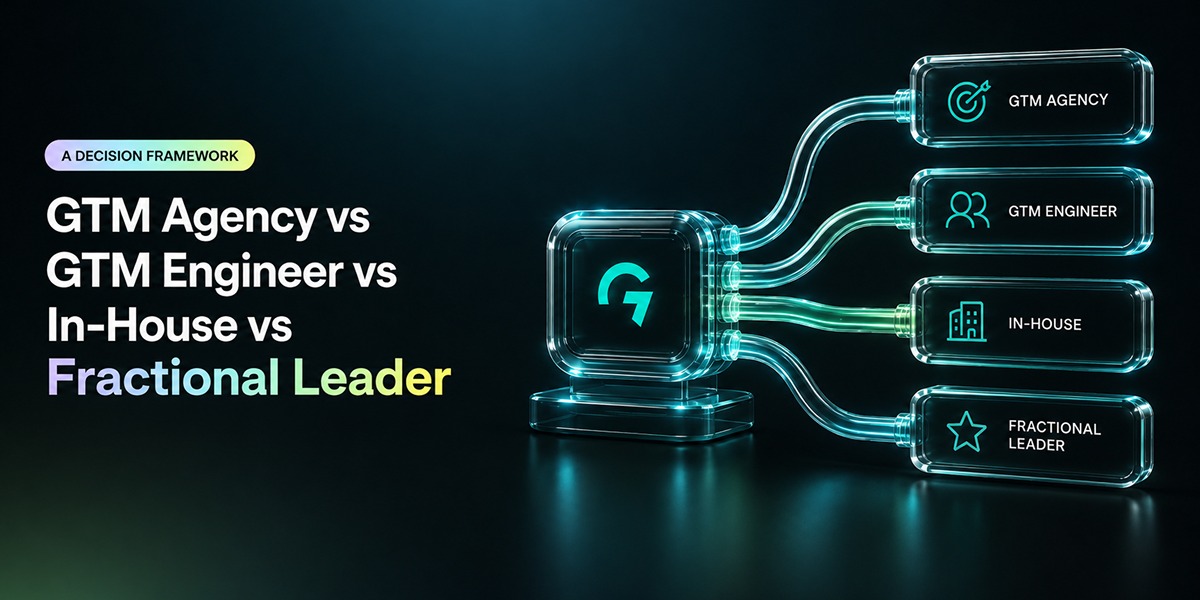
So the honest framing is not GTM agency vs GTM engineer vs in-house vs fractional leader. These four are not competing answers to one question. They are answers to four different questions, and the right move is usually a combination in sequence.
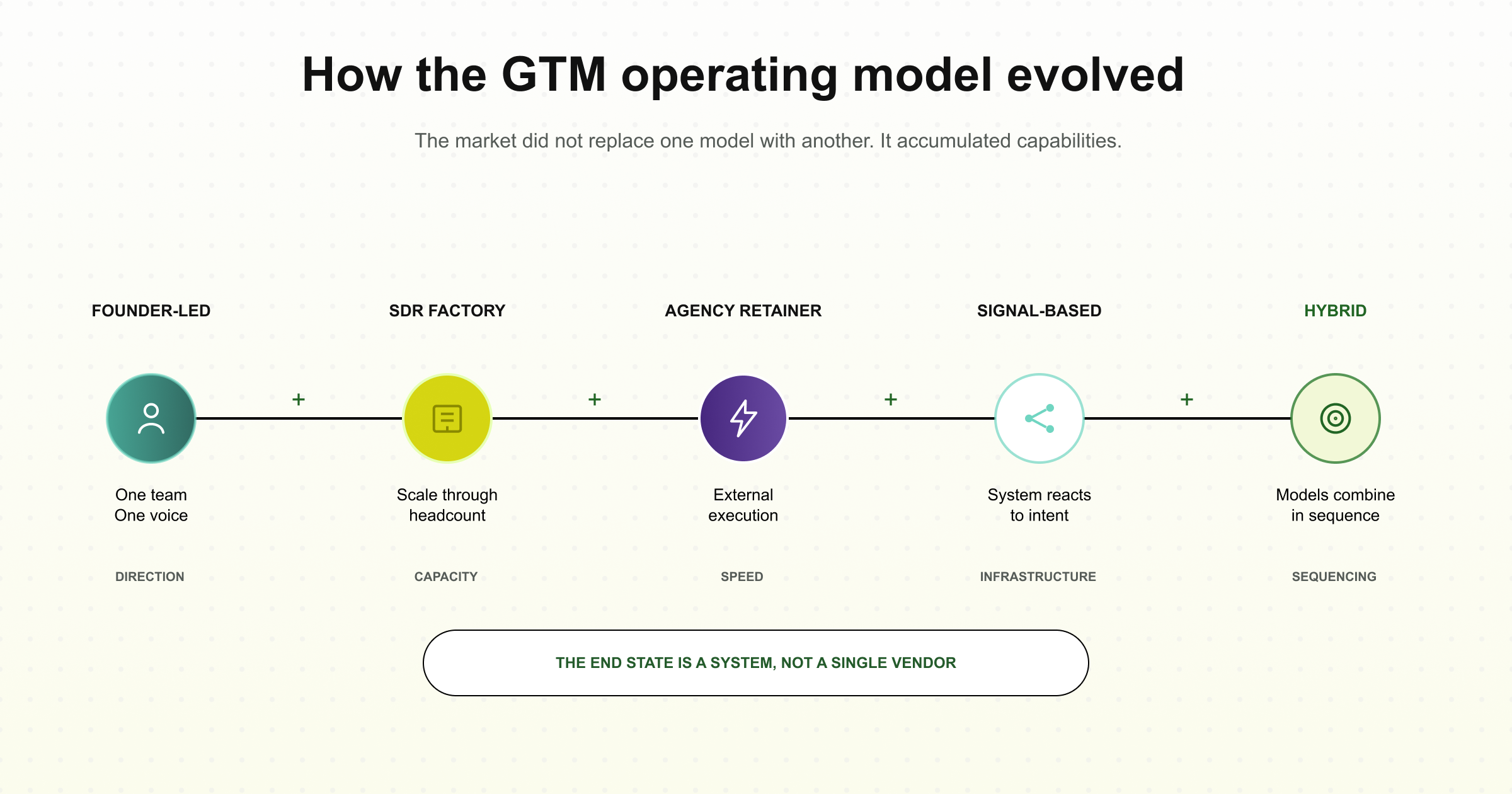
Basically, an agency buys you speed, a GTM engineer buys you infrastructure, an in-house team buys you ownership, and a fractional leader buys you direction. You cannot swap one for another. What follows is how to tell which one your company actually needs right now, and in what order the rest should follow.
Why This Decision Is Expensive to Get Wrong
Every founder I talk to treats this as a budget question. It is a runway question, and the arithmetic is unforgiving.
The Arithmetic of a Wrong Hire
Start with time, not money. LinkedIn Talent Solutions puts average time-to-fill at 42 days, and HR.com’s Future of Recruitment Technologies report puts senior and executive roles at 60 to 90 days, with nearly 40% of senior roles running past 90.
Add ramp to that and the number stops being abstract:
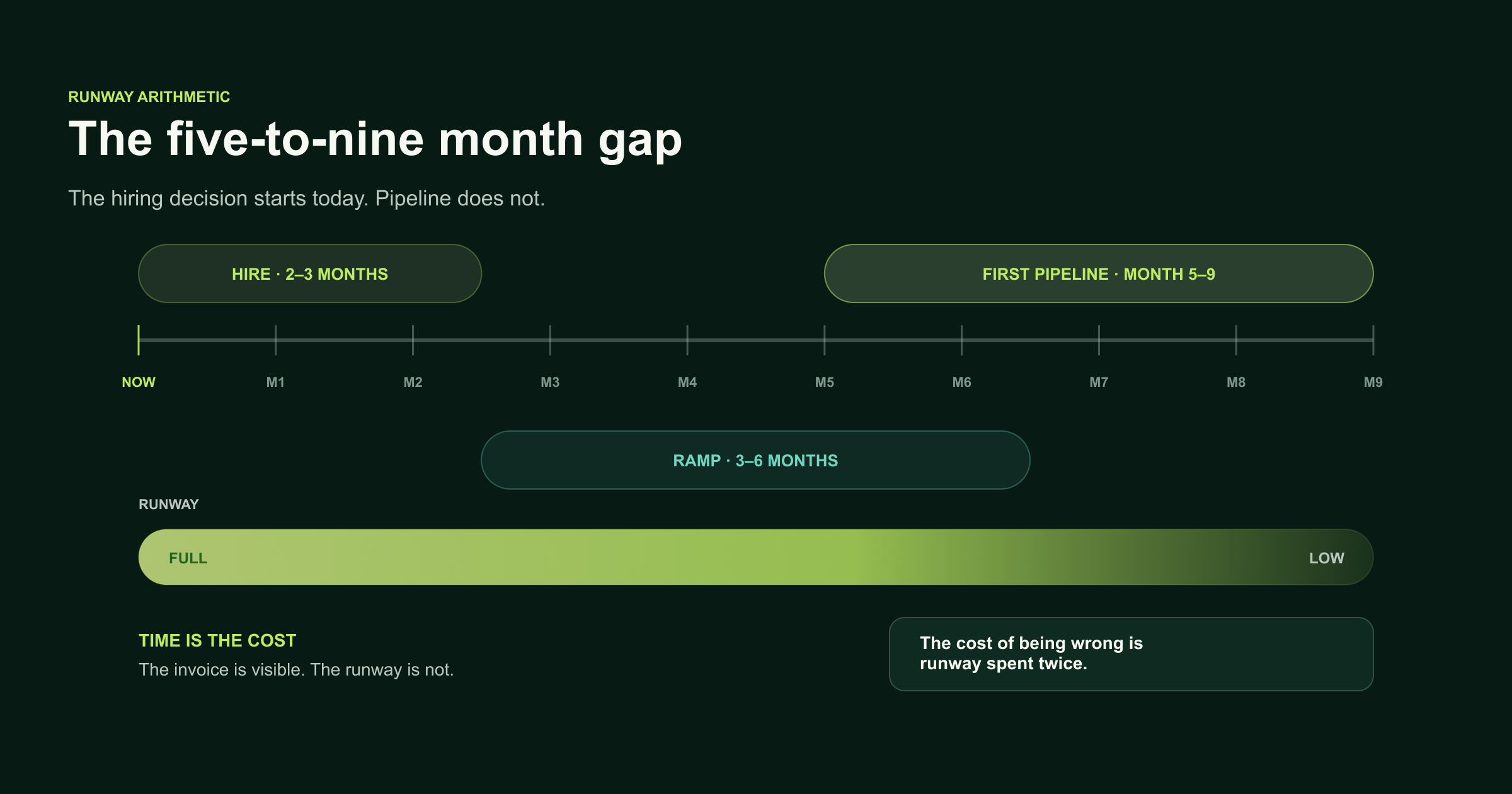
- Two to three months to hire a senior GTM leader
- Three to six months to ramp them into your market, product, and buyer
- Five to nine months before that hire produces first pipeline
That is not a claim. That is addition. If the hire is wrong, you find out somewhere around month seven, and the correction costs the same five to nine months again.
Tenure data suggests the correction is not rare. Spencer Stuart’s CMO Tenure 2026 study, based on 346 named CMOs at S&P 500 companies as of June 2025, puts average CMO tenure at 4.1 years against 5.0 years for the C-suite overall. Only the COO seat turns over faster, at 3.3 years. Thirty-one percent of S&P 500 companies now carry no enterprise CMO at all.
The picture at the front line is similar. The Bridge Group’s 2025 SDR Models & Metrics Report, covering 351 B2B companies, puts median annual SDR turnover at 32%, split 20% voluntary and 12% involuntary, with median tenure around 1.9 years.
And the seat itself is contracting. Emergence Capital’s “Beyond Benchmarks” analysis of 560+ B2B software companies found 36% cut SDR or BDR headcount in the trailing year, the largest reduction of any sales role, while only 19% grew it.
Hiring is not the only thing that changed. The economics of the team you would be hiring into changed too.
Leaner Teams Are Outperforming Bigger Ones
ICONIQ’s State of Go-to-Market 2026 report, a survey of GTM executives at more than 150 B2B software companies, found AI-forward companies running GTM teams 20 to 43% leaner at the same revenue. The gap is widest early:
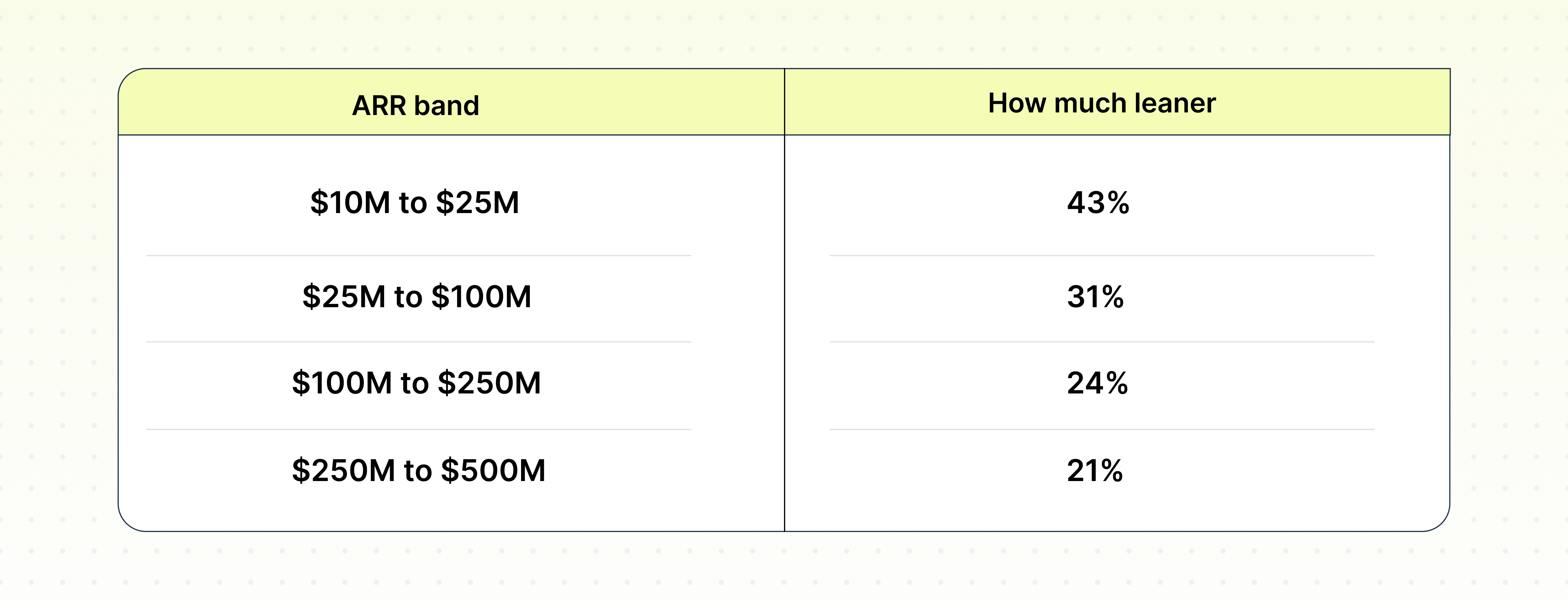
The obvious objection is that leaner might just mean underperforming. ICONIQ answers it in the same report: high-AI adopters post higher AE quota attainment across every segment, 106% against 80% in SMB.
So headcount is no longer the proxy for GTM capacity it used to be. Which changes what “building a team” is even supposed to buy you.
The Market Has Already Picked Hybrid
Founders tend to frame this as in-house or outsourced. The data says the field stopped choosing.
Sagefrog’s 2026 B2B Marketing Mix Report found hybrid in-house plus agency models reached 46% in 2026, up from 36% the year before. Fully in-house fell from 38% to 32%. Fully outsourced fell from 26% to 22%. Sagefrog is itself a B2B agency, so treat it as a self-published survey, but it is the original study rather than a write-up of one.
Both pure plays are losing share to the combination. That is the shape of the answer before we even get to the models.
Your Buyer Changed Too
The last reason this decision is expensive has nothing to do with your org chart.
- Gartner’s March 2026 survey of 646 B2B buyers found 67% prefer a rep-free experience for at least part of their purchase, up from 61% in June 2025
- Forrester’s B2B Buying Study put buyers at 70 to 80% of the journey before contacting sales as of 2019, and the figure has only moved in one direction since
- Research from Responsive, reported by eMarketer, found 38% of B2B buyers use AI to vet and shortlist vendors and 47% use it for market research and discovery
Selling now happens largely before a human is involved. That raises the value of positioning and infrastructure relative to headcount, which is exactly what the four models weight differently.
Before comparing them, it helps to agree on what the words mean.
Key Definitions
Four terms in this piece get used loosely everywhere else, so here is how I use them.
GTM operating model
The organisational design choice for who does your go-to-market work: an external agency, a GTM engineer, an in-house team, a fractional leader, or a combination. It is a design decision constrained by stage, PMF status, and runway. It is not a procurement decision constrained by budget.
GTM engineer
A technical operator who builds and runs the systems that generate and route pipeline. They own data orchestration, enrichment, signal detection, sequencing, automation, and CRM plumbing. They are an infrastructure builder, not a strategist.
Fractional CMO
A senior marketing leader engaged part-time to set direction, audit what exists, and build a roadmap. The role audits and directs. It does not operate tools, and it does not come with an execution layer attached.
Signal-based outbound
An outbound motion where workflows fire when buying signals converge on an account, rather than on a calendar schedule. A funding round alone is noise. A funding round plus a relevant job posting plus a technology change is a reason to reach out this week.
Waterfall enrichment
A data method that queries multiple providers in sequence for the same contact or account field, taking the first valid result and moving on. It raises match rates and cuts wasted spend against any single provider.
With shared vocabulary in place, we can look at each model on its own terms.
Model 1: The GTM Agency
An external partner with a pre-built team and tested playbooks, engaged to run a motion you have not built yet.
An agency trades ownership for speed. You give up some control and some institutional knowledge, and in return you skip the hiring cycle entirely.
What You Are Actually Buying
The case for an agency is structural rather than statistical. There are four things you get on day one that you cannot get any other way:
- No hiring cycle. The team exists.
- No ramp period. They have run the motion before.
- Tested playbooks. Refined on companies that look like yours.
- Immediate channel expertise. Learned on someone else’s budget rather than yours.
That last point is the one founders undervalue. Every channel has a tuition cost, and the only question is whose budget pays it.
How Engagements Are Structured
Four commercial shapes cover almost everything in the market:
- Retainer. The common default. Fixed monthly scope, month-to-month by convention.
- Performance. Priced per SQL or per qualified meeting.
- Project. Fixed deliverables, fixed end date.
- Hybrid. Retainer plus a success fee.
Performance pricing gets talked about far more than it gets used. Independent 2026 analyses put performance-based pricing at roughly 10 to 18% of agency engagements, so treat it as an option rather than a norm.
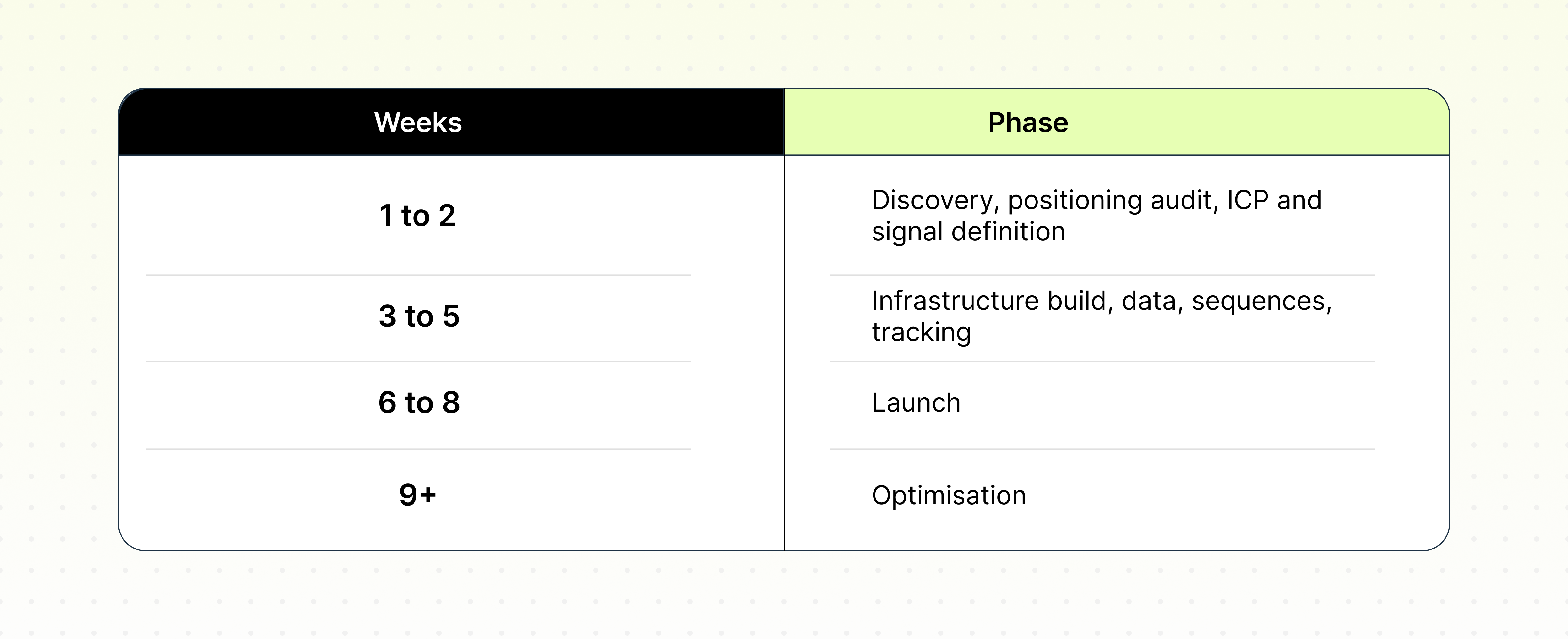
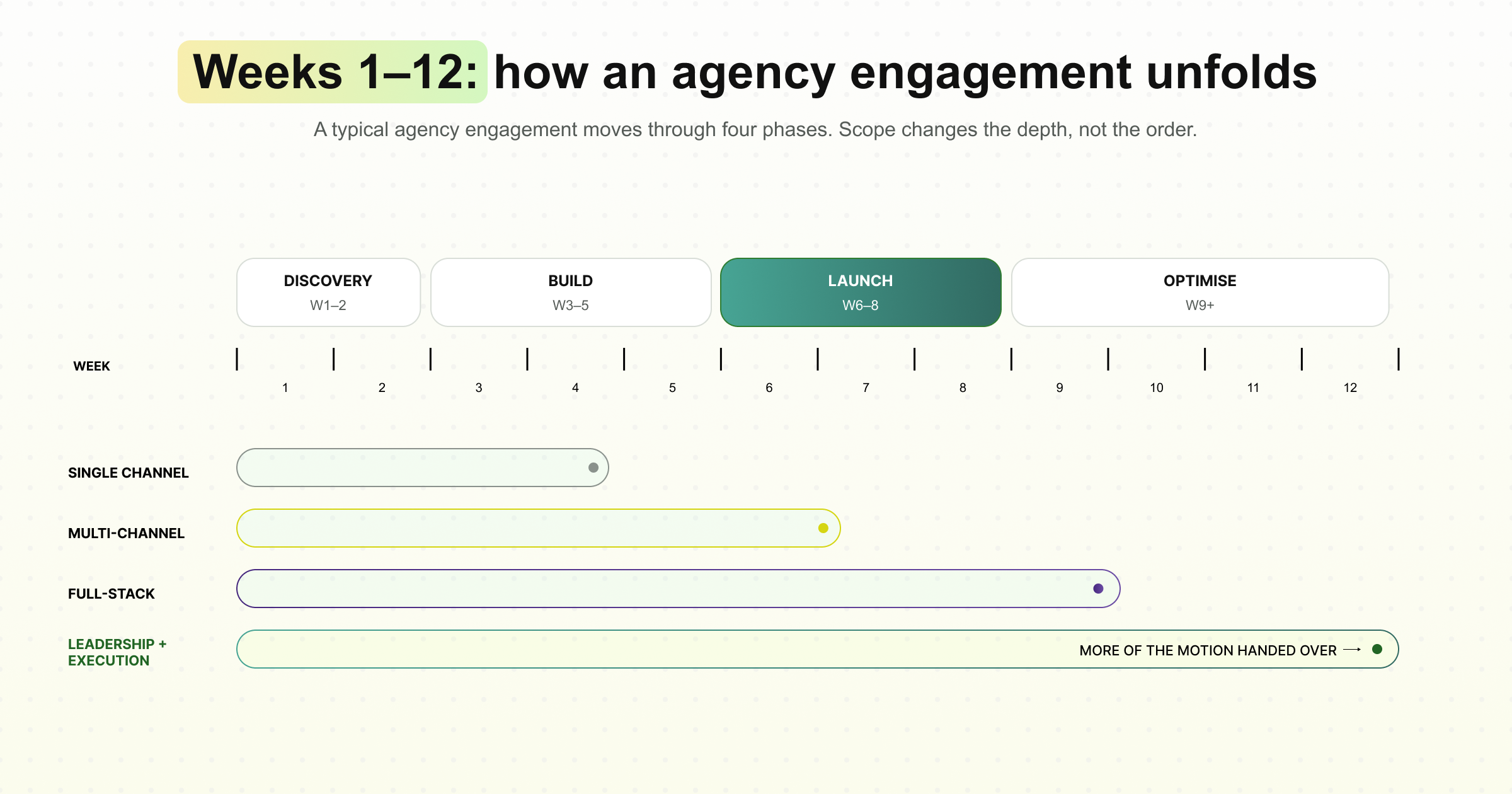
A typical engagement timeline runs to a predictable rhythm:
Investment levels vary by how much of the motion you hand over: entry is single-channel, mid is multi-channel, full-stack is strategy plus execution plus RevOps, and the top end bundles fractional leadership with execution.
Where It Breaks
The failure modes are consistent enough to name:
- Vendor dependency. Institutional knowledge lives outside your company.
- Context switching. Your account is one of several on the team’s plate.
- Retainer inflation. Scope grows more easily than it shrinks.
- The seniority bait and switch. Seniors sell, juniors execute.
There is one mistake that dwarfs those. Buying a single channel and calling it a GTM motion is the most common way an agency engagement disappoints, and it is usually the buyer’s framing rather than the agency’s failure.
Knowing where it breaks makes the fit question easier to answer.
With the trap named and priced, the fit question becomes straightforward.
Best Fit
Seed to Series B, when you are validating a motion or entering a new market and cannot afford nine months of learning. If you already know the motion works and you just need more of it, you are buying the wrong thing.
An agency runs the motion. The next model builds the machine underneath it.
Model 2: The GTM Engineer
A technical operator who builds the data, signal, and automation infrastructure that generates pipeline.
This role barely existed three years ago. Bloomberry’s October 2025 analysis of 1,000 GTM engineering jobs found 205% year-on-year growth in postings, and Clay’s own GTM engineering guide puts roughly 100 new listings live every month.
A growing job category is one thing. What the role actually operates is another.
The Stack
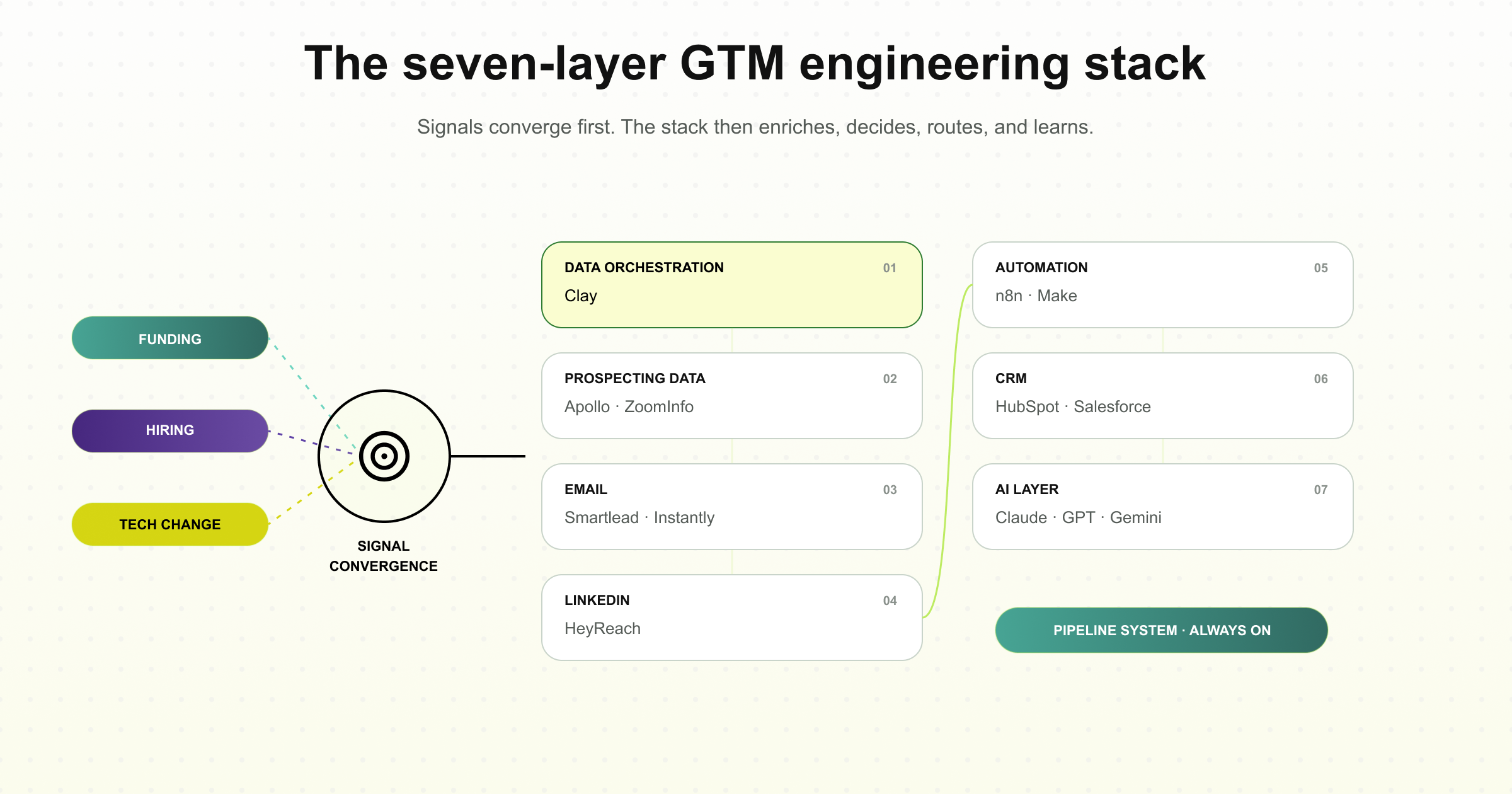
A GTM engineer works across seven layers. Naming them is the fastest way to understand what the role does:
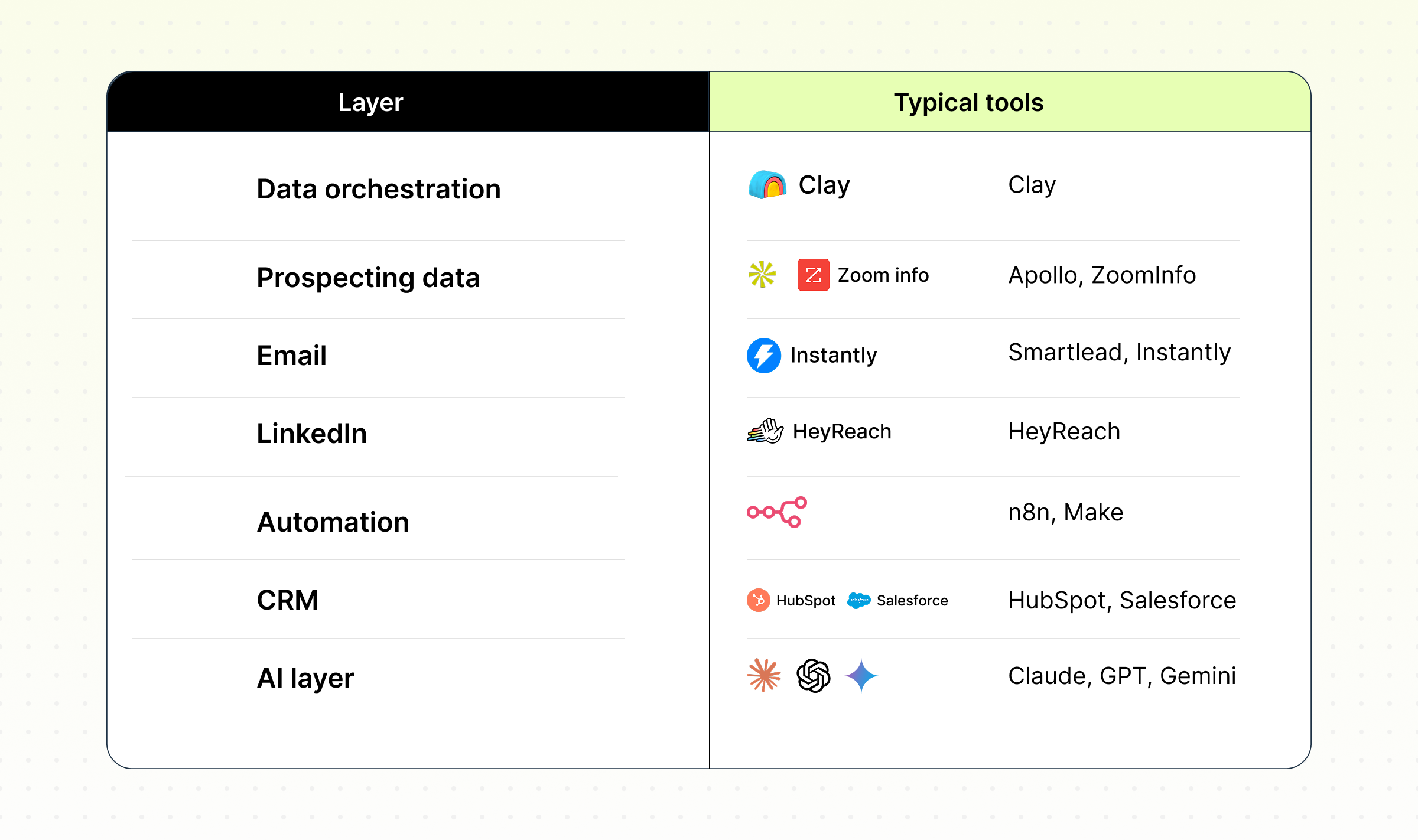
Two rows in the wider ecosystem need a caveat rather than a recommendation:
- Intent and ABM platforms. 6sense and Demandbase are strong products that only start earning their cost at meaningful scale, roughly above $50M ARR. Below that, signal detection is cheaper to assemble than to license.
- Website intelligence. The current options are RB2B, Warmly, and HubSpot Breeze Intelligence. Clearbit Reveal is no longer one of them: HubSpot acquired Clearbit in December 2023, discontinued the free platform and Connect on 30 April 2025, and retired the Logo API on 1 December 2025.
Clay sits at the centre of this stack, and its trajectory explains why the role emerged at all. Clay announced reaching $100M ARR in December 2025 and a $5B valuation via a $55M employee tender offer led by DST Global on 28 January 2026, following a $3.1B Series C led by CapitalG in August 2025, with 14,000 customers and enterprise net revenue retention above 200%. For a worked example of this stack running end to end, our intent-based LinkedIn outreach workflow names every tool at every stage.
The point is not the valuation. It is that an orchestration layer with that kind of adoption creates a job category, and 120+ agencies now sit in Clay’s Solutions Partner directory with seven bootcamps teaching the discipline.
The stack is only the equipment. The method it exists to run is the part that matters.
What Signal-Based Outbound Actually Means
Traditional outbound fires on a schedule. Signal-based outbound fires when conditions converge.
The difference in practice looks like this:
- Schedule-based: send 500 emails on Monday because it is Monday
- Signal-based: reach 12 accounts on Tuesday because each one hired a relevant role, shipped a relevant change, and matched your ICP in the same fortnight
Waterfall enrichment is what makes the second version viable at volume. Clay’s own product page describes waterfall enrichment as routinely tripling customer data coverage and quality, which is a vendor claim about a vendor’s product and worth labelling as such.
If you want the underlying concept before going further, our beginner’s guide to ABM and signals covers which accounts to chase and when, and our 25 B2B buying signals post is the signal library itself. For a worked example of what one of these systems looks like end to end, we mapped 8 stages and 30+ tools into one sequence.
The Positioning Dependency
Here is the rule that decides whether this hire works, and it is not negotiable.
Automation amplifies what is already there. We argued this at length in AI Agents vs AI Automation, and it applies with full force here. A GTM engineer hired before positioning is locked does not fix weak messaging. They industrialise it.
The sequence matters more than the hire:
- Positioning and ICP locked
- Message tested manually against real buyers
- Motion validated at small volume
- Then the GTM engineer builds the system
Skipping to step four is the single most expensive mistake in this section.
Where It Breaks, and Best Fit
The limitations are real and worth stating plainly:
- Single point of failure. One person holds the whole system.
- Technical complexity. The stack is genuinely hard to maintain.
- Steep learning curve. For them, and for whoever inherits it.
- They are not a strategist. This is an execution and infrastructure role.
Best fit is post-PMF, once positioning is locked. You can buy it as a full-time hire or as staff augmentation working inside a week. A common bridge pattern runs agency from months one to nine, hire in months four to six, and hand off at month nine.
Infrastructure is one thing to own. Owning the whole function is another decision entirely.
Model 3: The In-House Team
A permanent team that owns your go-to-market function end to end.
In-house trades speed for permanence. Everything takes longer and everything stays.
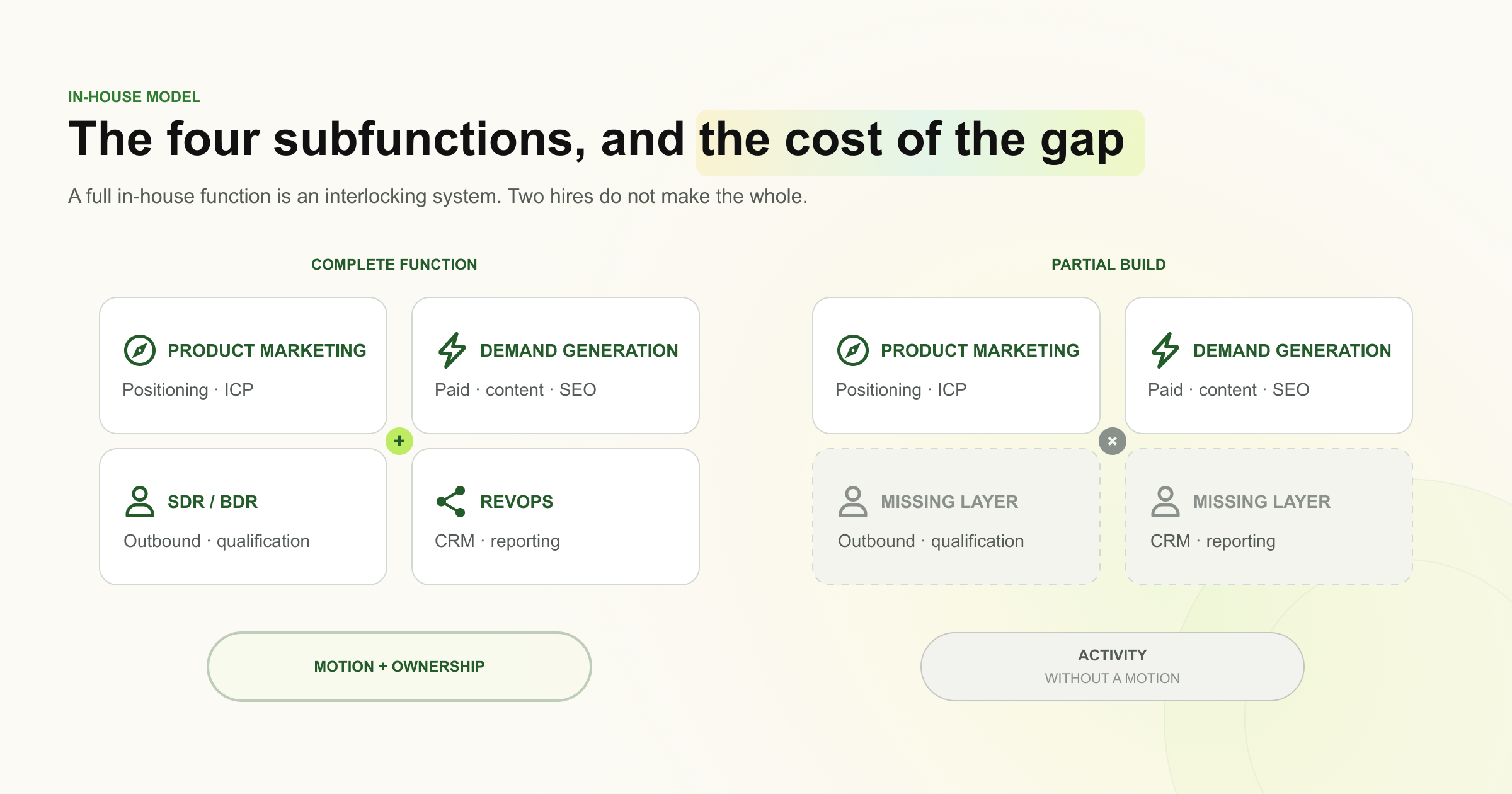
The Four Subfunctions
A complete in-house GTM function has four core parts, and understanding what each owns explains why partial builds underperform:
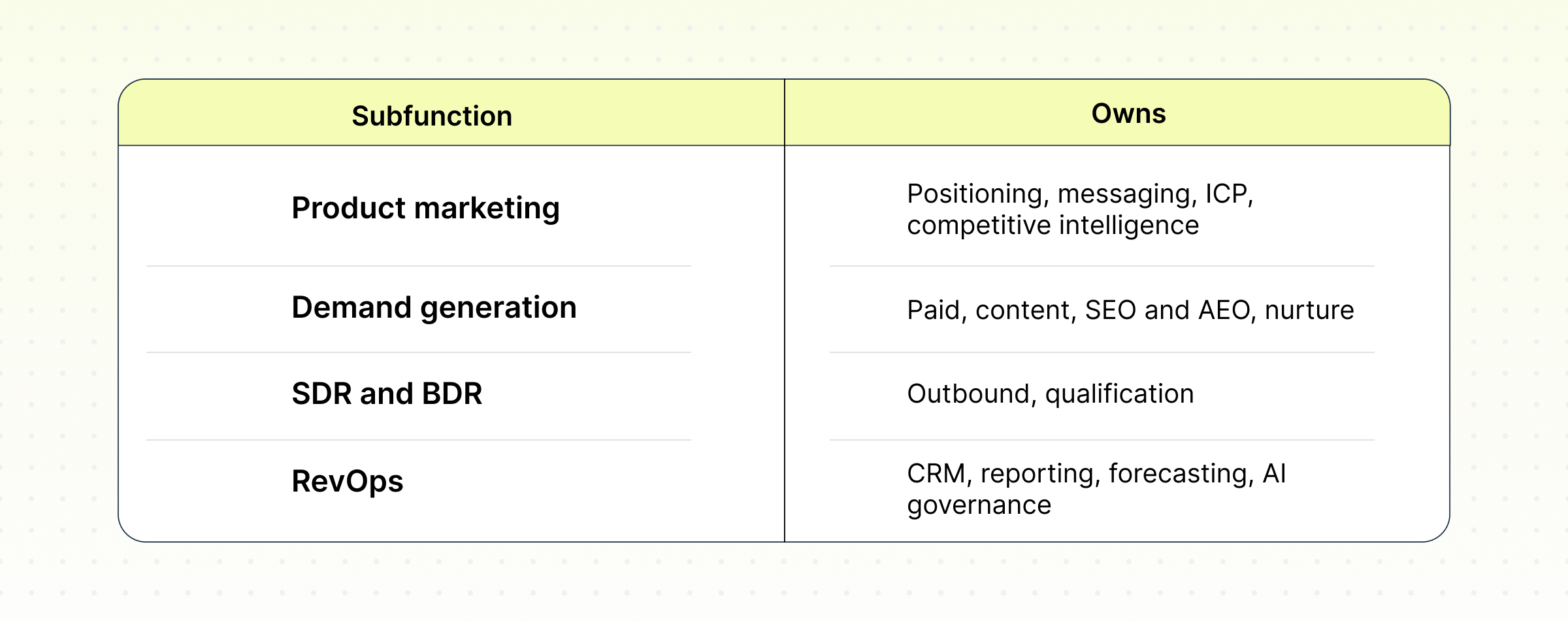
Customer marketing and content or brand arrive later, at scale. ICONIQ’s 2026 data puts typical composition at 45 to 55% sales, 20 to 30% post-sales, 15 to 20% marketing, and 5 to 10% RevOps.
Hire two of the four and you get a team that produces activity without a motion. This is why in-house is not a cheaper agency, and it is also why the cost conversation goes wrong. The gap between them is where go-to-market usually fails, which is a problem we have written about separately in why nobody really knows GTM.
What It Really Costs
Base salary is the number founders model. It is the smallest part of the picture.
The spend has three layers:
- Direct compensation. Base, variable, equity.
- Loaded cost. Benefits, recruiting fees, tooling seats, management overhead.
- Time. Five to nine months from decision to first pipeline, per the arithmetic above.
Time is the layer that never appears in the budget model and always appears in the runway. On tooling specifically, our comparison of legacy GTM tools versus AI-native tools versus Claude covers what the stack itself costs to run. We learned that one on ourselves: our own agency hit $1M ARR in six months and it took eighteen months to deserve it.
Where It Breaks, and Best Fit
The failure mode is singular and consistent: building before the motion is validated. A team hired around an unvalidated ICP will execute confidently in the wrong direction for two quarters.
Best fit is mid-single-digit millions in ARR, with a validated motion and an ICP complex enough that outsiders cannot learn it quickly. Complex ICP is the underrated qualifier. If your buyer takes six months to understand, the case for in-house strengthens considerably regardless of stage.
Owning execution still leaves the question of who sets the direction.
Model 4: The Fractional Leader
A senior GTM leader engaged part-time to audit, direct, and build the roadmap.
Fractional trades execution for seniority. You buy judgment you could not afford full-time, and you buy it without hands.
How the Engagement Runs
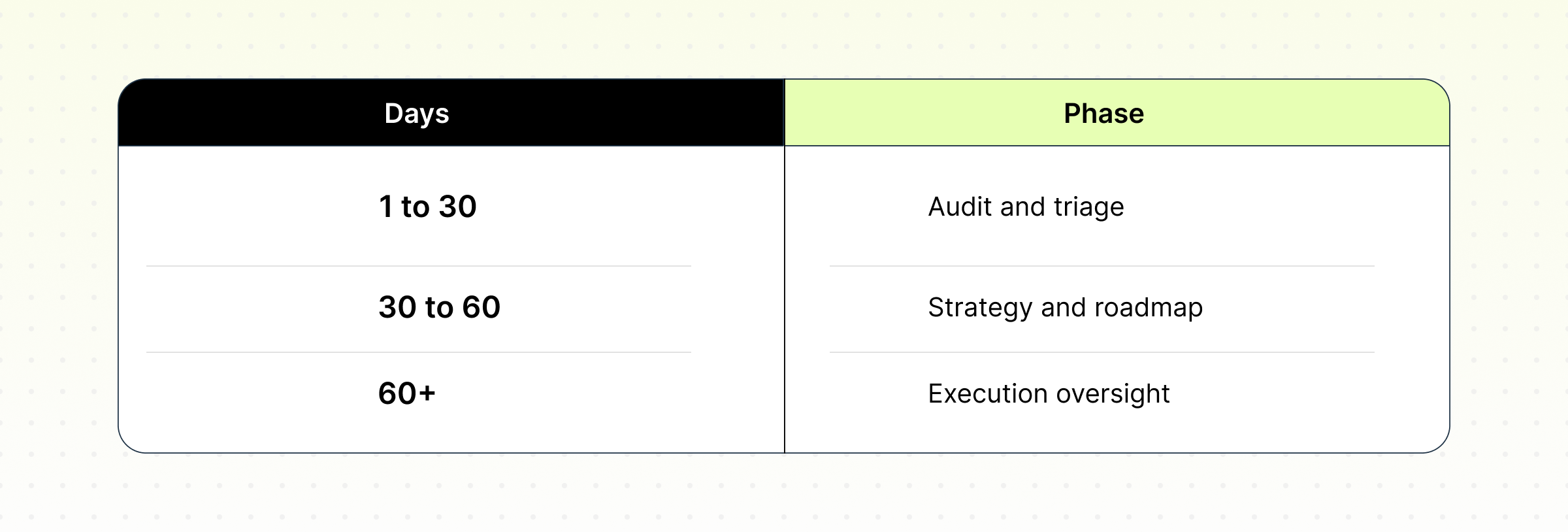
Three phases, with the time commitment stepping down as systems take hold:
The shape of the engagement is consistent. What varies is how senior the person is, and that changes what they will actually touch.
Three Seniority Levels
The title matters more than founders expect, because it determines how close to execution the role sits:
- Fractional CMO. Board-level. Narrative, category, budget, board reporting.
- Fractional VP Marketing. Execution-oriented. Closer to the work, still directing rather than doing.
- Fractional GTM leader. Broadest scope. Marketing plus sales ops plus RevOps.
None of the three operates tools. That is the source of the most common and most expensive misunderstanding in this model.
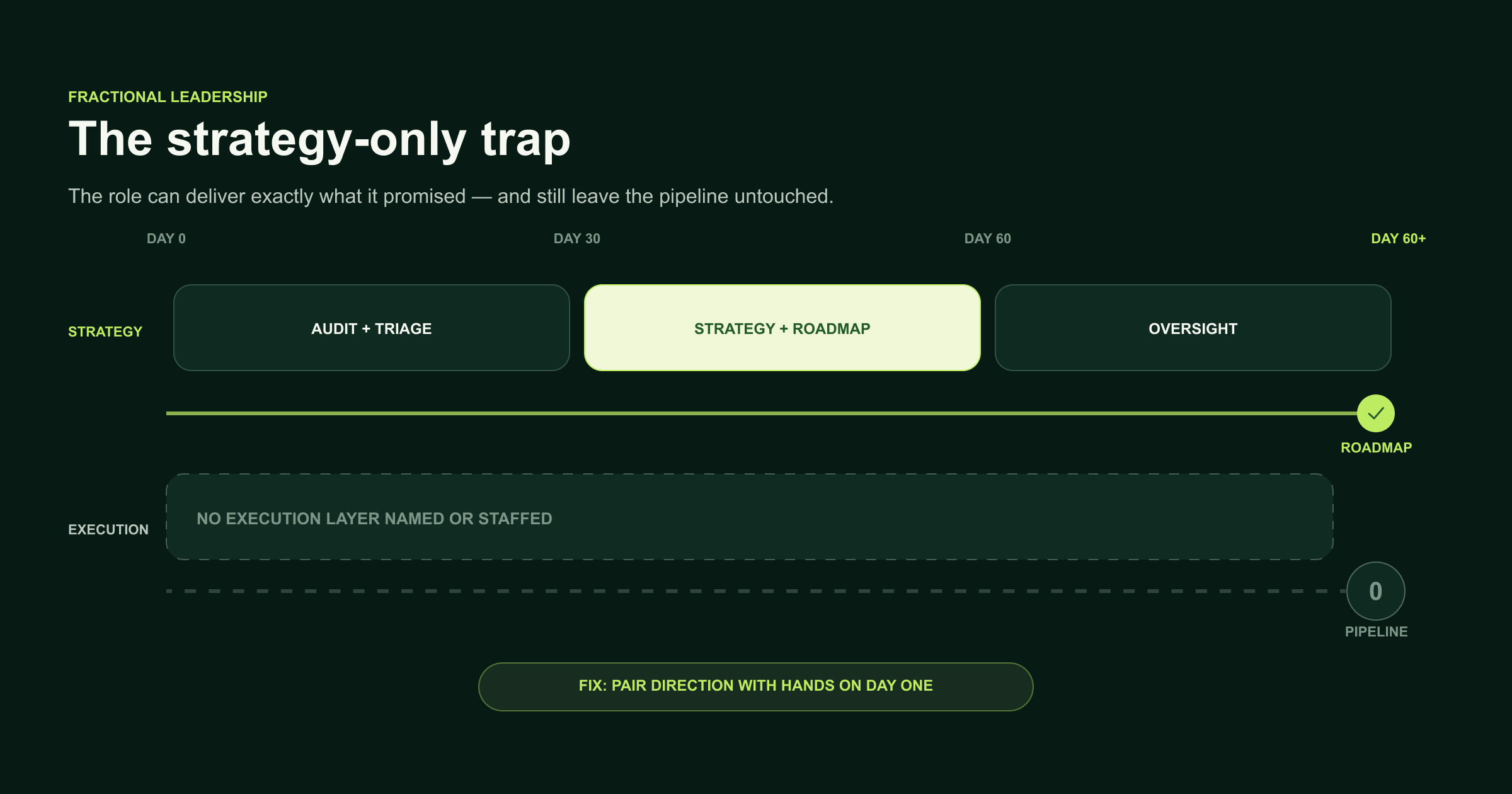
The Strategy-Only Trap
This is the passage I would most like founders to remember.
You hire a fractional leader expecting strategy and execution. Ninety days later you have a considered roadmap, a positioning document, a quarterly plan, and no pipeline. Nothing went wrong. The role was never an execution role, and nobody said it was.
The consequences compound in three ways:
- True cost is a multiple of the retainer once you add the execution layer the roadmap requires.
- Ninety days of runway produce a plan rather than a result.
- Pre-PMF, the trap is worse. The fractional builds a system around an ICP nobody has validated.
The fix is not to avoid fractional leadership. It is to hire it with the execution layer already named, staffed, and budgeted on the same day.
Best Fit
Series B and beyond, with an existing team to direct. Below that, the model works only when paired with execution, which is precisely the hybrid case.
Seen individually, the four models look like alternatives. Side by side, they stop looking that way.
The Four Models Side by Side
This table is orientation, not a ranking. Read the “core trade” column first, because it is the only column that tells you anything about your own situation.
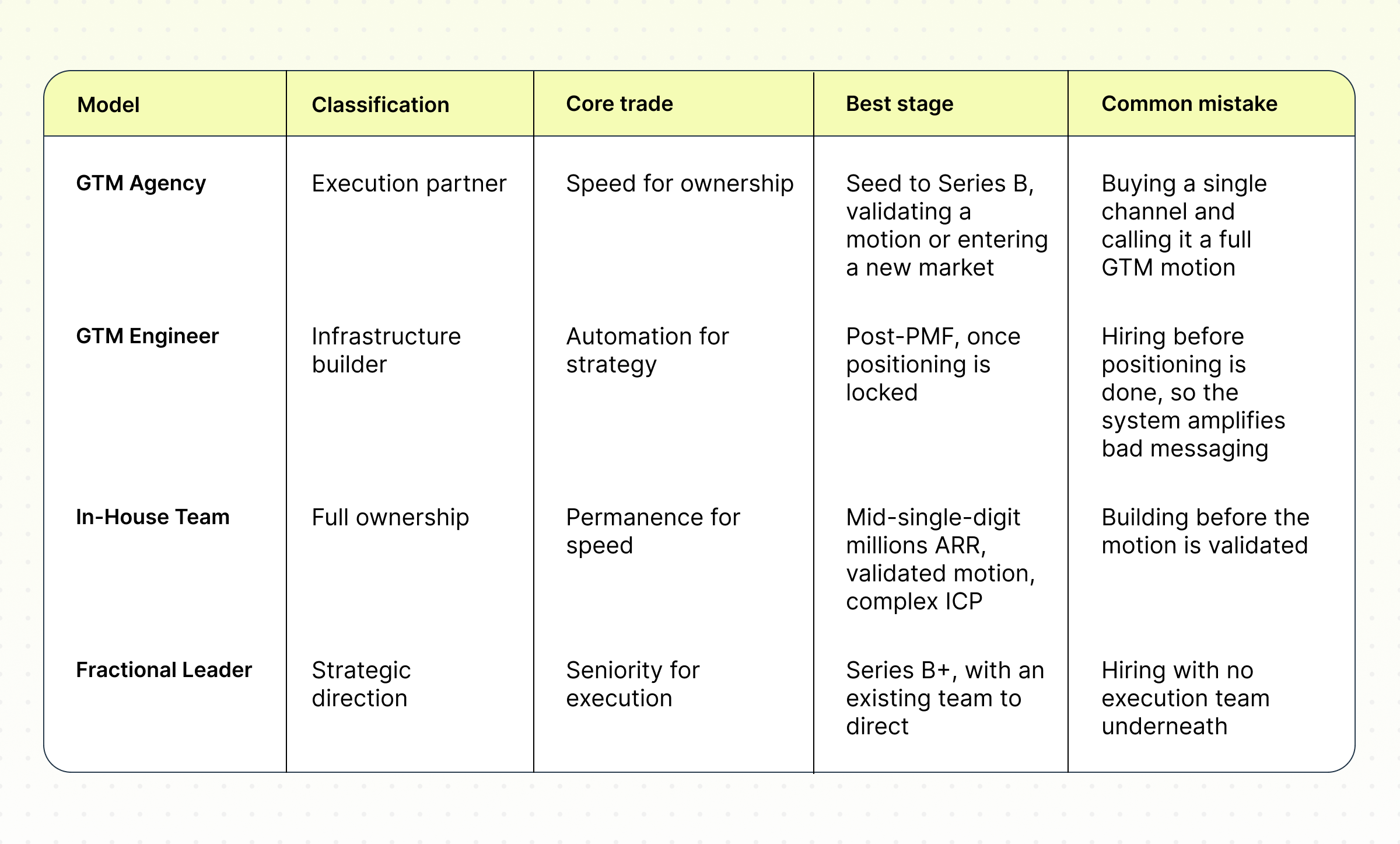
Four different trades. Four different questions. Which brings us to the number that decides most of these calls.
Total Cost of Ownership
The cheapest option on paper is rarely the cheapest in practice.
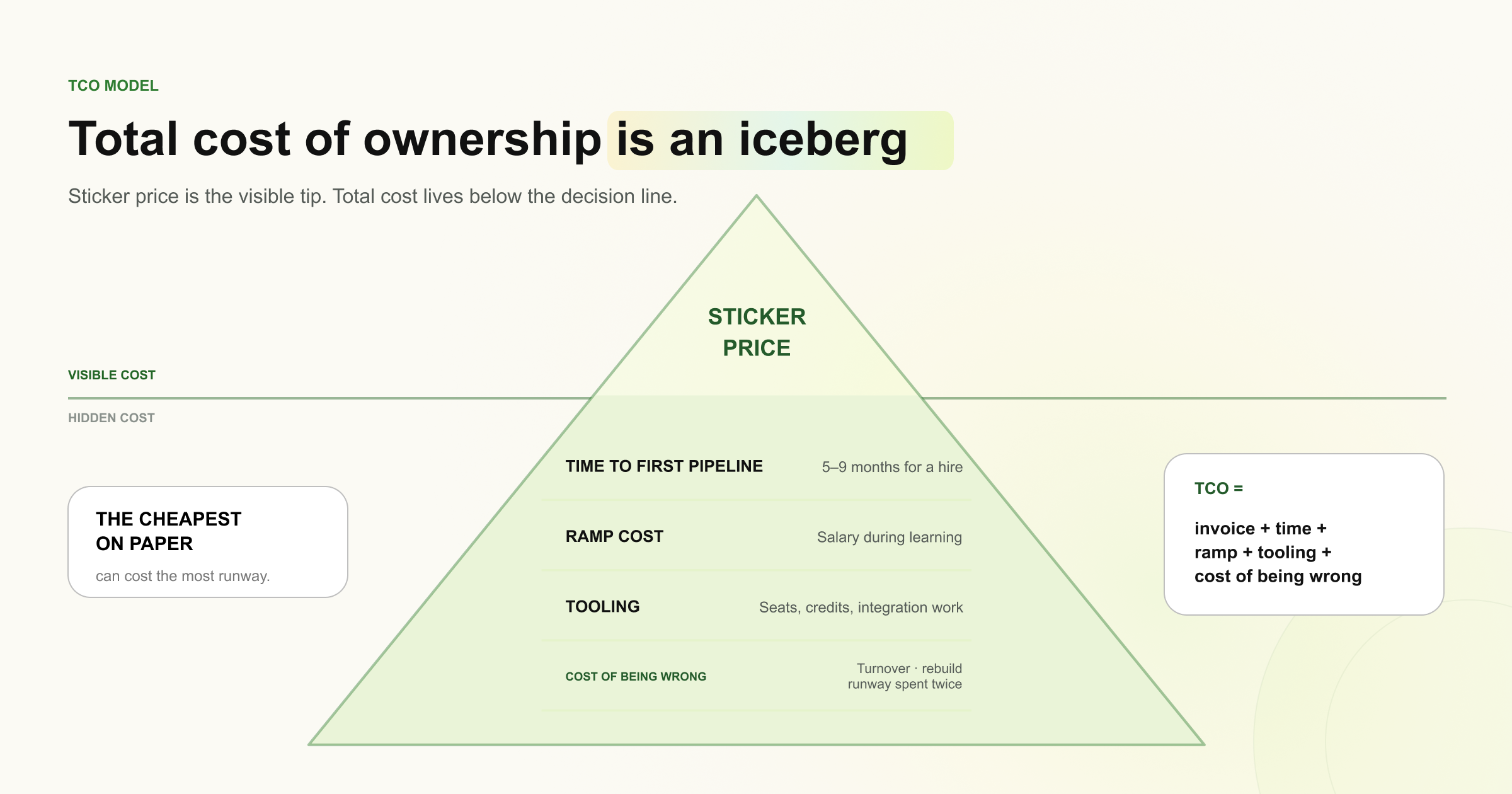
Sticker price is the least useful number in this decision, and I have watched it drive more bad calls than any other input.
What Sticker Price Leaves Out
Four costs sit outside the invoice:
- Time to first pipeline. Five to nine months for a hire, weeks for an agency or staff augmentation.
- Ramp cost. Salary paid during months that produce learning rather than pipeline.
- Tooling. Seats, credits, and the integration work between them.
- The cost of being wrong. Turnover, rebuild, and the runway spent twice.
I have written before about what happens when this gets ignored. We once documented $30,247 a month across 22 tools with zero pipeline coverage, and the diagnosis was not the tools. Stack spend is not strategy, and neither is headcount.
Naming the hidden costs is useful. Pricing them per model is more useful.
A TCO Checklist per Model
Ask these before signing anything:
- Agency: what is the retainer, plus tooling, plus the internal time to manage the relationship, plus the cost of rebuilding if we part ways?
- GTM engineer: what is loaded compensation, plus the stack, plus the risk that this system has exactly one maintainer?
- In-house: what is loaded compensation across all four subfunctions, plus tooling, plus five to nine months of ramp, plus expected turnover at industry rates?
- Fractional: what is the retainer, plus the full cost of the execution layer this roadmap will require?
Run those four honestly and the ranking usually inverts. Which is also why the answer is rarely one model.
Hybrid Models and Sequencing
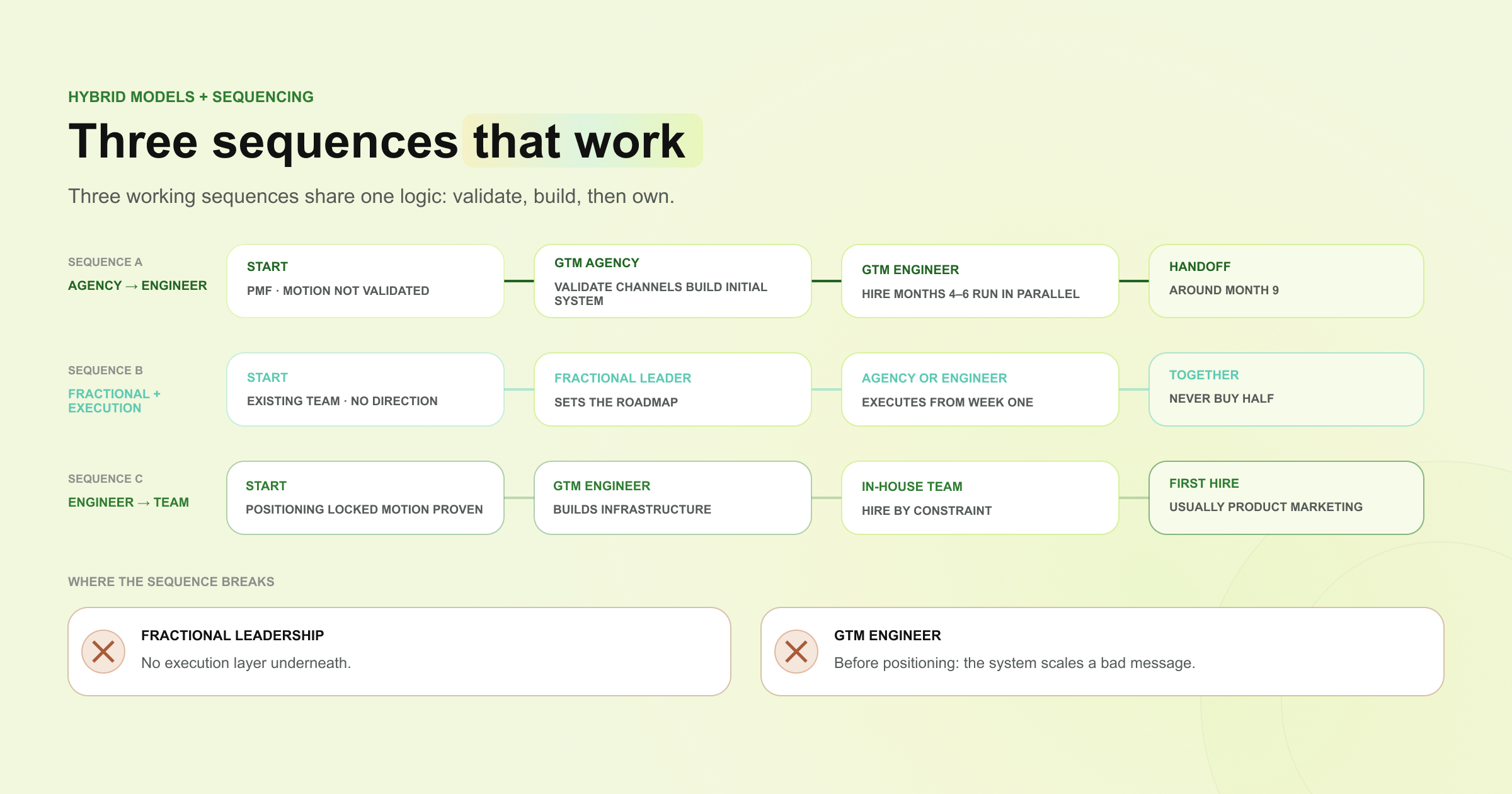
The market already moved here, per Sagefrog’s 46% hybrid figure. The interesting question is not whether to combine, but in what order.
Three Sequences That Work
Sequence A: agency first, then engineer. Best when you have PMF but no validated motion. The agency validates channels and builds the initial system. You hire the GTM engineer in months four to six, run parallel, and hand off around month nine.
Sequence B: fractional plus execution, together. Best when you have a team but no direction. The fractional leader sets the roadmap while an agency or engineer executes it from week one. Never buy the first half of this without the second.
Sequence C: engineer first, then team. Best when positioning is locked and the motion is proven. Infrastructure carries the load while you hire the four subfunctions in order of constraint, usually product marketing first.
Those three sequences share a logic. The failures share one too.
What Does Not Work
Two combinations fail reliably:
- Fractional leadership with no execution layer. Covered above. This is the most common hybrid failure.
- GTM engineer before positioning. The system will faithfully scale whatever message you have, including a bad one.
Sequencing solves for most of it. What is left is a set of beliefs that survive despite the evidence.
Myths Versus Reality
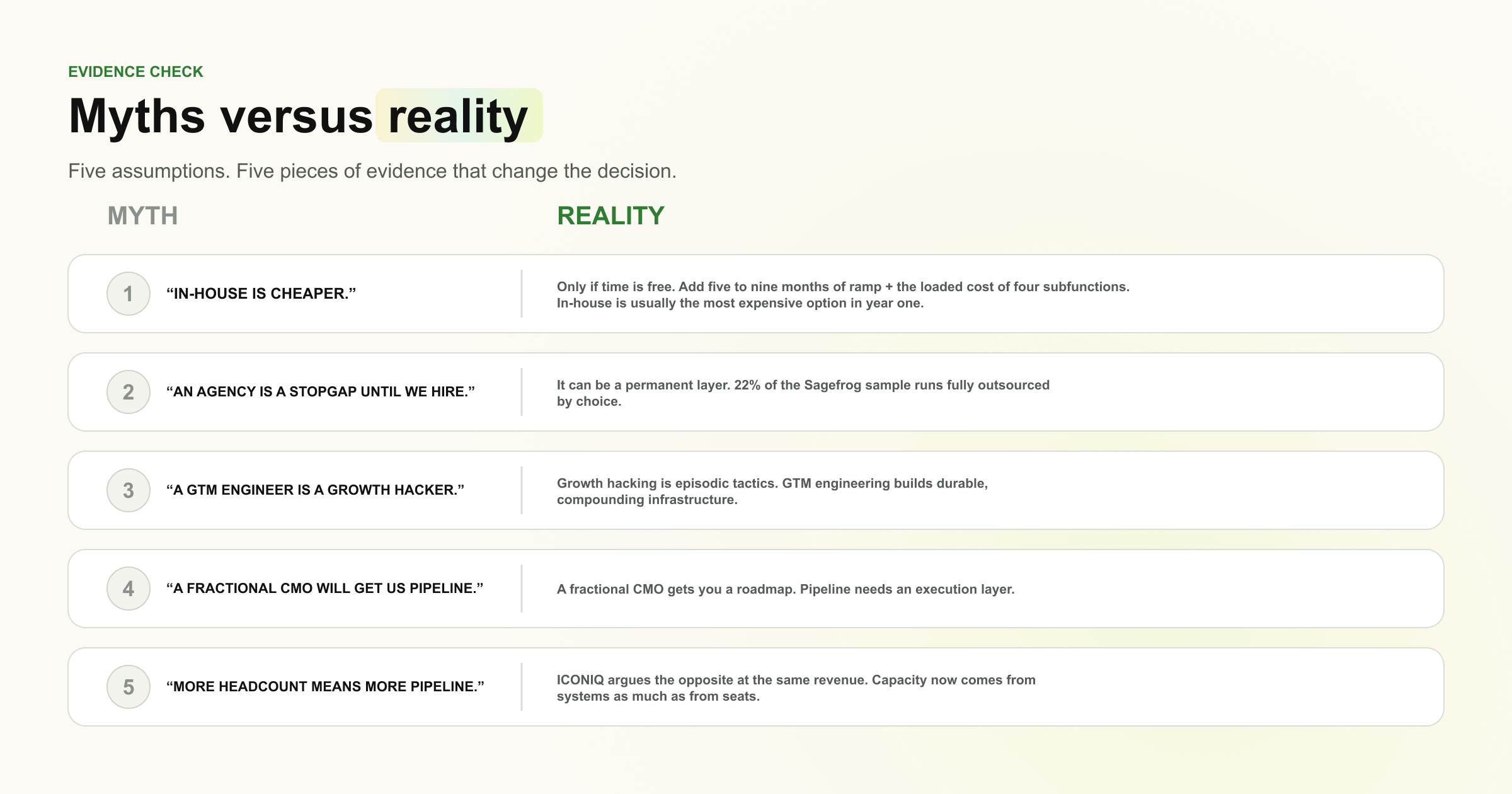
Five assumptions come up in nearly every founder conversation I have on this topic.
1. “In-house is cheaper.” Only if time is free. Add five to nine months of ramp and the loaded cost of four subfunctions, and in-house is usually the most expensive option in year one.
2. “An agency is a stopgap until we hire.” Sometimes. It is also a permanent layer for companies that never want to own a channel, and 22% of the Sagefrog sample runs fully outsourced by choice.
3. “A GTM engineer is a growth hacker.” No. Growth hacking looks for clever tactics. GTM engineering builds durable infrastructure. The first is episodic, the second is compounding.
4. “A fractional CMO will get us pipeline.” A fractional CMO will get you a roadmap. Pipeline needs an execution layer, and hiring the first without the second is the most predictable disappointment in this piece.
5. “More headcount means more pipeline.” ICONIQ’s leanness and quota attainment data argue the opposite at the same revenue. Capacity now comes from systems as much as from seats.
If those are the myths, it is only fair that I state where my own model does not apply.
Where ONEGTMLAB Is Not the Answer
I would rather lose a deal than take one that cannot work. Four situations where we are the wrong call:
- Post-Series B with an established CMO and a full team. You need capacity, not an operating model. Hire into your existing structure.
- Consumer or PLG-only motions. Our work is built for B2B outbound and account-based motions. Different physics.
- Pre-PMF. If the ICP is not validated, any system we build institutionalises a guess. Go talk to buyers first.
- A single-channel need. If you need paid search run well, hire a paid search specialist. You do not need an operating model for one channel.
If none of those describe you, the next section is the useful one.
GTM Readiness Checklist
Work through this before you engage anyone, including us. Each “no” points at a different model.
Positioning and ICP
☐ We can name our ICP by firmographic, technographic, and behavioural criteria
☐ We have tested our core message manually against at least 20 real buyers
☐ We know why we win and why we lose, from actual deal data
Motion
☐ At least one channel has produced repeatable, attributable pipeline
☐ We know our conversion rates from first touch to closed won
☐ We can describe our buying committee by role
Infrastructure
☐ CRM data is clean enough to build on
☐ We can detect at least three buying signals for our category
☐ Someone owns reporting and can defend the numbers
Capacity and constraint
☐ We know whether our constraint is strategy, execution, or infrastructure
☐ We know how many months of runway this decision can consume
☐ We know who internally will own the relationship or the hire
How to read your answers
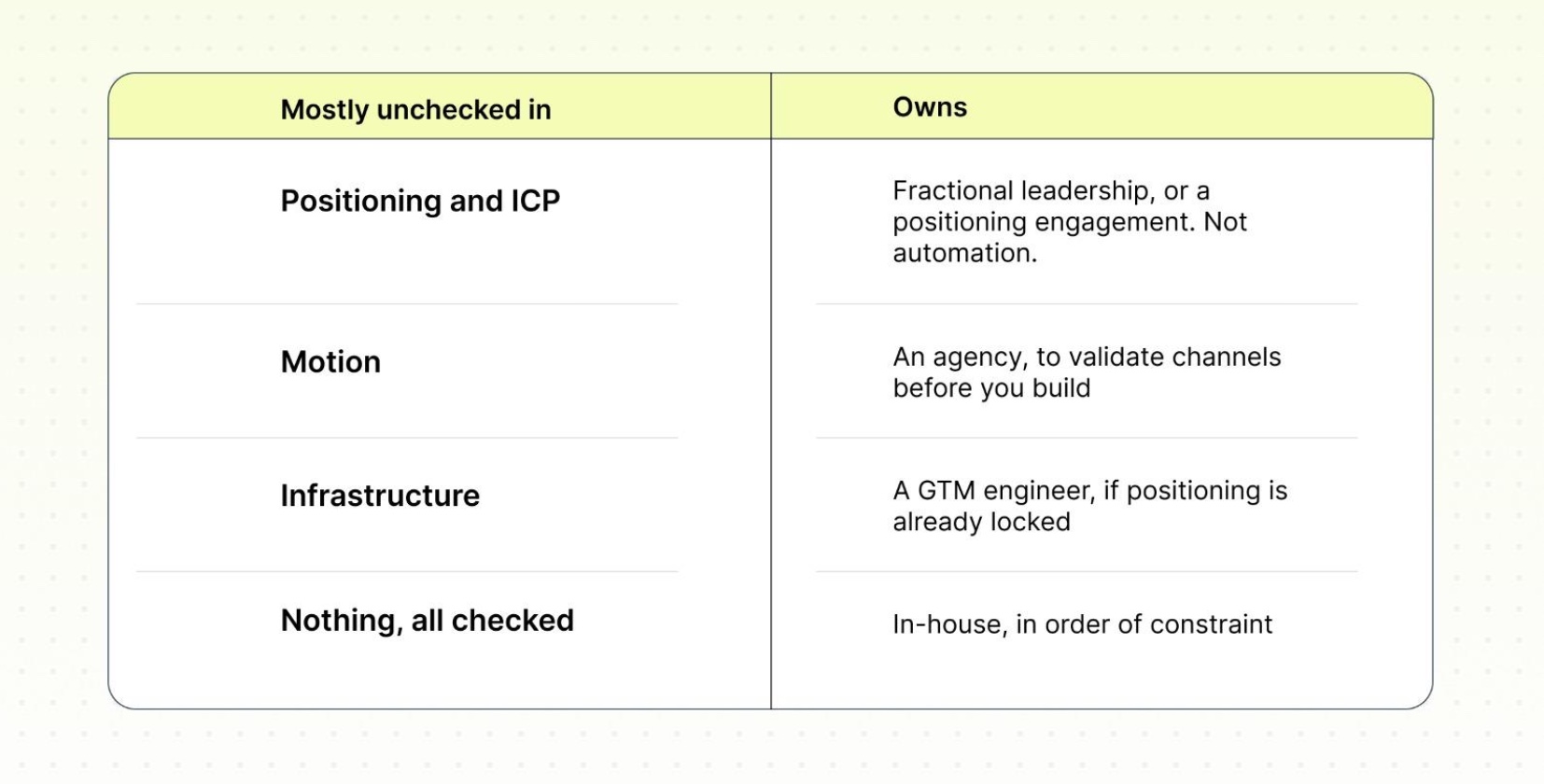
The remaining questions are the ones founders send me directly.
.png)
Two Questions Before You Decide
Everything above compresses into two diagnostics. Answer them honestly and the model usually names itself.
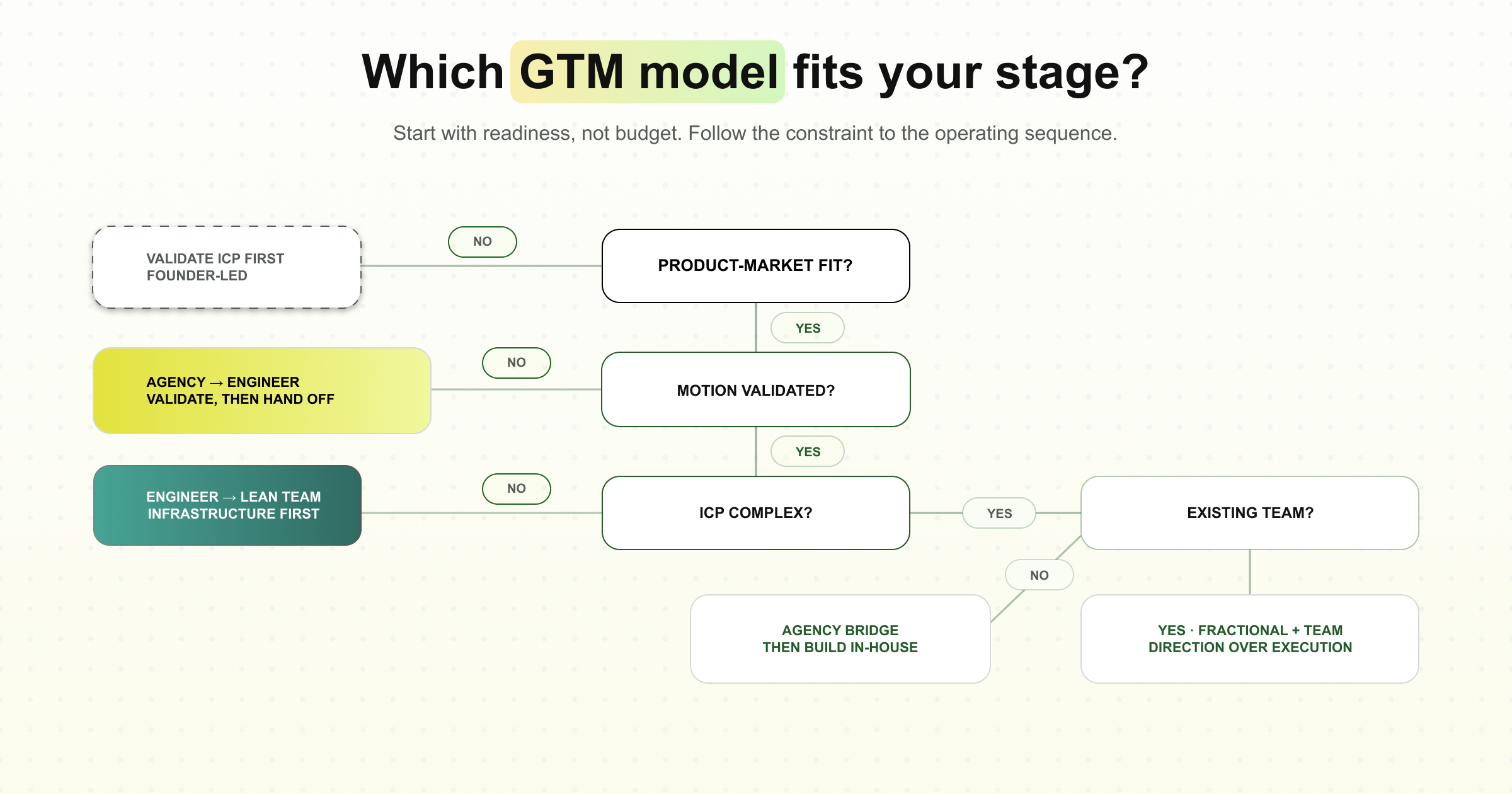
1. Is my constraint strategy, execution, or infrastructure? If strategy, you need direction and you need it paired with hands. If execution, you need an agency or a team. If infrastructure, you need a GTM engineer, provided positioning is already locked.
2. How many months of runway can this decision consume before I need evidence it worked? Under three months rules out hiring entirely. Under nine months rules out building the full in-house function. That single number eliminates more options than any budget conversation will.
The four models are not competing for your budget. They are waiting for their moment in your sequence, and getting the order right is worth more than getting any single choice perfect.
If you want to think it through with people who have run all four models, here is where to start:
- Join the ONEGTM Club Slack. Founders working through this exact decision, plus the operators running the systems. No pitch.
- Read the 0-to-$2M GTM playbook. The sequencing detail this piece could not fit, with the plays written out.
- Book a call. If you want a direct read on which model fits your stage, we will tell you when the answer is not us.