

Here are the two skills a founder actually needs. Everything else you can outsource, delegate, or fake till you make it. These two, you cannot.
The skill that keeps you afloat is selling and being seen.
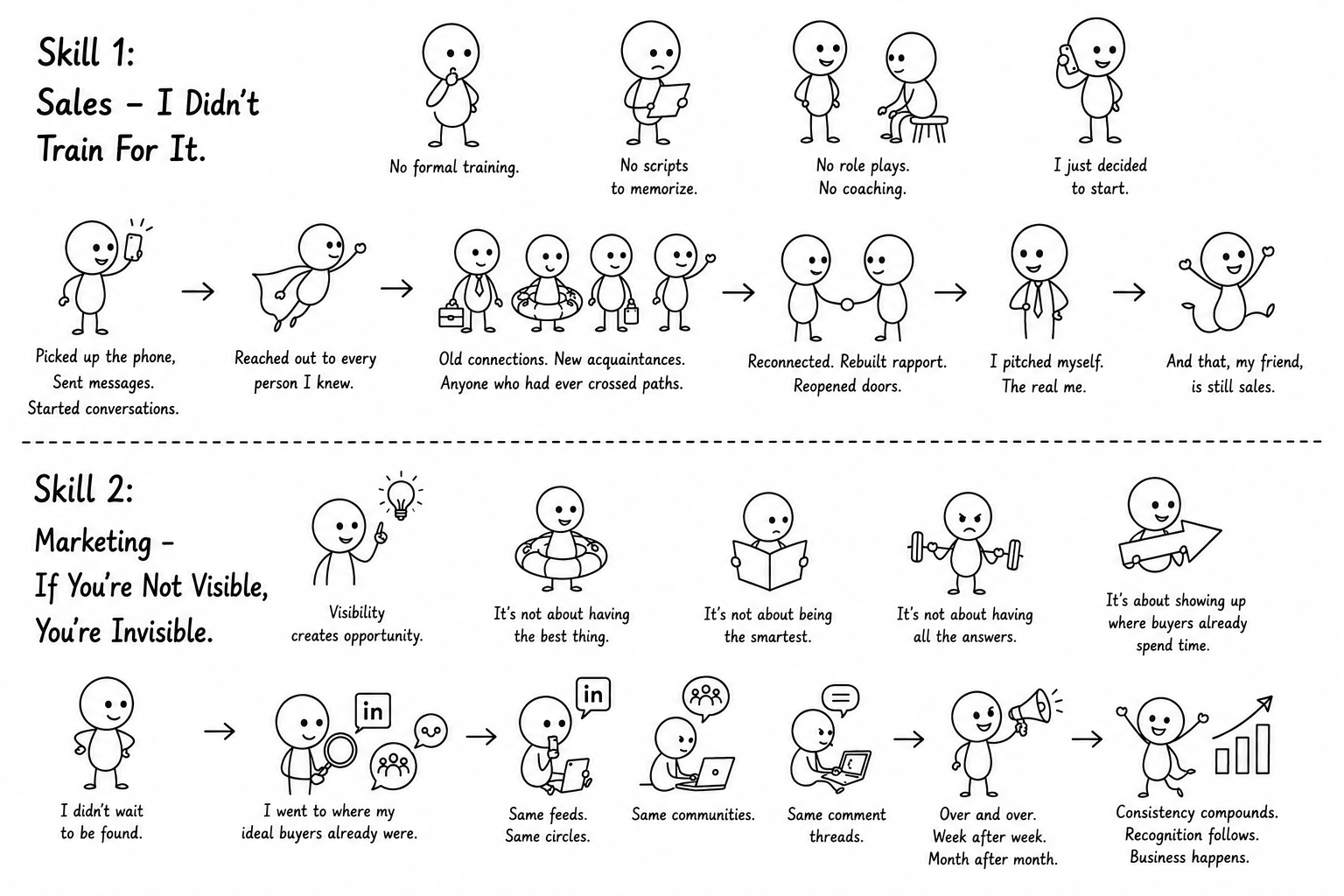
Skill 1: Sales – Mind You I Never "Did Sales."
A confession that will not shock any founder reading this.
I never sat through sales training. Never memorized an objection handling script. Never role played a discovery call with a coach.
What I did was simpler and scarier. I picked up the phone, messaged, and cold reached out to every connection I had built across a decade in corporate. Old managers. Ex colleagues. People I met once at a conference and never spoke to again until that message.
I pitched myself. Not a pitch deck. Me.
Turns out that counts as sales too.
Now you that’s the sell part, let move to the being seen part.
Skill 2: Marketing – What Gets Seen Gets Sold
There is an old saying that translates roughly to this: things that are visible are the things that sell.
Not the best product. Not the smartest founder. Not the deepest expertise.
The one who shows up where their buyers already are.
I did not sit and wait for inbound to discover me through sheer brilliance. I went and stood exactly where my ICPs were hanging out. Same LinkedIn feeds. Same communities. Same comment sections. Repeatedly. Annoyingly. Consistently.
That repetition is not a personality quirk. It is a growth mechanism disguised as one.
Practices That You Should Pair With These 2 Skills
Skills alone won't cut it. You need to build the habit of following certain practices, like the ones below, to actually reap the benefits.
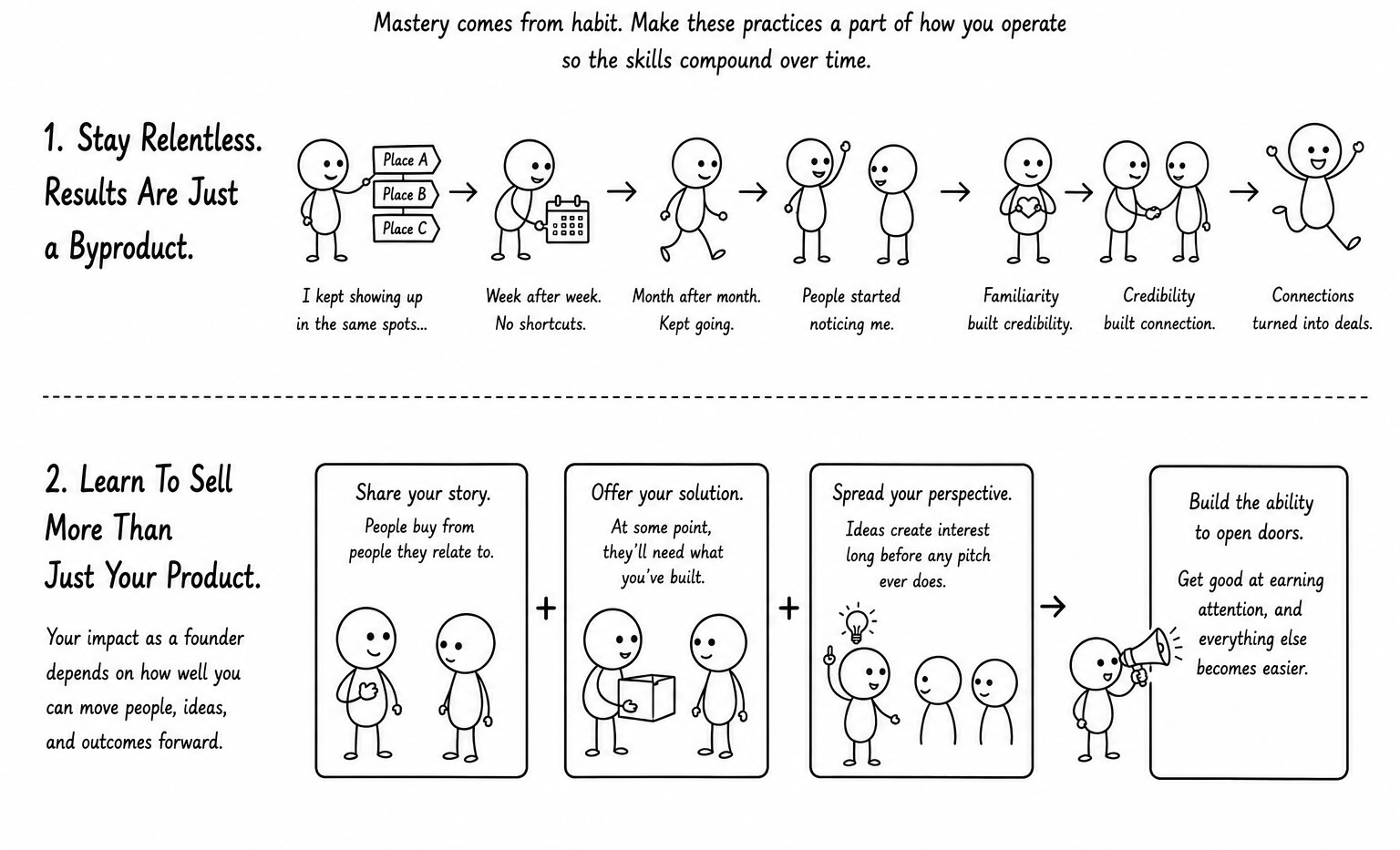
Be Persistent. Persistence Is The Actual Skill, Sales Is Just The Output
It sounds cooler to say "I closed my first ten clients through sales." It sounds less cool to say "I showed up in the same three places every single week for months until people started recognizing my name before my pitch."
But the second one is what actually happened.
Persistence built the visibility. Visibility built the trust. Trust is what eventually got called "sales."
Sell Anything, Sell Everything
As a founder your job is not to sell a product. Your job is to be capable of selling anything.
→ Sell yourself, because nobody buys from a stranger
→ Sell your product, because eventually someone has to
→ Sell a thought, an idea, a point of view, because that is what pulls people in before they even know what you are building
Most people separate these into different skills. They are the same muscle. Once you can convince someone to give you fifteen minutes of their time for nothing in return, convincing them to pay you for something valuable becomes a formality.
Quick Reminder: Your Inner Circle Is Not A Shortcut, It Is A Runway
Let's kill a myth. Using your network to get your first attention is not cheating.
Your first believers will always come from somewhere close. A friend. A former colleague. A random connection who downloaded your lead magnet on a slow Tuesday and actually read it.
That is not a weak start. That is a launchpad.
Use that early push. Let it carry you while your personal brand does the slower, harder work of actually spreading on its own. Your words start traveling further than your direct network. Strangers start recognizing your name attached to a specific point of view.
That is the moment outbound stops being cold and starts being warm before you even hit send.
So Which One Are You Actually Practicing
Generally founders obsess over the product roadmap and treat sales and marketing like a phase two problem, something to hand off once things "get serious."
I would argue the opposite. They are phase zero. Before the roadmap, before the hires, before the fancy positioning deck.
You do not need to be a natural closer. You do not need to be a marketing genius with a six figure ad budget. You need to be willing to be seen, repeatedly, in front of the right people, saying something worth remembering.
Everything else is logistics.
If you stopped showing up tomorrow, in every place your ICPs currently see you, would your pipeline notice within a week?
Be honest and answer.