.png)


Software engineers have a word for a bad habit that looks like a solution.
They call it an anti-pattern.
It is not a bug. Bugs break loudly. Bugs get caught in review, get a ticket, get fixed by Thursday.
An anti-pattern is quieter. It works just enough to pass. Everyone repeats it. Nobody questions it. And it costs you a year.
GTM is full of these. We just never bothered to name them.
That is the actual problem.
Why naming is the whole fix
"Our pipeline is weak" is not a problem statement. It is a mood.
You cannot assign a mood. You cannot fix a mood on a Monday. You can only sit in a QBR and feel it together.
"We are running MQL Theatre" is a problem statement. It has a symptom. It has a root cause. It has a first action that fits in one sentence.
Engineering learned this decades ago. Marketing and sales ops never did. So we keep rediscovering the same seven failures at every company, invent a fresh name each time, and treat each one like it is unique to us.
It is not unique to you. It is a pattern.
How to spot one in your own team
↳ It produces motion, not outcomes
↳ It survives because a metric moves
↳ Everyone senses something is off, nobody can point at it
↳ The next hire copies it because it looks like process
↳ That last one is why anti-patterns compound. Nobody inherits a bug. Everybody inherits a process.
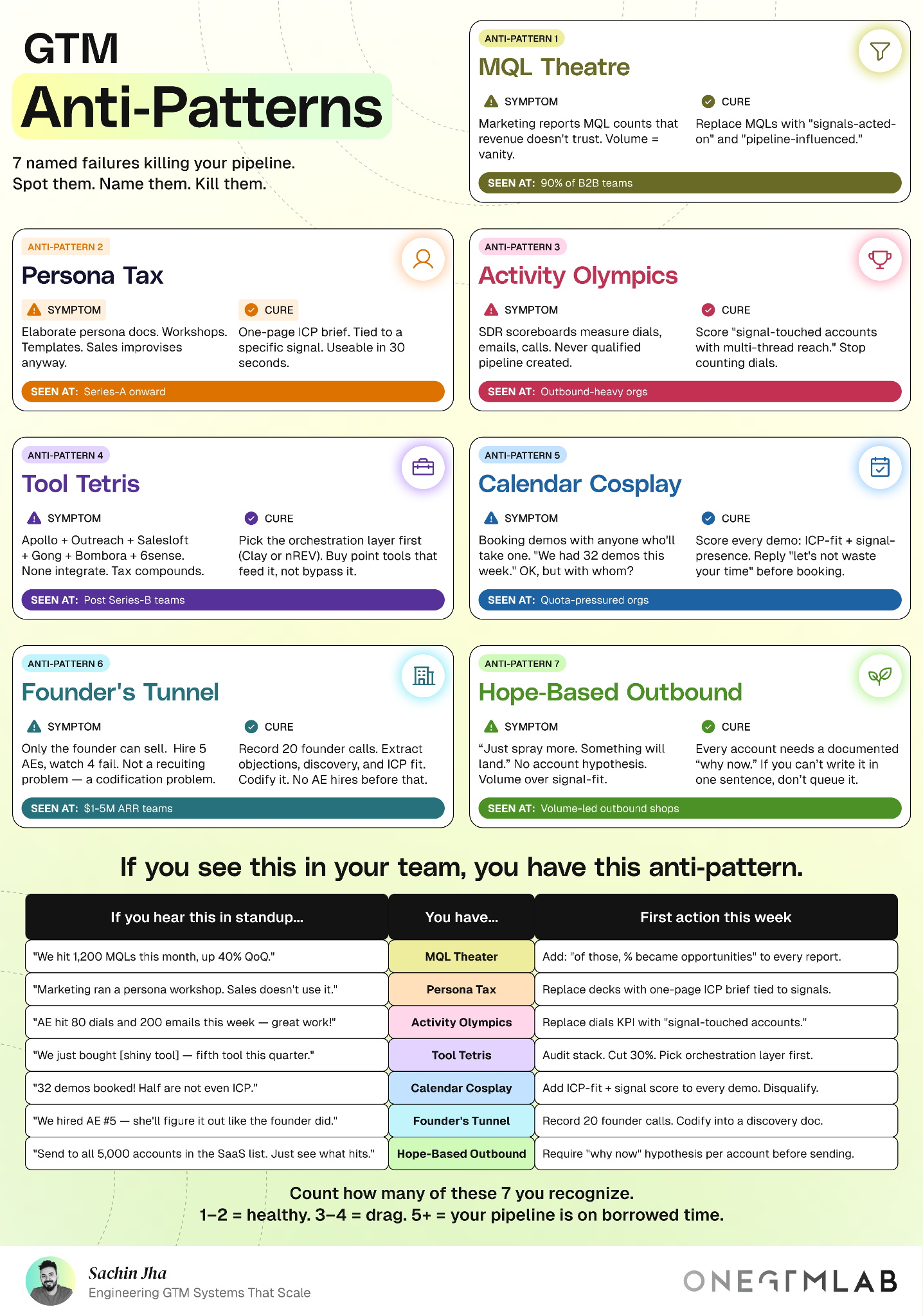
The seven we see most often
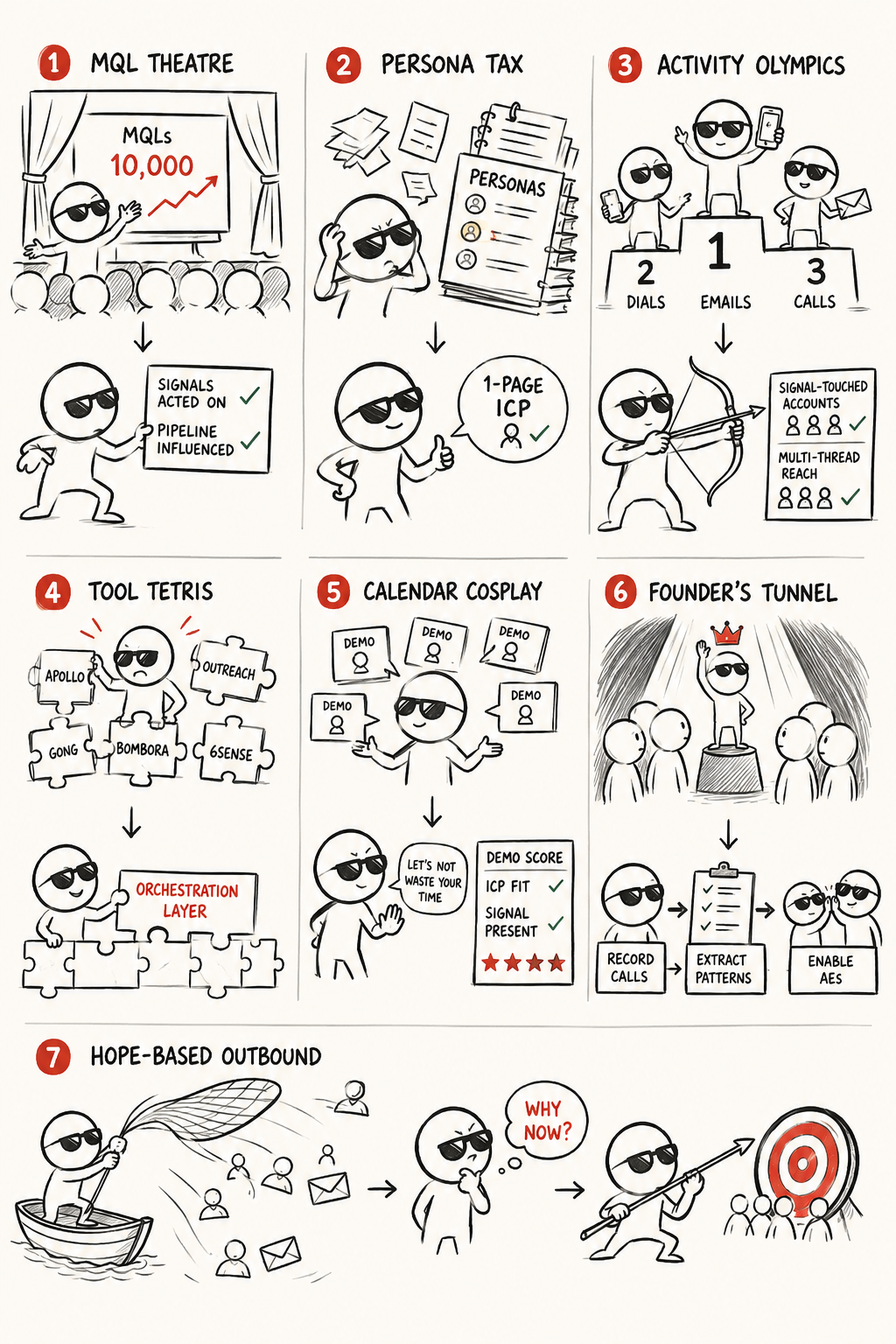
↳ MQL Theatre. Marketing reports MQL counts that revenue does not trust. Seen at roughly nine out of ten B2B teams. The cure is to replace the MQL line with signals-acted-on and pipeline-influenced. If a number cannot be defended in a revenue meeting, stop reporting it.
↳ Persona Tax. Elaborate persona docs. Workshops. Templates. Sales improvises anyway. Common from Series A onward, when the team is finally big enough to build artifacts nobody uses. The cure is a one-page ICP brief tied to a specific signal, usable in thirty seconds.
↳ Activity Olympics. SDR scoreboards measure dials, emails, calls. They never measure qualified pipeline created. Endemic to outbound-heavy orgs. Score signal-touched accounts with multi-thread reach instead. Stop counting dials.
↳ Tetris. Apollo plus Outreach plus Salesloft plus Gong plus Bombora plus 6sense. None of them integrate. The tax compounds monthly. Post Series B, this is almost universal. Pick the orchestration layer first. Buy point tools that feed it, not bypass it.
↳ Calendar Cosplay. Demos booked with anyone who will take one. "We had thirty-two demos this week." Okay, but with whom. Quota-pressured orgs run on this. Score every demo on ICP fit and signal presence. Reply "let us not waste your time" before booking.
↳ Founder's Tunnel. Only the founder can sell. So you hire five AEs and four fail. Standard at one to five million ARR. It is not a recruiting problem. It is a codification problem. Record twenty founder calls. Extract the objections, the discovery, the ICP fit. No AE hires before that exists.
↳ Hope-Based Outbound. Spray more, something will land. No account hypothesis. Volume over signal-fit. Every account needs a documented "why now." If you cannot write it in one sentence, do not queue it.
The standup test
Read those again slowly. You did not think "we have a problem."
You thought of a specific person. Or a specific meeting.
That is what naming does. So run this on yourself.
Listen to your next standup and write down what you actually hear:
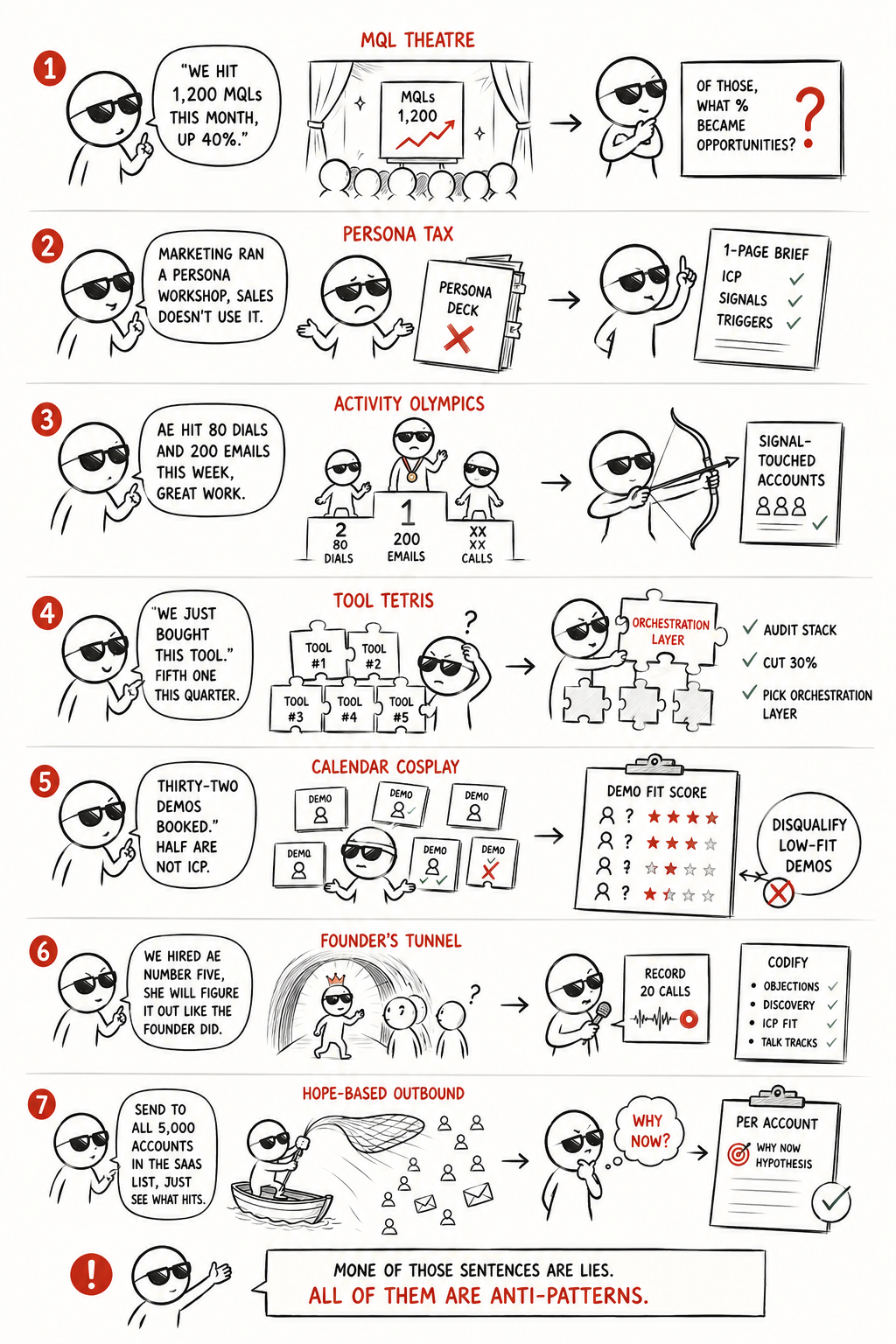
↳ "We hit 1,200 MQLs this month, up 40 percent." That is MQL Theatre. Add "of those, what percent became opportunities" to every report.
↳ "Marketing ran a persona workshop, sales does not use it." Persona Tax. Replace the deck with a one-page brief tied to signals.
↳ "AE hit 80 dials and 200 emails this week, great work." Activity Olympics. Swap the dials KPI for signal-touched accounts.
↳ "We just bought this tool." Fifth one this quarter. Tool Tetris. Audit the stack, cut thirty percent, pick the orchestration layer.
↳ "Thirty-two demos booked." Half are not ICP. Calendar Cosplay. Add a fit score to every demo and disqualify.
↳ "We hired AE number five, she will figure it out like the founder did." Founder's Tunnel. Record twenty calls and codify them first.
↳ "Send to all 5,000 accounts in the SaaS list, just see what hits." Hope-Based Outbound. Require a why-now hypothesis per account.
None of those sentences are lies. All of them are anti-patterns.
Count how many of the seven you recognise. One to two is healthy, every team has some. Three to four is drag, you are working harder for the same output. Five or more and your pipeline is running on borrowed time.
Nobody on your team is doing anything wrong. Every one of these behaviours is somebody executing their job description correctly. Which raises the harder question: if the people are not broken and the effort is not missing, what exactly is producing the failure?
That is a systems question, not a performance question. Most teams keep answering it with a hiring plan.
We fix this for companies across cyber, devtools, AI, and healthcare, at one million ARR and at a hundred million. The symptoms look different at each stage. The root cause rarely does.
Reply with your count. If it is three or higher, thirty minutes with me will be the most useful GTM conversation you have this quarter.