


A founder told me last month that he needed a forward deployed engineer.
Then spent twenty minutes describing an AI automation engineer.
He was not confused. He had the words.
What he did not have was the thing underneath them, and those two are easy to mistake for each other.
The same gap runs through GTM work in technical markets.
Your messaging is accurate, your claims check out, and it still reads like an outsider writing to an insider.
Reading more does not fix that.
Here is the test I use instead. Say your buyer’s phrase for what you sell, out loud, on a live call, without translating it first.
If you paused, you have vocabulary.
Fluency is using a term correctly under pressure, in a live conversation, without pausing to translate.
Those two words get used interchangeably, so it is worth being precise about what separates them.
The difference between knowledge and fluency
The gap between them is smaller than it sounds and it decides whether a technical buyer keeps listening.
Knowledge is retrievable. Fluency is automatic.
Knowledge is something you can look up and repeat back correctly. Fluency is something you use without retrieving it.
The distinction only shows under pressure.
Give anyone a week and a search engine and they can write a technically correct paragraph about any vertical.
Put the same person in a live call with a skeptical technical buyer and the gap shows in about ninety seconds.
Vocabulary is what people usually mean by domain knowledge
A lot of people who say they know a space have collected its nouns. The categories, the vendors, the acronyms.
That is worth having. It is the entry fee rather than the advantage.
This is also where this piece differs from The Only Two Skills A Founder Actually Needs.
That one is about which skills to learn. This one is about how deep one of them has to go before it works.
The clearest way to explain the difference is not to define it further. It is to describe what it sounds like.
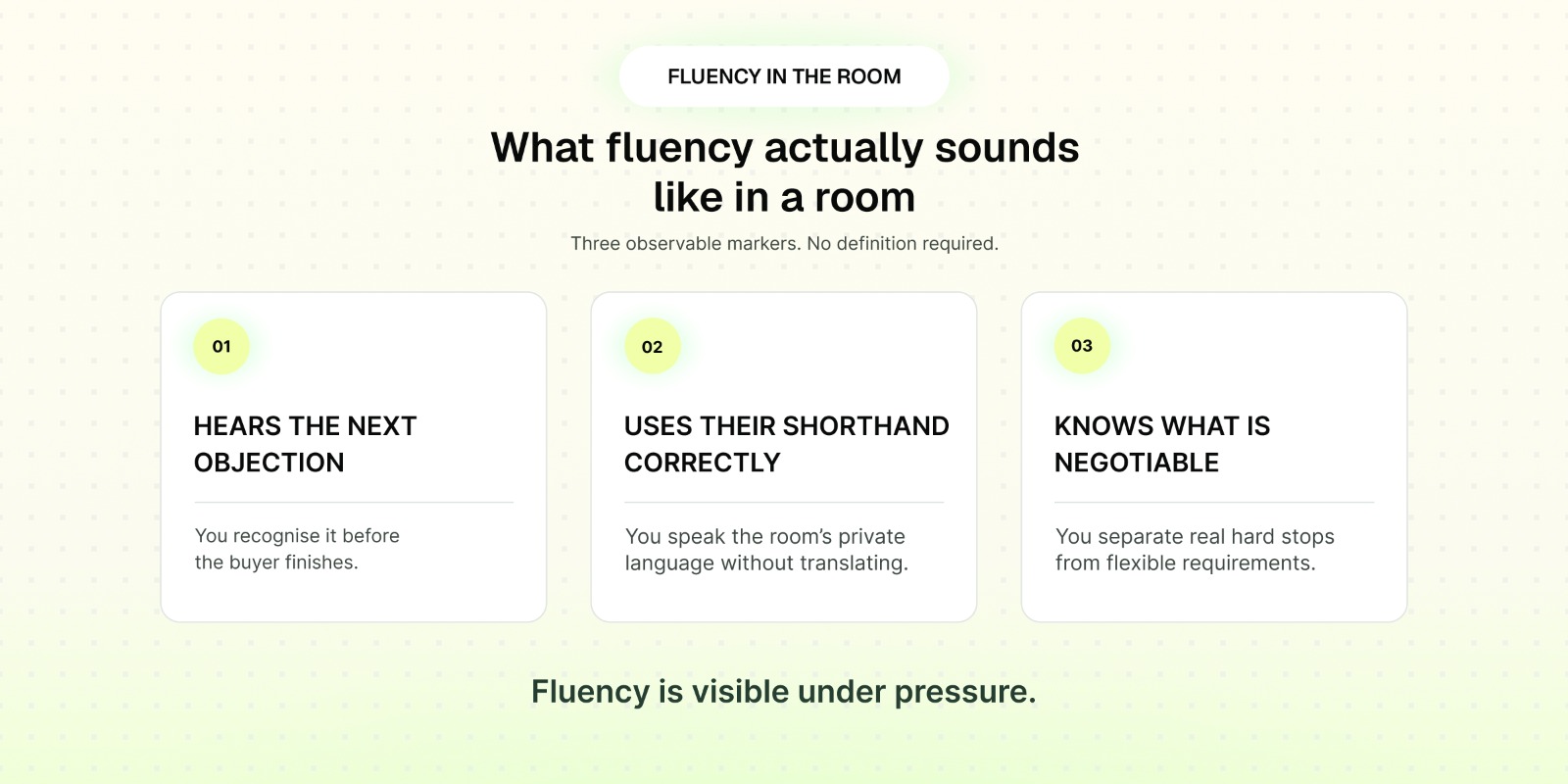
What fluency actually sounds like in a room
Three markers, all observable by anyone sitting in on the call.
You hear the next objection before it arrives
Not because you memorised an objection-handling doc, but because you have heard this exact objection in three other accounts.
You start answering before the buyer finishes raising it, and the room relaxes because you are clearly not hearing it for the first time.
You use their internal shorthand back to them, correctly
Every technical organisation has private language.
Abbreviations for their own systems, a nickname for the migration everyone hated, a verb for the thing that happens at 3am.
Using it correctly signals you have been in rooms like this one. Using it slightly wrong is worse than not using it at all.
You know which stated requirement is actually negotiable
Buyers present requirements as though all of them are fixed. They never are.
Fluency is knowing which item you have watched get negotiated away in two previous deals, and which one is a genuine hard stop.
None of that comes from a positioning document, which raises the practical question of where it does come from.
Building fluency fast in a technical vertical
You cannot skip the reps, but you can choose better ones.
Three that work faster than anything else I have tried.
Read the last twenty support tickets, not the marketing site
The marketing site tells you how the category describes itself. Support tickets tell you what actually goes wrong on a Tuesday.
Twenty tickets teach you more usable language than twenty vendor pages, because those are the words your buyer uses when nobody is watching.
Sit in on calls silently before you run them
There is a strong instinct to contribute on your first call in a new vertical. Resist it.
Five calls listened to are worth more than one run badly, and a bad call costs more in a small technical market than people assume.
Learn the two or three constraints that shape every deal
Every technical vertical has a few constraints sitting underneath every conversation, whether or not anyone names them.
They explain more buyer behaviour than any persona document will.
Once you know them, objections stop looking like objections and start looking like consequences.
What counts as a constraint here
Not a preference. A constraint decides whether a deal is possible at all.
- A regulatory or contractual obligation the buyer cannot waive
- A technical reality of their environment that rules out whole categories of solution
- An internal metric the buyer is measured on, which any new tool has to move in the right direction
.jpeg)
All of that is method. What it looks like in practice is easier to show in the vertical I actually work in.
The cyber and devtools case
Cyber and devtools are where ONEGTMLAB does most of its work.
Both punish vocabulary faster than any category I have sold into.
In cyber, fluency is knowing what a shift actually looks like
Naming SIEM vendors is vocabulary. Knowing what a SOC analyst does across an eight hour shift is fluency.
The queue, the triage, the escalation path, the handover at shift change, and the constant tuning of false positives that nobody thanks you for.
Two constraints follow from that.
Anything adding alert volume without reducing triage time is dead on arrival, and you get security-reviewed before you get bought.
In devtools, fluency is having shipped with the category
Reading about a tool category is vocabulary. Having shipped code with it, and having been annoyed by it, is fluency.
The constraint shaping most devtools deals is that the adopter is rarely the payer.
Developers choose, platform leadership funds, and the two need different conversations.
The second is friction. Anything that slows a build gets removed regardless of how the value case looked in the deck.
Buyers in both categories can tell in one sentence
A security buyer or a senior engineer can place you inside one sentence.
Not from a wrong fact, but from a slightly off emphasis, or a term used in a way an insider never would.
You do not get told when this happens. The call just becomes politely shorter.
Which is the uncomfortable part of the argument, and also the reason it is worth building at all.
When domain fluency becomes a moat
The reason to invest here is not that it makes you sound credible.
It is that this is the one GTM advantage a competitor cannot purchase.
What the matrix actually shows
When I scored nine roles across eighteen skill areas in the FDE Skills Matrix, domain fluency landed in a pattern I did not expect.
The scale runs 3 for critical, 2 for important, 1 for useful and 0 for not the job.
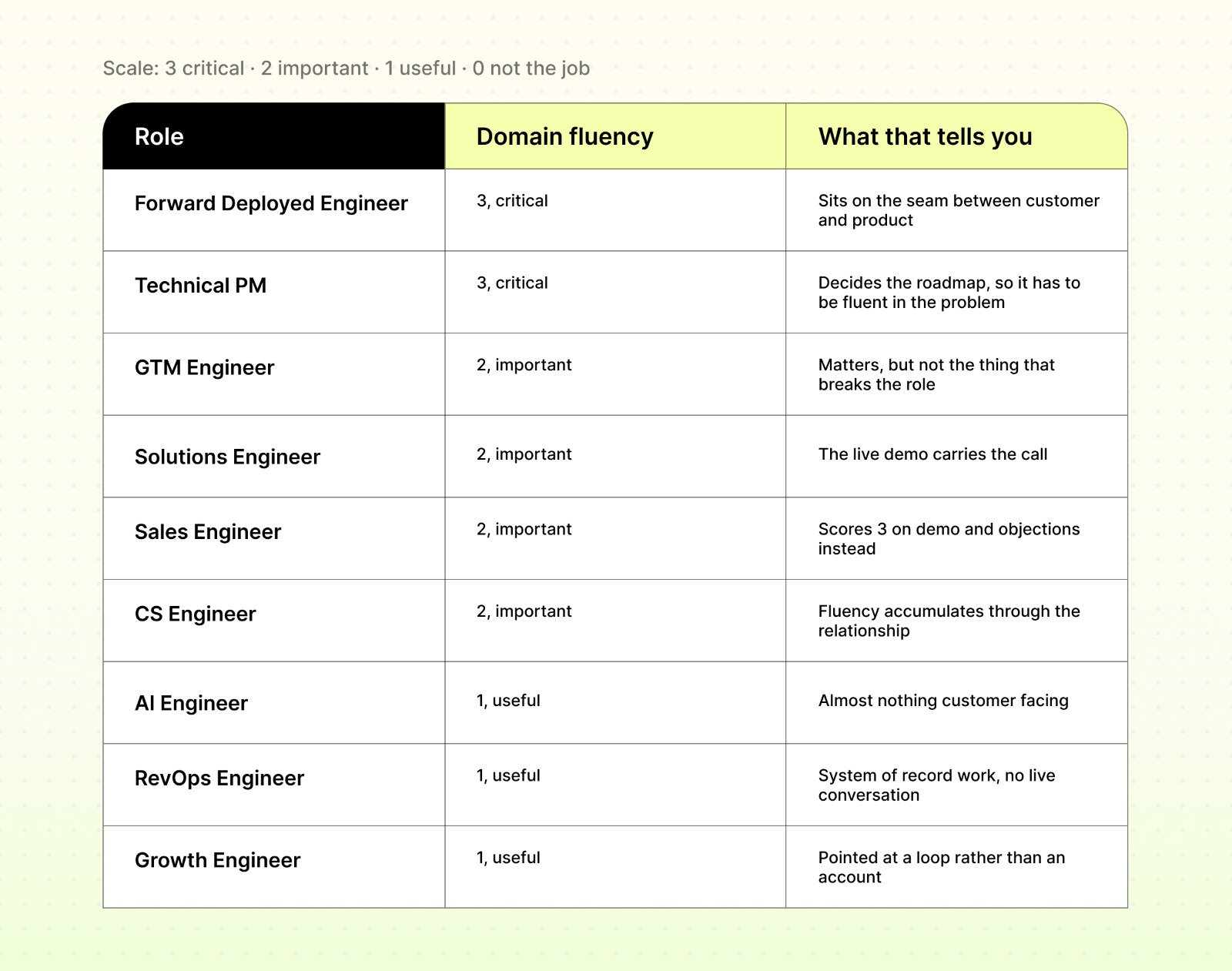
Domain fluency scored across nine roles. Critical in two, important in four, useful in three.
The pattern is proximity to a live conversation.
Fluency is critical in exactly the two roles closest to a customer deciding something, and merely useful in the three most systems-facing ones.
That seam between customer and product is where the forward deployed engineer sits, and it is the same seam I argued GTM usually fails in, in The Truth Is, Nobody Really Knows GTM.
Which of those seats you occupy is a separate question, and one I have written about in GTM Agency vs GTM Engineer vs In-House vs Fractional Leader.
Why AI does not close this gap
I run an AI-forward GTM company, so let me answer the obvious 2026 question rather than dodge it.
AI is extraordinary at vocabulary. It hands you the acronyms, the vendor landscape and a technically correct paragraph in seconds.
It does almost nothing for fluency, which is built from having been in the room when something went wrong.
There is a shortcut to sounding like you did the reps, not to doing them.
That is precisely why it is a moat. Anything AI can hand your competitor tomorrow is not an advantage.
A judgment, not a finding
Of the eighteen skills on that matrix, this is the one I have never seen anyone fake successfully.
The matrix does not measure that and I am not going to pretend it does.
It is a judgment from watching people try. Every other skill on the list can be covered by a good tool, template or hire.
The career argument follows from the GTM one
Because fluency sits in the person rather than the stack, it survives both tool changes and title changes.
Someone fluent in a vertical can move from forward deployed engineer to CS engineer to technical PM and stay valuable.
Someone with only tool skills relearns at every AI cycle, which is the argument I made in GTM Engineering Is Not a Job Title.
The pattern I keep seeing is people jumping titles instead of building columns.
A role trends, the headline gets rewritten, nothing underneath changes.

.png)